Edward G. Robinson

  • A Slight Case of Murder (1938)

    A Slight Case of Murder (1938)

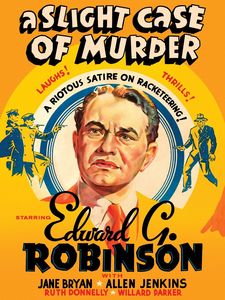
    (On Cable TV, May 2020) By the end of the 1930s, a few things had to be true for A Slight Case of Murder to exist — The lessons of the post-Prohibition era were getting clearer for everyone; Gangster movies were getting a bit overexposed and in need of some fresh angle; Edward G. Robinson was getting tired of his (admittedly great) numerous performances as a gangster; and the play “A Slight Case of Murder” had a modest Broadway run from September to November 1935. Combining all of these together meant a Warner Brothers gangster film adapted from the comic play, starring Robinson in a somewhat atypical but very satisfying turn playing a funny mobster. The premise has him turn to legal brewing after Prohibition, only to realize years later that he’s not good at being a legitimate brewer (not drinking his own beer makes him blind to how terrible it is). Further complications arise when his daughter brings back home a boyfriend employed as a policeman, and when he finds four dead rival gangsters in his living room. To be fair, A Slight Case of Murder is not that funny—it’s a comedy, but it aims for a few laughs and plenty of smiles rather than overdoing it. As a result, it’s not great but it’s certainly watchable. Robinson is remarkably at ease sending up his own image as a gangster, and the film is best seen as audiences of the time did—once you’ve become a bit too familiar with his other mob boss roles.

  • Two Weeks in Another Town (1962)

    Two Weeks in Another Town (1962)

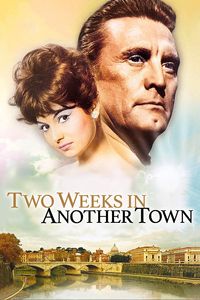
    (On Cable TV, April 2020) If you want to see the results of the Hollywood-on-the-Tiber era, during which Hollywood studios headed to Rome’s Cinecittà in order to take advantage of lower production costs and a studio built by Mussolini, then watch any of the dozen sword-and-sandal epic of the era. If you want a film about that filmmaking era, however, there’s Two Weeks in Another Town to bring back, a decade later, many of the main creative forces behind The Bad and the Beautiful in a thematic follow-up examining how Hollywood stars lived in their little Roman bubble far away from California. There are differences, obviously—Two Weeks in Another Town is in colour, and not quite as purely entertaining in its examination of Hollywood. But it does star Kirk Douglas as a washed-up actor trying to find a new place for himself in the movie industry, and a behind-the-scenes fictionalization of a difficult film shoot. Douglas is surrounded by notables such as Cyd Charisse (who’s not given enough to do), Edward G. Robinson (as a director at the end of his rope), and George Hamilton hilariously cast as a brooding artiste-type actor. While the film is interesting, it also has plenty of misplaced cues and darker themes that ensure that it’s not a feel-good film despite its hopeful ending. Studio meddling is apparently to blame for not delivering the core vision, but even in its adulterated form, the film features themes of suicide, professional uselessness, jealousy and isolation—all of which clash with the Dolce Italia atmosphere occasionally showcased. It’s a shame that some terrible rear-projection work takes away some of the late-film scene’s emotional effectiveness. Let’s just say that Two Weeks in Another Town gets about three-quarter of the way there—it’s interesting to give us a glimpse at an episode of Hollywood history, but not as great as it could have been had it figured out what it wanted to say and found a more disciplined way of telling it.

    (Second Viewing, On Cable TV, June 2021) The “Hollywood on the Tiber” era is one of the most interesting episodes in film history – Hollywood going to Rome in order to take advantage of fiscal incentives and Cinecitta, a top-notch studio built by Mussolini as a propaganda instrument. Hence the slew of swords-and-sandals films of the early 1960s and the numerous American films somehow set in Rome in the 1960s. Two Weeks in Another Town is one of the few productions of that era to be about itself, as our troubled protagonist (Kirk Douglas, reliably fascinating as always) gets a new chance to help a friend complete a Hollywood production shooting in Rome. There are glimpses at moviemaking, dramatic situations alluding to the reality of how movies were made at the time, and characters almost entirely portraying a fictional film’s cast and crew. The rather good cast also helps, what with Douglas playing a recovering alcoholic former star actor, Cyd Charisse as his ex-wife, a young and trim George Hamilton as a rising actor, and Edward G. Robinson as an aging director. On paper, there are plenty of reasons why Two Weeks in Another Town shouldn’t work, starting with the lead character: Who should care about a former movie star putting back together his life after alcoholism? Who should care about Charisse’s character when she barely has any dialogue? The film was apparently cut short by fifteen minutes by the studio, and those seams are more blatant when you start looking at the dramatic structure of the film. But, fortunately, there’s quite a bit more to it – the focus on filmmaking is strong enough (similarities with The Bad and Beautiful are all over the place, from its theme to a shared team of creative leads) and the glimpse at the Hollywood on the Tiber era is frequently charming enough to create a bit of longing for what it must have been at the time. It’s also hard to go wrong with Douglas in the middle of it all – Two Weeks in Another Town probably wouldn’t have worked with another actor.
  • Scarlett Street (1945)

    Scarlett Street (1945)

    (On Cable TV, February 2020) I do like Scarlett Street quite a bit, but I have a feeling I would have liked it even more if I had seen it not so shortly after 1944’s The Woman in the Window, of which it’s practically a remake with the same director, stars and themes. Here too, Edward G. Robinson plays a middle-aged man whose artistic impulses lead him to meet a dangerous woman (again; Joan Bennett) who asks him for a murderous favour that eventually takes everything from him. But if you’re not aware of The Woman in the Window, then Scarlett Street does play a bit better. It’s a steady slide from one slightly greedy action to a worse one, and things just keep escalating for our poor protagonist, who thought he could just indulge himself without anyone knowing. The hand of fate weighs heavily, and director Fritz Lang films it all in shadowy style. One thing that Scarlett Street does better than its predecessor, however, is not blink at the last moment—in true noir fashion, there’s no waking up from the nightmare that comes from corruption. You’d be hard-pressed to find many better early noirs, and both Robinson and Bennett are used to great effect here. I’m nearly sure that seeing this again in a few years, without first watching its predecessor, will make it even more effective.

  • The Stranger (1946)

    The Stranger (1946)

    (On Cable TV, October 2019) In Orson Welles’s filmography, The Stranger is often regarded as one of his least remarkable efforts. An early film noir set in a small town where a Nazi-hunter comes to investigate, it was (at the time) an attempt by the disgraced Welles to prove that he could be counted upon as a dependable actor/director, free from the drama that punctuated the first few years of his career. We all know how Welles’s career eventually turned out when driven away from Hollywood, but he was successful in turning out a competent and profitable result with The Stranger. Alas, this work-for-hire means that the film has far fewer of the distinctive touches we associate with Welles at his best: while highly watchable, the result seems rote. The action moves efficiently through stock characters, and Welles even at his most commercial is still a cut above most directors of the time. The dialogue has some great moments (such as the magnificent speech about the nature of Germans, as horribly stereotyped as it may feel now) but the film’s biggest distinction is how closely it engages with the immediate aftermath of WW2: Never mind the film’s interest in escaped Nazis living in the States: it also features then-new graphic footage of concentration camps … including a pile of bodies. Just to make it clear what this is about. You can certainly see in The Stranger a transition film in between the domestic thrillers of the early-1940s and the more fully realized noir aesthetics of the end of the decade. The result is still worth a look, not least for the compelling performances of Welles, Loretta Young and Edward G. Robinson. It’s a striking illustration of what happens when a great artist is given familiar material.

  • The Woman in the Window (1944)

    The Woman in the Window (1944)

    (On Cable TV, June 2019) There are two distinct sections in classic noir film The Woman in the Window. The first takes up most of the film and is an exemplar of the form. The second is the film’s final two minutes, and it destroys what we think of a noir movie. I’m eager to discuss it in spoilerriffic details, but first we’ll have a few general comments about the film’s bulk. (Any readers unfamiliar with the film are advised to go see it—no, really, it’s worth a look—before proceeding any further.)  Edward G. Robinson reinvented himself in the role of a meek professor finding himself in the middle of a terrible situation, forced to kill the lover of the woman he just met, and then arrange a coverup that goes awry. Joan Bennett is quite good as the titular woman, beguiling enough (wow, that see-through blouse!) that she can lead men to murder and deception. Dan Duryea is the third highlight of the film, playing a would-be blackmailer who cranks the tension even higher. Director Fritz Lang brings some moviemaking savvy to the film, but the result seems uncomfortable with the implicit dark humour of the screenplay as ironies mount and surround the protagonist. For much of its duration, The Woman in the Window is pitch-perfect noir as our meek protagonist simply finds himself at the wrong place and the wrong time, and keeps making desperate decisions that run against his better judgment and make the situation worse. It all leads to a climactic sequence in which he swallows enough pills to bring down a horse … and wakes up at the beginning of the film, having imagined it all. Do note that there are enough clues and foreshadowing here and there to make the ending somewhat organic and premeditated rather than tacked on: our protagonists openly muses about degrees of murder in the opening segment, then talks about the siren call of adventure with his friends before falling into slumber. The problem with the film may be one of anticipated codes: What we know of noir as it developed after 1944 is that its protagonists don’t get an easy way out: they suffer the whims of a capricious universe that sends temptations, mobsters and femmes fatales their way, and even having a solid moral compass may not be enough to save them from ruin. Still, there is a feeling that the happy ending is not deserved, that it cheapens the dramatic buildup, that it runs counter to the very foundations of noir. Whether it’s good or not is immaterial—although film historians will be quick to point out that the film was a commercial success and that its immediate remake, Scarlett Street (released a year later and featuring the same director, stars, plot) with a far more unforgiving ending, isn’t as remembered as the original. Few stories, all mediums combined, ever try to attempt the “it was all a dream” stunt for good reasons, and The Woman in the Window is a study in why.

  • Double Indemnity (1944)

    Double Indemnity (1944)

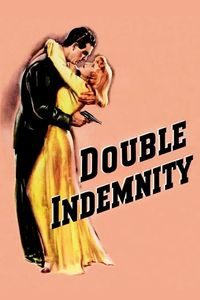
    (On TV, June 2018) Like many, I like film noir a lot, and Double Indemnity is like mainlining a strong hit of the stuff. Pure undiluted deliciousness, with black-and-white cinematography, unusual investigator, femme fatale, crackling dialogue, strong narration and bleak outlook. Here, the focus on insurance agents trying to figure out a murder mystery is unusual enough to be interesting, while the Los Angeles setting is an instant classic. Fred MacMurray is a great anti-hero (morally flawed, but almost unexplainably likable along the way), Barbara Stanwyck is dangerously alluring and Edward G. Robinson is the moral anchor of the film. Double Indemnity does have that moment-to-moment watching compulsion that great movies have—whether it’s the details of an insurance firm, dialogue along the lines of the classic “There’s a speed limit in this state” exchange, a trip at the grocery store, or the careful composition of a noir film before they even had realized that there was a film noir genre. Double Indemnity is absorbing viewing, and a clear success for director Billy Wilder, gifted with a Raymond Chandler script from a James M. Cain novel.

  • Key Largo (1948)

    Key Largo (1948)

    (On Cable TV, February 2018) There are actors that elevate the material they’re given no matter the genre or how many years later you see the result, and so while Key Largo is in itself a perfectly serviceable thriller, having Humphrey Bogart in the lead role certainly doesn’t hurt. At times a small-scale thriller in which various people are trapped in a Florida hotel during a hurricane (showing its theatrical origins), the film eventually opens up to a boat-set finale. In another classic pairing with Bogart, Lauren Bacall plays the dame in distress, with strong supporting performances from Edward G. Robinson and Claire Trevor. Director John Huston keeps things tight and suspenseful as characters are forced to interacting in a small setting—you can see the influence that the film had over some of Tarantino’s work, for instance. Key Largo is not particularly remarkable, but it does have this pleasant late-forties Hollywood studio sheen, meaning that you can watch it and be assured of a good time.

  • Soylent Green (1973)

    Soylent Green (1973)

    (On DVD, December 2017) Everyone knows Soylent Green’s big twist, but there’s a lot more to the movie than Charlton Heston’s panicked “it’s PEOPLE!”  Firmly dystopian even when it doesn’t make sense, it doesn’t take a long time for Soylent Green to showcase its nightmarish vision of an overpopulated New York in a world where the environment has been (entirely?) destroyed. Things are so bad that steak and vegetables are a rare delicacy, and where even good cops can’t help but pillage the apartment of a rich murder victim. Euthanasia has been ritualized, street protests are cleaned up by heavy machinery and there’s a clear twilight-for-humanity theme to the film’s atmosphere. Heston stars as a cop intrigued by the murder of one of the city’s elite, but much of the movie is one bad thing after another, all the way to a gut-punch of a conclusion that finalizes the grim fate of its protagonist through a happy montage earlier established to signify a Requiem. You can know everything about Soylent Green’s conclusion and still be impressed (in the most depressing sense of the word) by the film’s relentless grimness. Very loosely adapted from Harry Harrison’s classic genre SF novel “Make Room! Make Room!” (which doesn’t even feature the big twist of the film), Soylent Green gets more interesting the more you read about it, especially how Edward G. Robinson’s final performance ends with an elaborate death sequence (the actor died twelve days after filming). Firmly belonging to the “Science-fiction as a warning” school of filmmaking, Soylent Green is often rough and crude. But it does carry a certain impact that helps make it stand out even today. It’s clearly a product of the seventies, but I found it somewhat more interesting than it’s endlessly parodied twist would suggest.