Ernest Lubitsch

  • Die Austernprinzessin [The Oyster Princess] (1919)

    Die Austernprinzessin [The Oyster Princess] (1919)

    (On Cable TV, December 2021) Perhaps the biggest surprise of The Oyster Princess isn’t necessarily how amusing it is — coming from Ernest Lubitsch, the contrary would have been noteworthy—but how much it goes for an absurd comic style that feels far more modern than the silent era. It calls itself “a grotesque comedy” and that’s as good a depiction as any — it really goes overboard in depicting the excesses of its upper-upper-class characters (a parody of both the European nobility and the American nouveaux riches), for instance, in having dozens of servants doing menial things. The film also features “a foxtrot epidemic” and people peeking at a newlywed couple through a keyhole, if that tells you a little bit more about what to expect. The mood is frantic, confused, not at all restrained or dignified, unlike many films of that period. It’s worth seeing for being the first film acknowledged to show that undefinable “Lubitsch Touch,” but it’s also worth seeing by itself for itself — The Oyster Princess is more than sporadically funny by today’s standards, but hilarious when measured against many other movies of the time.
  • Rosita (1923)

    Rosita (1923)

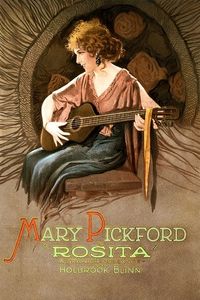
    (On Cable TV, December 2021) Despite my utmost admiration for Ernest Lubitsch’s sound movies, his early silent career is hit-and-miss. No real surprise there — dialogue is often the best part of a classic Lubitsch movie, and he was developing his style at the same time as the movie industry was figuring out the basics of film grammar. I’d put Rosita (his first Hollywood film, I believe) as an average silent entry in his filmography — not as good as his sound films, but not as underwhelming as some other Lubitsch silents. None other than Mary Pickford (in her first adult role) stars as a protest singer who, in criticizing the king, ends up making herself attractive to the king himself. Many romantic complications ensue as the heroine navigates between the attentions of the King and her own true love. Rosita is watchable and it ends well — but it’s no great Lubitsch comedy. Still, you have to admire the way the film was rescued from oblivion — for decades, it was considered lost until a safety print was discovered during the 1960s and that single copy was the sole version that existed for many more decades. It’s only in 2017 that a restored version was premiered, giving us access to a good crucial link in both Pickford and Lubitsch’s career. Rosita may not be that good of a film, but it doesn’t deserve obscurity.

  • The Student Prince in Old Heidelberg (1927)

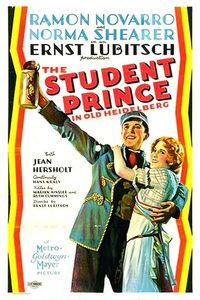
    The Student Prince in Old Heidelberg (1927)

    (On Cable TV, December 2021) As much as I try to like silent films, sometimes it just doesn’t work. I was maybe expecting too much out of The Student Prince in Old Heidelberg: as a film by Ernest Lubitsch, I was looking forward to something much funnier than this melancholic tale of old-world royalty being denied true love. It’s not badly made by the standards of the time, but it takes a dedicated silent film fan to sit through the film’s rather long 105 minutes. Norma Shearer stars alongside Ramon Novarro, but don’t hope for many romantic pyrotechnics along the way, especially considering how the film is fated to end. Those looking for the Lubitsch touch may want to temper their expectations — The Student Prince in Old Heidelberg is professional but lacking his usual verve.

  • So This Is Paris (1926)

    So This Is Paris (1926)

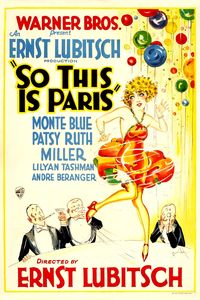
    (On Cable TV, May 2021) Isn’t it fun when movies upset our preconceptions? Prior to seeing So This is Paris, I would have been tempted to associate Ernest Lubitsch with wonderful dialogue. I would have been likely to dismiss the very idea of a silent musical. I could have argued that sophisticated ironic comedies were non-existent in the silent era. But then there’s So This is Paris, compelling at a whip-tight 80 minutes that takes on the idea of a married couple having affairs with another couple. It all gets complicated when one of the men is arrested and sentenced to jail and identities get mixed up. Comedic on a far more intimate scale than the Chaplin or Keaton movies of the era, it’s a film that clearly anticipates the witty sound comedies that Lubitsch would go on to direct — there’s more than a few well-placed gags, ironic commentary (all the way to a final title card that gets a big laugh), protagonists that certainly aren’t virtuous, a mature outlook on sex and marriage, all wrapped up in self-confident directing that doesn’t waste a moment. Most amazing of all is a lavish musical number featuring a contemporary depiction of the Charleston — we modern audiences are gifted with a rhythmic soundtrack that practically makes us hear the dancing performers, but let’s appreciate the sheer gall of a musical number in a silent film. For a 95-year-old film, So This is Paris is spry and surprising — and it’s nearly enough to make you curious about what else gets (unfairly) dismissed as “a silent film.”

  • The Smiling Lieutenant (1931)

    The Smiling Lieutenant (1931)

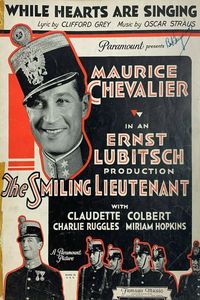
    (On Cable TV, January 2021) There are a surprising number of reasons why The Smiling Lieutenant remains worth a look ninety years later. It is, perhaps most notably, an early Oscar nominee—at a time when frothy romantic comedies could actually win (and sometimes even win!) a Best Picture Academy Award. (Amazingly, it disappeared from circulation for a few decades until a copy was rediscovered in the 1990s.)  But it’s also an example of what writer-director Ernest Lubitsch could do in the Pre-Code era, tacking adult themes and racy narratives that would become impossible to sneak past the censors even a few years later. Finally, it’s an early film featuring no less than a dashing and impossibly charming Maurice Chevalier, Claudette Colbert’s adorably round cheeks (with the great comic timing that came with them), and the lesser-known Miriam Hopkins, whose star has faded somewhat in the intervening decades despite being a box-office sensation in the 1930s. The premise has to do with a young officer smiling and winking at his beloved—but the gesture is also being received by a lovelorn princess who, through various circumstances, gets her hooks deep into the lieutenant. What becomes a romantic triangle eventually reaches a still-surprising conclusion, but not before a quick wedding and unlikely makeover by a romantic rival. As with most Lubitsch films, there is a distinctive quality to The Smiling Lieutenant that makes it worth a look even if the results aren’t quite up to the premise—of all comparable films, I still much prefer One Hour with You. Still, it’s funny, sophisticated and substantially more daring than what would follow under the Hays Code. I’m not that happy with the final few minutes of the film and history tells us that the production of the film didn’t match the fun experience on-screen (Chevalier had to contend with the death of his mother during production), but the result is still worth a look with a Pre-Code kick that still amazes.

  • One Hour with You (1932)

    One Hour with You (1932)

    (On Cable TV, October 2020) It’s easy to see in One Hour with You why Maurice Chevalier was Hollywood’s Favourite Frenchman in the early 1930s—It’s not just about the really charming accent, it’s about the congenial bonhomie, the joie de vivre and the almost irresistible charm of the man. This may not be a great movie, but it’s a lot of fun and it allows Chevalier to do what he does best, up to speaking (and singing) directly to the audience in an attempt to explain himself. The story, slight as it is, has to do with a happily married couple being tempted by adultery—and while, in the freewheeling pre-Code era, our heroes do succumb to “temptation” by kissing, modern audiences may want to fill out more salacious details in their minds. Still, the plot isn’t nearly as interesting as seeing Chevalier (and Jeanette MacDonald as his wife) sing and deliver some great monologues, along with some witty repartee and sophisticated European attitude toward marriage, love and courtship. Amazingly enough, the film can be said to have been directed by Ernest Lubitsch and George Cukor thanks to some production shenanigans, although the Lubitsch touch is more obvious. Clocking in at a tightly tuned 80 minutes, the film earns a few laughs and leaves us with a big smile on our faces (which, considering that I watched it in close proximity with other tales of adultery through the decades, is no mean feat). A great script filled with witty dialogue and sophisticated comedy wraps up the rest. A clear star vehicle that delivers, One Hour With You is a shining example of Pre-Code romantic comedy, funny, daring and still incredibly effective ninety years later.

  • The Merry Widow (1934)

    The Merry Widow (1934)

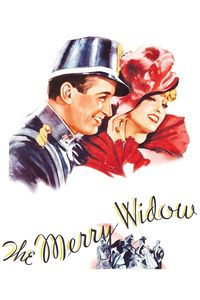
    (On Cable TV, August 2020) According to some contemporary accounts, Maurice Chevalier was one of Hollywood’s highest-paid actors of the 1930s, and his cultural influence essentially defined the French stereotype in American movies. He reportedly spoke English quite fluently in real-life, only to revert to a distinctive French accent in his movies. As much as I dislike the artifice, I must say that it helped create a strong screen persona: That of a bon vivant, gentle womanizer, easygoing hedonist… or, in other words, close to the stereotype that Americans still carry about French people, one that French people don’t do much to try to dispel. You can see that persona and attitude at play in The Merry Widow, a romantic fantasy in which imaginary European kingdoms are used as reasons for a soldier to court a rich widow. From the get-go, the film seeks an amiable, generally harmless tone: one early scene has soldiers chanting as they go to war, but with lyrics clearly stating that their only reason to go there is to impress the girls at home. Against this backdrop, Chevalier takes on the role of a playboy tasked with the serious business of national union through romantic courtship, and the rest of the film goes from there. There are plenty of reasons why this premise wouldn’t fly today, but the result is quite likable as a historical capsule. Ernest Lubitsch directs with his usual touch, and the music is surprisingly catchy. It’s clear that the film celebrates women, romance and courtship in a harmless fashion without any predatory overtones. Chevalier is truly likable, and Jeanette MacDonald is also quite good as the wooed widow. Top-notch production values in terms of sets and costumes mean that there’s always something lavish to look at. Still, the comedy is the draw and The Merry Widow is funny enough to entertain. Chevalier at his peak was not to be underestimated.