Fast and Furious series

  • F9 aka Fast and Furious 9 (2021)

    (Video on-Demand, September 2019) Regular readers will remember that I’m an undying devotee of the Fast and Furious series of vehicular action movies: Even after ten movies in twenty years, they remain one of the most dependable experiences you can have at the movies, with an ensemble cast of characters enduring death-defying stunts in service of evermore-ludicrous stories. While I have a feeling that the series may have peaked around instalments 5–7, ninth mainline entry F9 is still operating in the same vein, with the same cast and top-line crew at the helm. Ludicrously powerful (and selective) magnets power the film’s last-half action sequences in a fender bender of practical effects and unapologetic CGI. Oh, and two characters go to space aboard a rocket-powered Pontiac Fiero, but that’s almost to be expected considering the style of the series to date. Once again, F9’s plotting brings a new episode’s worth of melodramatic soap-opera-worthy revelations, this time resurrecting another character from the dead and uncovering a long-forgotten brother who proves to be a match for the protagonists. Never mind the late-sequence revelations — the fun here is in believing that Vin Diesel and John Cena can play halfway convincing brothers without the rest of the crew cracking up. Not that the film is that far away from self-commentary, as it dawns upon one character that far too much has happened to them without serious harm that they must be freakishly invincible. One of the keys of the series has to be the cast — not necessarily in terms of fine acting (even with Helen Mirren showing up for a brief and delicious car heist-and-chase sequence with her at the wheel), but in terms of sheer likability. As much as I like Nathalie Emmanuel’s usual curly bob, for instance, she here looks adorable with twin Dutch braids… but best of all, she gets a lead role in an action scene of her own playing off the series’ presumption that every character is a superior driver. Cena is his usual charismatic self — there’s never any doubt that he’s meant to join the family by the end. Meanwhile, Diesel looks a bit off, perhaps as a side effect of making the series too much about him. Fortunately, F9 is the kind of film that just keeps getting better and better. I would have been disappointed at the halfway mark (too much soap opera, not enough action), but the ending sequence redeems it all. It’s amazing that we’re ten films in a series at this point, so I’m inclined to be lenient about the creakiness of the “revelations” at this point. Let’s face it — as long as we’re having fun in the action scenes, this series still has plenty of miles left in it.

  • Fast & Furious Presents: Hobbs & Shaw (2019)

    Fast & Furious Presents: Hobbs & Shaw (2019)

    (In Theatres, August 2019) The origin story of Fast & Furious Presents: Hobbs & Shaw sounds like a case study for an ambitious Hollywood studio executive: what if the two biggest stars of your biggest moneymaking franchise start squabbling badly enough that it makes headlines? The obvious answer is to spin off another series to specifically showcase one of the squabbling stars and hope that the box-office keeps churning in. So it is that there’s nary a Vin Diesel to be found in Hobbs & Shaw, as the film feels free to jettison much of the increasingly burdensome “Family” of the main series in favour of focusing on the antagonistic relationship between Agent Hobbs (Dwayne Johnson) and reformed terrorist Shaw (Jason Statham). This spinoff clearly takes bold leap into science fiction as the antagonist is a cyber-enhanced “Black Superman” as played by the always-incredible Idris Elba. But that’s not the least credible aspect of a film that has its protagonists escape a falling smokestack, pull a flying helicopter by their arm muscles or run down the side of a skyscraper. No, believability and physics aren’t the strong suit of Hobbs & Shaw—in keeping with the original series, this is more about quick quips, demented action sequences, celebrity cameos (including a very funny Ryan Reynolds and an amused Helen Mirren) alongside an exaggerated sense of fun. It generally works—while elements of the third act feel like a step back from the calculated insanity of the previous action sequences, the film as a whole can depend on great lead action icons and a rather cute Vanessa Kirby building on the good reviews she received in Mission Impossible: Fallout. It’s not as good or as involving as much of the mainline series, but Hobbs & Shaw does the trick in between other instalments.

  • The Fate of the Furious aka The Fast and the Furious 8 (2017)

    The Fate of the Furious aka The Fast and the Furious 8 (2017)

    (On Cable TV, January 2018) So, it’s January first and what better way to start the movie-seeing year than with the latest instalment of the reliably ludicrous Fast and the Furious franchise? The Fate of the Furious doubles down on the increasing madness of the series, which means that the film starts with a street race in which the protagonist’s vehicle catches fire well before the finishing line and ends with a face-off between fast cars and a nuclear submarine. Yes, it’s that kind of movie. Once again, we’re back in the world of high-end cyber-espionage, with street racers saving the world through various heroics. There are even plot twists, what with series protagonist Vin Diesel flirting with the dark side by dint of manipulation. The character motivations don’t always make sense, the action beats are far-fetched and the plot is an excuse to get from one set piece to another, but that’s the price to pay for seeing Jason Statham joining the good guys, spectacular action sequences and enough self-assured movie mayhem to remind us why this mix of comedy, action and outright absurdity works so well. The most interesting sequence comes midway through the movie, as the newest self-driving technologies and the ever-rising possibilities of hacking combine to make New York a playground for vehicular mayhem, all the way to making cars rains down from above. Great stuff, and a series highlight. Otherwise, what you get is what you’ve been getting since the series pivot Fast Five: attractive actors, beautiful cars, big dumb (but savvy) action, globe-spanning locations, a focus on family that now approaches self-parody and enough dangling threads that sequels aren’t just possible, but expected. (Although the most recent news out of the franchise are of feuds that don’t bode well for the entire cast returning.)  I’ve been a fan of the franchise since the very first one (although the second film sorely tested my faith) and The Fate of the Furious hasn’t changed my mind. Bring on Fast Nine


  • Furious Seven aka The Fast and the Furious 7 (2015)

    Furious Seven aka The Fast and the Furious 7 (2015)

    (In theaters, May 2015) I’ve been a fan of the Fast and Furious film series since the first 2001 installment (even though my faith was sorely tested by the second film), but I never expected its seventh installment to be so purely enjoyable, even as it features a poignant emotional send-off to a fallen star.  Series lead Paul Walker died during the production of the film, and part of Furious Seven’s impossible mandate was to find a way to deliver hugely entertaining action sequences while acknowledging Walker’s final departure.  The first part of the mission is obviously achieved: Furious Seven contains bigger action sequences, a decent number of laughs, some innovative camera work (including cameras that move in-synch with people crashing through glass tables), decent villains, likable heroes and a decent amount of innovative stunts even in a series that seems to have done everything possible on four wheels.  The action moves fluidly across continents, juggles several recurring characters and a few new ones, harkens back to its perennial theme of family and is just about everything one could wish for in a summer blockbuster.  But no one expected the film to be able to deliver such an effective good-bye to Paul Walker, who is last seen here literally taking a fork in the road to stay safely with his new family, accompanied by a montage and a sad song meant to make even the least emotional members of the audience get a huge lump in their throat.  It works far better than even the most cynical pundits will allow: Walker was in many ways the heart of the series, and Furious Seven couldn’t have given him a better or more appropriate send-off.  Incredibly enough, it doesn’t feel manipulative or crass: it feels like the end of the road, even knowing that the series will have another sequel in two or three years.  Well done.

  • Furious 6 aka Fast & Furious 6 (2013)

    Furious 6 aka Fast & Furious 6 (2013)

    (Video on Demand, December 2013) I am unapologetic about my enthusiastic love for this series ever since the first 2001 installment: I’m not much of a car guy, but I love the blend of action, machines, and humor that the series offers.  Fast Five was a notable pivot in that it took the series away from strict street-racing action (no more girl-on-girl kissing!) towards globe-trotting heists and adventure, with considerable broadening of the franchise’s appeal.  Now Furious Six capitalizes on this shifting dynamic, and takes audiences to Europe in the search for bigger and better action scenes.  The highlight is a highway sequence that pits muscle cars against a tank, leading to a climax set on a massive cargo plane rolling down a seemingly endless runway.  With “vehicular warfare” (oh yeah), we are far from the Los Angeles street-racing origins of the series and yet not that far, given how the series has adopted “family” as an overarching theme and eventually manages to bring back everything to the humble neighborhood where it all began.  Fast and Furious 6 successfully juggles a fairly large ensemble cast, while giving a big-enough spotlight to series superstars Vin Diesel and Paul Walker, with able supporting turns by Dwayne Johnson and a spot for newly-resurrected Michelle Rodriguez.  The script is more blunt than subtle (the ham-fisted dialogues really bring nothing new to the film) and the direction could be a bit less tightly focused so to let the action scenes breathe, but for existing fans of the series, this is nothing except another successful entry.  There are even a few jokes thrown in: The street-racing sequence is introduced by Crystal Method’s circa-2001 “Roll it Up”, while Johnson not only gets at least two jokes referencing his wrestling background (mentioning “The Walls of Jericho” and a final tag-team fighting move with Vin Diesel) but also a few Avengers shout-outs in-between “working for Hulk”, “Captain America” and “Samoan Thor”.  By the post-credit end, the film not only straightens out the series timeline to include Tokyo Drift, but introduce a wonderful bit of casting in time for the next installment.  It’s going to be a bit of a wait until the next film…

  • Fast Five aka The Fast and the Furious 5: Rio Heist (2011)

    Fast Five aka The Fast and the Furious 5: Rio Heist (2011)

    (In theaters, April 2011) My unexplainable love for The Fast and the Furious series suddenly gets a lot more explainable with this surprising fifth segment: Reaching well beyond the street-racing antics of the previous volumes and deeper into the criminal action/thriller mode, Fast Five manages to satisfyingly weave together plot threads and a dozen characters from the four previous films, while delivering inventive action sequences.  The prologue effectively sets the tone and the film’s lack of regard for physics: thus reassured, we can enjoy the rest of the film, the over-the-top action sequences, the reunion of the series regulars and the colourful Rio de Janeiro locale.  This has to be one of the best pure-action movies of the past few years: It’s snappy, it’s competent, it doesn’t take itself seriously and when it clicks, it really works.  Vin Diesel growls as well as he can, and he’s joined by Dwayne Johnson for a head-on collision between two of the most credible action heroes of the moment.  While the script isn’t perfect (a few lulls; a few nonsensical plot development; little refinement by way of dialogue), it’s pretty good at giving a few moments to everyone in the cast, at setting up the interesting action sequences, and even at winking at the audience: There are a number of inside jokes for series fans here, perhaps the biggest being a cut that skips over the film’s usual street-racing sequence.  The cars may not be as nice at the previous films, but the action sequences are quite a bit more striking.  I wish, however, that director Justin Lin would open up his action sequences a bit more, lay off the crazy editing and let the long-shots speak for themselves.  (Fortunately, he’s already much better now than in the previous two films.)  Don’t leave during the credits: there’s a short scene that will please series fans while setting up a promising sixth instalment.

    (Second viewing, Streaming, December 2025) Very few long-running movie franchise reinvented themselves so decisively nor so successfully than the Fast and the Furious franchise did in Fast Five. From four disconnected movies about street racers, this installment pulled plot threads and reinvented itself as a deliriously bombastic action franchise, constantly pushing back the limits of its stunts and thrills. At his third time in the director’s chair, Justin Lin is comfortable complementing big action spectacle with smaller character moments, and if the rest of the film is no slouch when it comes to action sequences, the big finale in which two car tow a safe and wreak havoc through Rio de Janeiro is an anthology piece. It was a joy to watch back in 2011 and it’s still an adrenaline jolt more than a decade later — and in retrospect it’s a gamble than handsomely paid off with at least two more follow-ups reaching the same heights before the series reached diminishing returns.

  • Fast & Furious aka The Fast and the Furious 4 (2009)

    Fast & Furious aka The Fast and the Furious 4 (2009)

    (In theaters, April 2009) It’s useless to try to judge this film by most conventional standards. Its sole goal, after all, is to stroke the pleasure centers of automobile enthusiasts (a group that mostly overlaps with Y chromosomes) and its success it directly tied to how much automobile goodness it crams on-screen. The return of the first film’s cast isn’t a bad idea, but the boys have all the fun while the girls are kept off-screen or hastily taken out of the picture. At least Vin Diesel and Paul Walker have some fun rekindling their on-screen rivalry. Action-wise, the standout remains the opening chase sequence: The rest of the picture is a bit too over-edited and CGI-enhanced to make much of an impact. As for the cars, well, they’re a satisfying mixture of modern rice-burners and classic American muscle. It’s a shame that the cheerful multicultural shock of Tokyo Drift isn’t as strong here, but make no mistake: Between the colorful Southern California locale and the reggaeton soundtrack, this is still a twenty-first century motion picture for the young and licensed. It’s fun, it’s not often boring and, most of all, it shows fast cars and girls kissing girls –there’s no denying that it’s another entry in the ongoing franchise.

    (Second viewing, Streaming, December 2025) In the Fast and Furious pantheon, the fourth instalment is the boring but necessary one — noticeably limper in matters of action, but still essential in charting the series and reuniting the leads into a more coherent whole that would be developed later on. It’s not a surprise if I hadn’t bothered re-watching it, nor thought about it too much since seeing it: with its sequel redefining the series, it’s hardly an essential watch if you’re into what the franchise became with Fast Five. But taken as a whole, it does have a few high points in-between the drudgery. The opening sequence, in which the series’s fascination for stealing things off moving vehicles is indulged with a five-trailer gas tanker, is the kind o f strong over-the-top action sequence that would become the mainstay of later films in the series. There’s some good-and-necessary character work from Paul Walker (back as a cop, for one film) and Vin Diesel in having the characters reunite not-so-easily, as well as a few more crumbs to Jordana Brewster and Michelle Rodriguez. It’s the real sequel to the first film, and it finishes hammering the foundation that the series would use as of the next installment. Still, Fast & Furious remains remarkably duller than it should: Despire acceptable work from director Justin Lin, early good moments gradually give way to an underwhelming third act, hampered (as the film’s production history says) by an undercooked script due to the then-writer’s strike. The villain is dull (with a whole identity-switcheroo plot wrinkle that’s completely useless), the last action scene was a bad idea from the get-go, and the “death” of a main characters is badly handled. While its first act is more easily watchable than I remembered, Fast & Furious gradually reminded me of why I found it so unremarkable — starts off strong, ends with a whimper. Fortunately, much better was to come later.

  • The Fast and the Furious: Tokyo Drift (2006)

    The Fast and the Furious: Tokyo Drift (2006)

    (In theaters, June 2006) There’s something about this series, I don’t know what, that hits all of the buttons that come pre-installed with the Y chromosome. I’m no car freak, and yet plunk me in front of a The Fast And The Furious instalment and watch me cheer over the hot cars, the race sequences and the kissing girls. (It’s not a Fast And Furious film if there are no kissing girls.) Here, the action takes us to Japan, a move that plays heavily on the cultural dissonance and the most outrageous aspects of Tokyo culture. Here, drift-racing clubs take on the air of an cosplay convention and some movie-magic transforms drifting from a tire-squealing risky manoeuvre to a romantic, even heroic endeavour. The film makes no sense, of course, but that scarcely matters once the action has begun. Yup, the hero is a moron; sure, he looks twenty-five; no, he couldn’t have done all of that without being Pearl-Haboured by the Yasuka. But who cares: There are cars, there are girls (whoo, Nathalie Kelley), there are races and there is plenty of fun. As a B-movie, it’s remarkably successful… and it’s even better than 2 Fast 2 Furious.

    (Second viewing, On DVD, July 2007) A year later, this film holds up surprisingly well. Yes, the cars and the action scenes are still the only reason to see the film: The emphasis on drifting makes it feel fresh and original, and the script knows how to vary the thrills of the action sequences. On the other hand, well, the script is still as bland as it was in theatres, with too many incoherences to count and a final act that really misses Sung Kang as the film’s most intriguing character. But what makes the film hold together even as other cheap teen action films fade away is the unusual Tokyo setting, the rapid pacing and the go-for-broke modernity of the atmosphere where reggeaton, a southern white boy, a latina girl and American hip-hop all mix joyously in a Japanese setting. It almost makes one hopeful for the future of the younger generations. In the meantime, there’s still the cars, the girls and the terrific soundtrack to enjoy.

    (Third viewing, Streaming, December 2025) The Fast and Furious franchise could have degenerated in a few direct-to-video follow-ups if it hadn’t been for director Justin Lin and the jolt of multicultural vitality that he brought to Tokyo Drift. Not only the film that saved the series, but the one that set it on the path it would follow to box-office blockbusting, it renews with easy watchability after the sometimes-laborious 2 Fast 2 Furious and goes back to strong character work — not to mention the cars and the driving. Though tepidly greeted by reviewers at the time, the film has appreciated in the nearly two decades since. The world is kinder to the kind of cross-cultural matter-of-fact diversity that Lin sought and the success of later films gives a halo effect to this installment — and nowhere as much than for Sung Kang’s cooler-than-cool Han, who (as the franchise’ history goes) single-handedly caused the series’ time-bending shenanigans and contributed to its ensemble-cast approach. Other aspects work well too: Lin’s direction is well-tuned even from the film’s first few moments, the soundtrack is exceptional and the sheer fun of the whole thing can’t be underestimated. It’s not perfect, mind you: Lin was still inexperienced as a director, and the film’s third act is noticeably weaker than it should be. But it was the right film at the right time for the series, and it’s still quite enjoyable now.

  • 2 Fast 2 Furious aka The Fast And The Furious 2 (2003)

    2 Fast 2 Furious aka The Fast And The Furious 2 (2003)

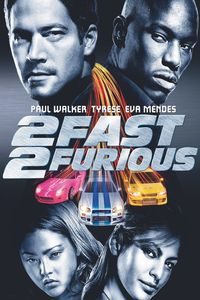
    (In theaters, June 2003) Cars, crime and chicks in sunny Miami; what else could you ask for? Okay, so Vin Diesel is missing and so is a lot of the energy of the original The Fast And The Furious. But it doesn’t matter as much as you think: This time around, the cars look better, and if no one can outfox Michelle Rodriguez from the first film, Eva Mendes and Devon Aoki are totally appropriate eye-candy. Paul Walker doesn’t have to struggle under the shadow of Diesel, and he emerges as a mildly engaging protagonist. (The homo-erotic subtext of his character’s relationship with buddy Tyrone can be a little ridiculous at times, though; how many jealous glances can we tolerate before bursting out laughing?) It’s a shame that about half the car chases don’t really work; dodgy camera moves, overuse of CGI over stunt driving and over-chopped editing don’t help in building a gripping action scene. At least the two highway sequences are nifty. The last stunt is weak and so are many of the plot points before then, but 2 Fast 2 Furious goes straight in the guilty pleasures category; a fine way to spend a lazy evening.

    (Second viewing, On DVD, March 2004) Fast cars, curvy women and sunny Miami: Even the second time around, it’s hard to be angry at this film even as the dialogue is painful, the action scenes aren’t particularly successful and the ending is lame. At least the DVD offers some consolation through a series of interesting making-of documentaries and a few extra car-related goodies. John Singleton’s tepid audio commentary does much to demonstrate the uninspired nature of the film’s production. Competent without being particularly commendable, adequate without being particularly satisfying. This one goes out straight to Eva Mendes fans and car buffs. Not that there’s anything wrong with being either.

    (Third viewing, Streaming, December 2025) Roughly ten installment later, there’s little doubt that 2 Fast 2 Furious is the runt of the Fast and Furious franchise.  Hurriedly put in production to capitalize on the first film’s box-office and missing the mark on several elements that would make the success of the film series, it’s a weak movie that does not deserve any pretension of it holding up.  At best, the success of its many sequels give it a halo effect to help get past its worst moments.  For fans of the series and its characters, this is the film that explains how Taj and Roman met, and how Brian lost his badge.  You can even detect the series’ first foray into ludicrous high technology with the “EMP harpoons” used twice during the plot. It does have a few good action beats: the two racing sequences aren’t bad, and there are two highway sequences with good moments (even if the sequences as a whole aren’t particularly good and filmed in unusually muted fashion). The rest of the film, though, is much blander than one would expect.  The Miami location is only used perfunctorily, while everything that touches Cole Hauser’s villain feels like it comes from an undistinguished straight-to-video police thriller (including a torture sequence that doesn’t fit with the series’ tone at all.)  Most of all, though, is that the film barely seems to touch upon either car culture, big stunts, increasingly solid web of interpersonal relationships or effortless entertainment that would come to define the series.  No wonder the later installments wouldn’t crib too many things from this one. (While I do regret not seeing Devon Aoki in other installments of the series, I gather that acting was more of a temporary thing for her, and she’s happy away from the screen.) There are many reasons why 2 Fast 2 Furious was fated to under-perform (hurried production, Vin Diesel’s hubris-driven decision not to return to the series, director John Singleton’s lack of affinity for the material, etc.) but the result is such a drag that it probably ends up being the most-skipped film in the Fast and Furious box-set.

  • The Fast And The Furious (2001)

    The Fast And The Furious (2001)

    (In theaters, June 2001) Yes! After a diet of pretentious pseudo-profound cinema and ultra-hyped moronic flicks aimed at retarded teens, it’s such a relief to find a honest B-movie that fully acknowledge what it is. If you like cars, you’ll go bonkers over The Fast And The Furious, one of the most enjoyable popcorn film seen so far in 2001. The plot structure is stolen almost beat-for-beat from Point Break, which should allow you to relax and concentrate on the driving scenes. There aren’t quite enough of those, but what’s there on the screen is so much better than recent car-flick predecessors like Gone In Sixty Seconds and Driven that director Rob Cohen can now justifiably park in the space formerly reserved for Dominic Sena and Renny Harlin. The film’s not without problems, but at least they’re so basic that they’re almost added features. The protagonist is supposed to be played by Paul Walker, but don’t worry; bland blond-boy gets each and every one of his scenes stolen by ascending superstar Vin Diesel, whose screen presence is of a rare distinction. Feminists will howl over the retrograde place of women in the film, but even wannabee-sensitive-guys like me will be indulgent and revel in Jordana Brewster and Michelle Rodriguez—not to mention the other obligatory car-babes kissing each other. Despite the disappointing lack of racing in the first half, there is a pair of great action sequences by the end, the best involving a botched robbery attempt on a rig with an armed driver. That scene hurts, okay? I still would have loved a better ending, but otherwise, don’t hesitate and rush to The Fast And The Furious if you’re looking for a good, fun B-movie.

    (Second viewing, On DVD, March 2002) There isn’t much to that film, if you look closely; three or four action scenes, conventional plotting, a few hot young actors and that’s it. But once again in B-movie-land, it all depends on the execution. Here, the young actors are really hot (from Walker to Diesel to Brewster to Rodriguez), the direction is unobtrusive enough and the film is infused with a love of speed that manages to make all quibbles insignificant. The ending is still problematic, with all its unresolved plot-lines, but the film holds up very well to another viewing. The DVD includes an amusing director’s commentary, deleted scenes (some good, some less. Unfortunately, the director once refers to an alternate ending that’s not included), a rather good making-of, three rather bad music videos and a bunch of other stuff.

    (Third viewing, Streaming, December 2025) Decades later, the publication of Barry Hertz’s history of the Fast and Furious franchise suddenly had me hankering for a re-watch of the series’ first instalment. As many have since said, The Fast and the Furious really holds up.  At its core, it remains a solid genre thriller, streamlined to focus on the essentials.  The story moves fast except when it slows down for just-enough background for the characters, the Los Angeles setting or the car culture that’s central to the film’s comfort.  The few action sequences are handled with a professional’s touch, with just enough non-mimetic material (such as some brief CGI, or the sped-up transitions from day to nighttime highlighting the different realms of the film) to highlight the metal-on-metal tactility of the stunts.  It’s easily watchable without too many dull or dumb moments.  And the soundtrack is terrific — although that may just be me recognizing the tracks I was listening at the time. But it’s the the halo effect of its many sequels’ blockbuster success that helps lift it up even further: Paul Walker is quite good here, and Vin Diesel is remarkable. Even comparing this relatively grounded first installment to its increasingly bombastic follow-ups isn’t that big of a jump: You can see where the most successful bits of the sequels come from, and where some of the characters are introduced.  The sequels also manage to tie up the loose ends of the abrupt ending, and develop some half-baked ideas.  But even taken on its own, The Fast and the Furious is a slick, fast, well-made action movie — well worth a look even a quarter-mile, er, a quarter-century later.