Franchot Tone

  • Her Husband’s Affairs (1947)

    (On Cable TV, November 2021) Before becoming The Lucy of I Love Lucy, Lucille Ball spent more than a decade working in movies, honing her comic timing in a series of vehicles that made good use of her skills. It’s interesting to see her progressively transforming throughout the 1940s, from a funny but still-generic debutante to the blend of tics, hairstyles and stares that would make up the more fully formed Lucille Ball of the 1950s and beyond. Her Husband’s Affair comes from the latter half of that process, at a time when Hollywood was beginning to understand what an asset Ball was, and was shaping scripts to her strengths. Here, she plays the level-headed foil to Franchot Tone’s eccentric husband, eventually rescuing him from a murder accusation but not before suffering through a long series of comic set-pieces loosely focused on wild and crazy inventions with unforeseen impacts. As far as even light comedies go, there’s a surprising lack of impact to Her Husband’s Affairs. Despite the proto-Lucy Ricardo flair to some of her material, Ball isn’t quite as interesting as she should be — there’s a sense that her character is being held back from the lunacy she could portray. Meanwhile, the same can be said about everything else in the film: despite its potential, Her Husband’s Affairs merely exists contently, getting a few smiles where there should be chuckles and laughs. It’s amiable enough and not a complete waste of time, but there are several much better films from the same time and genre. See it for Ball, maybe, but there’s not much else.
  • Today we Live (1933)

    Today we Live (1933)

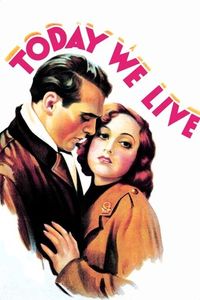
    (On Cable TV, October 2021) I got interested in Today we Live because I’m trying to complete my Howard Hawks filmography, but not every one of movies is a hit, and this early effort goes right in the bottom tier. On paper, there’s certainly plenty to like about the film and the people it involves. I mean: Directed by Hawks! Dialogue by William Faulkner! Featuring Gary Cooper, Joan Crwford and Franchot Tone! A big romantic WW1 epic! Well, sometimes the ingredients don’t take in the mix: Today we Live has an excruciating first hour of drawing-room conversations set against the WW1 backdrop, with a love triangle between the heroine and two officers laboriously constructed according to familiar conventions. It’s dull in a way that we rarely associate with Hawks movies (even previous ones, such as Scarface). The pacing issues are compounded by a dour tone that leaves no place for Hawks’ usual humour, and even less for capable, vivacious characters. Fortunately, the reason why Hawks took the project becomes more obvious in the second half, with some aerial combat footage (much of it apparently recycled from Hell’s Angels) and characters in peril. On the other hand, the abrupt change in tone and style does give further credence to the idea that the film is a botched blend of creative influences, studio interference and mid-flight corrections—reading about the troubled production history of the film is very instructive. In the end, what’s left is something that feels a lot like a lesser take on material done better in Wings or Hell’s Angels, and nowhere near what Hawks himself would do in later years.

  • The Gorgeous Hussey (1936)

    The Gorgeous Hussey (1936)

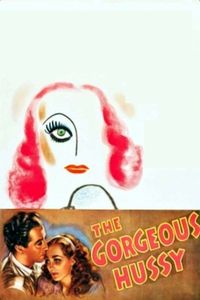
    (On Cable TV, September 2021) Maybe it’s my still-evolving understanding of English vocabulary, but I’m still grinning at the moxie required to name a movie The Gorgeous Hussey. It does fit, though: As a very fictionalized retelling of the life of a humble woman who became an unlikely power broker thanks to her friendship with American politicians such as Andrew Jackson, it’s meant to be a clash of sensibilities between beauty and politics within a character definitely meant to illustrate more contemporary values. In the surprisingly large filmography about American politics, this film stands out by being more about saucy romance and backroom dealings than policy or memorable speeches. Of course, the project was crippled from the get-go — made in the early aggressive early days of the Hays Code, The Gorgeous Hussey got away with its title, but could not do justice to the affairs, bawdy actions and ostracism of the Petticoat Affair it describes. As a result, it feels neutered — especially when you look up the historical record of the events that the film is meant to explore. It’s not a complete loss, though: visually, the film makes the most out of its period settings with great costumes and sets. Acting-wise, the good news is that the cast has a number of very familiar names, from Joan Crawford in the lead, James Stewart and Franchot Tone as supporting players, and Lionel Barrymore playing Jackson with panache. Unfortunately, that casting is now a double-edged sword: Crawford’s persona is too modern to play a historical figure without reminding audiences of her other films, and a similar problem also affects Stewart — magnified by the thinness of his part. All of these issues make The Gorgeous Hussey more a curio than a satisfying film in its own right. It’s worth a look to see how a Hays-Code-era film tried to portray a subject matter too salacious for its own good, but it’s not really much of a success on its own.

  • Love on the Run (1936)

    (On Cable TV, July 2021) Neither Joan Crawford, Clark Gable or Franchot Tone step far away from their established screen personas in Love on the Run, a kind of silly romantic comedy that had its start in the 1930s but certainly didn’t end there. The premise will be dead familiar to anyone who’s ever seen a screen romance: a millionaire (Crawford) wants to get away from the attention she’s getting, while an undercover reporter (Gable) is only too willing to help her… as long as there is a good story in it. The tension created by the lies sustains much of the film, as is the rivalry between reporters Gable and Tone. To contemporary viewers, what makes Love on the Run more than a romantic comedy is the 1930s atmosphere: With hard-nosed print reporters in the lead, colourful characters such as aviator (how exciting!), communication by cablegrams, the allure of a glamorous European getaway, and the menace of international spies, it’s almost more interesting now than it must have been at the time. Still, there isn’t much to the foundations of the story — it’s clearly a derivative of It Happened One Night (back then a box-office and Oscar sensation) and it plays in the same comic space as many films of its era. It’s fun to watch but not overly gripping even if you like the actors involved in it. Still, Love on the Run is perhaps best not appreciated by itself, but as a representative example of a genre — the 1930s Hollywood comedy, light on the screwball and heavy on the romance between marquee names.

  • I Love Trouble (1948)

    I Love Trouble (1948)

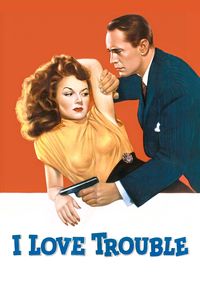
    (On Cable TV, May 2021) The late 1940s were a high-water mark for classic film noir, and I Love Trouble clearly revels in the big guns of the genre: a cynical Private Investigator, a femme fatale (or two), a corrupt client, a bunch of organized criminals and seedy Los Angeles underworld locations. But where the film distinguishes itself is its refusal to play by the dark, fatalistic tone of the genre. Instead, I Love Trouble harkens back to the comedic sleuth films of the 1930s by having an unflappable protagonist suavely played by Franchot Tone, wisecracking his way through tense situations (all the way to the gun-pointing finale) and managing to get the girl by the final moments of the film. As a result, I Love Trouble almost plays as a parody — it’s not really meant as such (more of a playful take, I’d say), but the change in tone can act as a tonic for those jaded viewers beaten-down by the archetypical world-weary noir tone. Despite the amusing approach, the film is as convoluted as any other noir — the pithy plot summary on Wikipedia is hilariously deceptive in that regard. The image quality is not good even on best-of-show TCM, but I can see myself revisiting this one in a while, simply to take in the witty repartee once again. But why wait? Best of all, I Love Trouble is in the public domain — there’s no reason not to watch it now if you’re interested in it.

  • Fast and Furious (1939)

    Fast and Furious (1939)

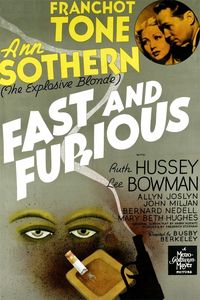
    (On Cable TV, July 2020) I was slightly mistaken in recording this Fast and Furious—I thought I was recording the 1954 Corman film—but it turns out to be a nice little surprise: a husband-and-wife amateur sleuth story very much in the vein of The Thin Man. It turns out to be the last in an MGM trilogy explicitly modelled on the more successful Powell/Loy series, except half-heartedly executed with different lead actors every time. In this instalment, Franchot Tone and Ann Sothern play the bickering couple to good effect, even though you’ll still miss William Powell in the lead. Fast and Furious is notable for having been directed by Busby Berkeley, but it does not have any of the musical numbers for which he’s best known. The resulting murder mystery is a bunch of hooey (even the characters pretty much run the gamut of suspects to exhaustion), the relationship between the characters is merely fine… and yet, it’s fun and short at merely 73 minutes. There are some good comedy moments involving summer in the city, lions in a hotel, an ex-asylum attendant, and a querulous user of in-room services. Plus, the setting being a fantasy upper-class version of the 1930s doesn’t hurt. While the 1930s had several much better films in the same amateur-sleuth genre, Fast and Furious is very satisfying even as a second-tier example of the form.

  • Dancing Lady (1933)

    Dancing Lady (1933)

    (On Cable TV, June 2020) While Dancing Lady is technically the first of Fred Astaire’s movie musicals, his fans should keep in mind that it took him a few movies’ worth of scene-stealing appearances before getting his first lead role, and so this film sees him relegated to a climactic showcase number, as himself, dancing with Joan Crawford. Not that he’s the only one making early appearances here that now overshadow the leads of the film—An early iteration of The Three Stooges also shows up, plus later star Nelson Eddy, making this film’s supporting cast far more remarkable than nominal leads Franchot Tone and Clark Gable. (I would add “…and Crawford” except that she looks absolutely spectacular here—although not a dancer of Astaire’s calibre.) As an early Pre-Code musical of the early sound era, Dancing Lady is still quite rough around the edges: even the narrative doesn’t go too far away from its Broadway inspiration by featuring a making of a musical as its narrative foundation. It feels a bit short at 92 minutes, but that’s probably because we’re expecting more Astaire. While Dancing Lady is perfectly watchable, it’s probably more of interest to Astaire fans and cinephiles tracking the evolution of the early musicals… although the Pre-Code attitude does make it more interesting than most.

    (Second Viewing, On Cable TV, October 2021) It’s very amusing to see Fred Astaire billed in a very secondary role in Dancing Lady—five years later, he would have headlined such a title and made it much better by sole virtue of integrating dancing with comedy acting. But this was his screen debut, and so Clark Gable gets the leading (non-dancing) role as a Broadway impresario trying to put on a show despite romantic complications with his leading lady (Joan Crawford) and her rich boyfriend. Much of the plot is obvious and paper-thin, rotely going over tropes of Broadway musicals without much flair nor energy. It’s seriously dull in much of its opening two-thirds—only opening up when the show gets going in the last act. Astaire fans will note that he’s playing himself (a Broadway dancer) in the film, all the way to being credited in the film’s glimpse of the playbill. The other noteworthy cameo is having the Three Stooges in a walk-on comic role. Crawford is rather impressive when going toe-to-toe with Astaire in the film’s best moments, while Gable doesn’t deviate much from his persona as the romantic non-singing non-dancing lead, letting Astaire take the leading role whenever the film switches over to the Berkeleyesque dancing sequences. It’s a good thing that Dancing Lady gets a late surge of energy, dancing and singing, because what comes before is mildly pleasant at best, and repetitive of better films at worst.