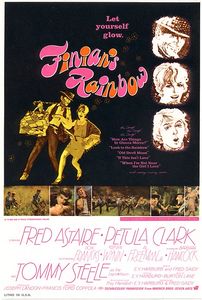
(On Cable TV, December 2018) Being right doesn’t mean much when you’re late, and unfortunately that’s the first conclusion I get from watching Finian’s Rainbow, an old-fashioned musical that has the right moral values about racism but the rotten luck of making it to theatres one year after movies such as In the Heat of the Night and Guess who’s Coming to Dinner completely changed the Hollywood conversation about racial injustice in the United States. As New Hollywood was remaking the film industry in a far different image, Finian’s Rainbow was torn between new issues and old-fashioned style, featuring no less than Fred Astaire singing and dancing about racial injustice while dealing with a meddlesome leprechaun trying to get its gold back. Yeah… I’m not making this up. It’s a musical in the purest tradition of the form, but it would have been so much better had it been made ten years earlier. Astaire isn’t bad, but he looks truly old here—I mean: he never looked young even when he was, but here age has visibly caught up to him, and his great dance routines look almost dangerous. Petunia Clark is fine as his daughter, but much of the comedy and remarkable performances come from other players (including Tommy Steele as a hyper-caffeinated leprechaun) in this bizarre southern state/Irish-mythology mash-up. The film’s message against racial discrimination goes through an incredibly racist character being magically transformed into a black person (hello blackface) in time to travel with a small group of singers—the song is great (“The Begat”), but everything leading to it has issues of some sort. Plus, it’s directed by none other than Francis Ford Coppola. Finian’s Rainbow, as you can guess, is a strange blend—sometimes great, sometimes endearing, sometimes dumbfounding and sometimes uncomfortable. It’s certainly interesting, but I’m going to stop myself from calling it a must-watch.
(Second Viewing, On Cable TV, March 2021) In retrospect, I’ve been too harsh on Finian’s Rainbow. Most of what struck me on a first viewing is still applicable to a second, but they don’t bother me nearly as much. Astaire looks old, but he does what he can and even the accumulating wrinkles can’t quite stop him from being an entertainer – and the film doesn’t focus nearly as much on him as it would have in earlier years. After all, he actually plays a father here. I’m also not quite as bothered by the film’s comic treatment of racism – it’s meant to be ridiculous, and the film does have its heart in the right place in mocking racists even when it’s recreating clichés along the way. I still don’t care all that much about the leprechaun and his gold, but some of the musical sequence staging (helmed by a young Francis Ford Coppola, once again worth highlighting) is vigorous and eye-catching. I still think Finian’s Rainbow has plenty of flaws, but they don’t annoy me as badly this second time around.