Gene Tierney

  • Where the Sidewalk Ends (1950)

    Where the Sidewalk Ends (1950)

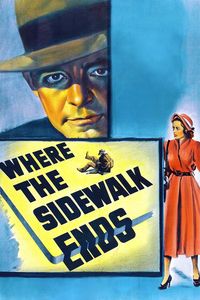
    (On Cable TV, October 2020) I’m always game for an Otto Preminger movie, and while Where the Sidewalk Ends doesn’t have the cachet of some of his better-known productions, it’s a perfectly fine example of a crooked-cop film noir. Dana Andrews plays a cop with a bit of a problem roughing up suspects, but things quickly turn ugly for him when a routine interrogation becomes manslaughter—covering up his traces only endangers the father of his newest flame, and much of the film consists in following him as he sees his scheme unravel and his conscience attempts one last stand. Cleanly directed, competently acted and almost perfectly following the classical noir atmosphere, this is an easy to watch, tightly-constructed film that tightens up the suspense and delivers a satisfying finale. Gene Tierney plays the love interest that ends up being the protagonist’s moral beacon, and Ruth Donnely has a small but very effective role as a bantering café owner. While twenty-first century viewers would frown at the idea of a rough cop being the hero, twenty-first century viewers would also expect his transgressions to be more extreme—in that light, there’s a curiously refreshing lower-stake approach to Where the Sidewalk Ends that almost makes it comforting viewing even when it gets into the gritty details of cop work in New York City.
  • Leave Her to Heaven (1945)

    Leave Her to Heaven (1945)

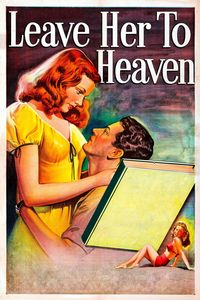
    (On TV, September 2020) The first half-hour of Leave Her to Heaven had me very, very confused—it’s a film noir, and yet I was served a Technicolor romantic drama about a man and his possessive new wife. While the images were spectacular (That lodge! Wow, that lodge!) and a foreboding prologue promised much, we were so deep in melodramatic territory that I found my attention slipping—Sure, Gene Tierney is always worth a look (although Jeanne Crain has her beat here), but would the film eventually get any better? And then it does, spectacularly. After a few arguments realistic enough to be uncomfortable, the film cranks it up midway through as a shocking death puts the female lead’s psychological cruelty to the forefront, and then it’s off to races as things get more and more convoluted for our likable protagonist. There are femmes fatales in film noir, and then there’s Gene Tierney’s character here, willing to plot revenge from beyond the grave in an effort to ensure that her husband will remain hers no matter what. By the end of Leave Her to Heaven, the film’s moniker as “the first Technicolor film noir” made complete sense—although I note with some amusement that it does provide a somewhat uplifting ending after so much misery. The blend of genres may be off-putting on a first viewing, but it does make the film stand out, even today, as something refreshingly different. Cornel Wilde is fine in the male lead role and Vincent Price does make a mark in a relatively short turn as a jilted then prosecuting attorney. But the film belongs to Gene Tierney, who was nominated for an Oscar for her performance. I’ll note that the film fits rather well in the “domestic thriller” subgenre of the era, albeit gender-flipped so that it’s the woman who is the threat rather than the husband. From an inauspicious beginning, Leave Her to Heaven does pack quite a punch in its later half. If you’re bored still after the first few minutes, keep watching—it gets much better.

  • The Razor’s Edge (1946)

    The Razor’s Edge (1946)

    (On Cable TV, September 2020) Despite its sharp title, The Razor’s Edge is not a thriller, not a film noir, not a crime movie—it’s a soul-searching literary drama adapted from Somerset Maugham’s novel and whose contemporary impact may not be immediately understandable by twenty-first century audiences. What a bit of historical investigation reminds us is that the story was written during WW2 and, upon release in 1944, gradually found a public receptive to its themes of aimlessness after a great trauma, then-unusual transcendental themes and resistance to the increasing materiality of American culture. Even elements such as casting Tyrone Power (then more akin to a matinee idol) were playing into that zeitgeist. (Gene Tierney looks nice, though.) Those may not be readily apparent many decades later, but they certainly feed the film’s thematic concerns. Whether the result is successful is up for debate—one of the dangers in adapting a novel heavy in unconventional themes is the double-flattening effects of material being handled by people who didn’t come up with it, and tailored to an audience even further removed from what the original work was trying to say. Then there’s the real danger of ending up with a dull clunker incapable of properly conveying the point—and at 145 minutes, The Razor’s Edge is clearly vulnerable to that statement. All of this to say—sit down and prepare yourself for a long sit because this isn’t some genre piece with regular action beats to keep you awake.

  • Night and the City (1950)

    Night and the City (1950)

    (On Cable TV, October 2019) Film noir is often about desperate people in bad circumstances, and in this light Night and the City certainly qualifies as such. Unusually taking place in London rather than in a large American city, it nonetheless plays up the grimness of low-class hustling, with a protagonist perpetually convinced that he’s only one lucky break, one spin of the wheel away from success. Grim and tawdry, it takes place in the city’s underworld, rubbing shoulders with wrestlers and killers. Richard Widmark is not bad as the protagonist, but I suspect that most viewers will better appreciate Gene Tierney as his long-suffering girlfriend. The unrelenting grimness of the result isn’t only in the atmosphere, but in the lack of sympathy for any character and the unsparing ending of director Jules Dassin’s preferred version (a British version reportedly softens up the ending—it’s not the one I saw). Night and the City is not a film for every audience or every mood, but it does stand as a prototypical noir even despite not taking place within American borders. You even get a (repeated) didactic mention of “Montréal, in Canada” just for the fun of it.

    (Second Viewing, On Cable TV, November 2020) There have been many films noir in the 1950s, and they do get to blur if you’re watching too many of them in rapid succession. What director Jules Dassin’s Night and the City has over others is its somewhat unusual location: For as American a genre as noir, it feels refreshing to see the film take place in London. The historical circumstances surrounding this are strange—Dassin was on the blacklist at the time, and MGM was looking to take advantage of some financial incentives to produce films in England. (It also set in motion the very improbable series of events that would make Jules Dassin the father of an iconic French singer, but that’s going way beyond the scope of this review.)  Taking place in the very noirish demimonde of boxing promotion, Night and the City piles on the noir trademarks; desperate characters squeezed into illegality by bad luck and circumstance, moody black-and-white cinematography; plenty of scenes in which characters run in deserted alleyways; a femme fatale, this time played by the legendary Greer Garson. Plus, the London backdrop is quite intriguing as a change of pace. It doesn’t make Night and the City all that good, but it does help it distinguish itself from so many close contemporaries.

  • Heaven Can Wait (1943)

    Heaven Can Wait (1943)

    (On DVD, September 2019) I started watching Heaven Can Wait reluctantly, convinced that it was going to be the original that led to the 1978’s Heaven Can Wait remake (which I really don’t like). But the Heaven can Wait original is called Here Comes Mr. Jordan and this is a completely different film. It ends up being a comedy by none other than Ernst Lubitsch, featuring Don Ameche recounting his life to the Devil in order to be admitted in Hell. As with most of Lubitsch’s films, it features a rather good script (adapted from a theatrical play, hence the strong dialogue) filled with clever touches, and an unobtrusive directing style that makes it absorbing viewing. Gene Tierney holds the female lead, with ample chemistry with Ameche when it counts. It’s a film made by people aware that there’s a jaded audience on the other side of the screen, eager to be seduced by a film but having been disappointed before. As a result, it feels as if Heaven Can Wait is constantly nodding at its audience, comforting them when it wants to and surprising them in other ways. It’s quite a likable movie, and it’s one of many that affirms Lubitsch’s strong touch on the material he directed.

  • Laura (1944)

    Laura (1944)

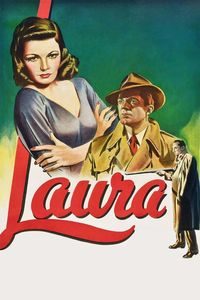
    (On TV, June 2018) There’s a weird, weird quality to Laura—a film noir with a dead protagonist overpowering all other characters, a hilariously unprofessional investigation and a literal ticking-clock denouement. And yet director Otto Preminger keeps all the elements in good balance, delivering a film noir that works almost better as a study of obsession than a straight-up murder story. Having actors such a Gene Tierney (suitably entrancing as Laura), Dane Andrews, Clifton Webb and Vincent Price (well before he became the prince of horror) also helps. The result is actually kind of delicious, what with the good dialogue, unusual structure (so that you’re not watching the same darn thing) and stylistic touches. Laura amounts to a surprisingly good film, perhaps not a core film noir but certainly adjacent to it.

  • The Ghost and Mrs. Muir (1947)

    The Ghost and Mrs. Muir (1947)

    (On Cable TV, April 2018) I think that what I enjoy most out of my data-driven method to watching classic cinema is approaching movies completely blind other than knowing that “a lot of people have watched this.”  That’s how I end up watching films that may not sound interesting, but end up being surprisingly enjoyable. Hence The Ghost and Mrs. Muir, a film that sounds terrible from a simple premise (“Widower moves into a seaside house, ends up forming a relationship with the previous owner’s ghost”) but ends up being unexpectedly captivating, and even somewhat fresh even seventy years later. The magic of the film isn’t in its premise but in its execution, with the lovely Gene Tierney turning in an impeccable performance as a widower looking for a fresh life on her own, and especially Rex Harrison as a crusty sea captain having lost little of his lust for life even in death. The first unremarkable few minutes are competently made, but the film takes a life of its own as soon as the ghost makes his appearance. Harrison’s near-parodic take on a sea captain is charming, and the film seamlessly shifts gear from suspense drama to romantic comedy, complete with rather witty dialogue. Then there’s another shift as a live romantic interest shows up, setting up a dramatic triangle that provides much of the film’s third quarter. Then it’s off to another seamless shift into romantic drama, with a last act that takes surprising leaps forward in time, and completes with an incredibly satisfying conclusion. The Ghost and Mrs. Muir has too many rough edges to be considered an all-time classic (some of the dialogue is pandering, and many of the dramatic twists are implausible at best—the last act is particularly problematic), but it’s highly enjoyable and has more than a few pleasant surprises in store for modern viewers. Charming and surprising, it has aged admirably well and represents, even today, an exemplary example of 1940s Hollywood cinema.