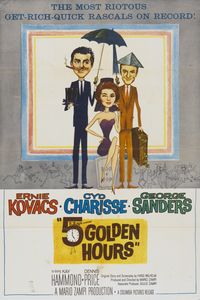
George Sanders

  • Five Golden Hours (1961)

    Five Golden Hours (1961)

    (On Cable TV, June 2021) By the time the 1960s hit, Cyd Charisse was out of a persona — as wonderful as she could be playing the icy leggy dancer in MGM musicals, her acting range did not always extend gracefully to more demanding non-dancing roles. When the MGM musical died of overexposure in the late 1950s, her career did not immediately stop — she was attractive enough and had sufficient name recognition to parlay her presence in other films and genres but the results of her later work are not as transcendent as the films she’s best known for. In Five Golden Hours, for instance, we see her try her hand at comedy alongside noted comedian Ernie Kovacs, with George Sanders in a supporting role. The plot has a con man taking aim at Roman widows, but eventually facing women with sharper and deadlier instincts. The result is… mixed. While Kovacs gets a few opportunities to shine, much of the film is a disappointment — a bit weak, slightly mishandled in matters of tone, not quite as eager to fulfill its potential. In that light, Charisse’s presence also feels not-quite-there: her talent for beautiful ice princesses is a good portion of what the role requires, but she can’t quite go the extra mile to round off a character with hidden depths. Shot in Rome by Mario Zampi, Five Golden Hours does remain worth a look for Charisse fans — it’s generally amiable even when it doesn’t reach its goals, and you can watch it while knowing that Charisse also used her Italian trip to film the much better-known Two Weeks in Another Town.
  • This Land Is Mine (1943)

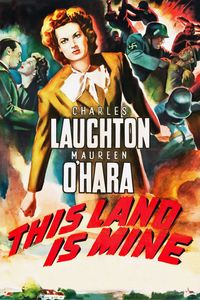
    This Land Is Mine (1943)

    (On Cable TV, April 2021) It took an exiled Frenchman to credibly portray the horrors of Nazi occupation to an American audience, and that’s why This Land is Mine still ranks today as one of the finest WW2 films made during WW2 itself. Narratively, it shows the Nazi occupation of France on a very personal level by focusing on a small town and some of its inhabitants. A great set of actors is up to the task — George Sanders as an informer, Maureen O’Hara as a teacher but especially Charles Laughton as a cowardly teacher who finds hidden reserves of courage under adversity. Clean directing from Jean Renoir and a striking script do the rest of the work. Renoir resists the temptation to get caricatural about both the French and the Nazis, and the result is something this lives on as something more than propaganda. The entire film works pretty well, but the ending is suitably poignant. This Land Is Mine remains a mild surprise and a great discovery.

  • Witness to Murder (1954)

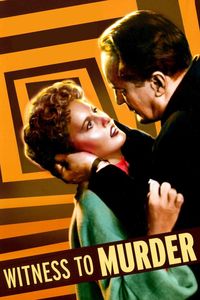
    Witness to Murder (1954)

    (On Cable TV, December 2020) I count at least four excellent reasons to watch Witness to Murder. For one thing, it has a really good late-period film noir premise, as a woman looks outside her apartment window and witnesses a man murdering another woman. The second reason is that our heroine is played by Barbara Stanwyck, in a late-career role (her first was in a 1920s silent film!) that does much to reinforce her chameleon-like acting range. The third reason is her opponent – a deliciously slimy George Sanders, with his haughty attitude complementing a character that delights in covering his track and making the heroine feel as if she’s going crazy. Finally, the fourth reason to watch the film may be more striking to modern audiences: the encroaching paranoia as the heroine tries to convince the authorities that a murder has taken place, but no one will believe her. The film isn’t afraid to rile audiences against impassive authority figures, and that does give, along with a role as a single career woman for the mature Stanwyck, a progressive kick to the result. A fifth, perhaps most visible reason to watch Witness to Murder would be the terrific cinematography, which luxuriates in strong black-and-white imagery to give the film an undeniably film noir visual polish that elevates the script into something worth seeing. No matter the reason, Witness to Murder does rank as a very enjoyable thriller, more for the above-average execution than the sometimes-frustrating nature of the script.

  • While the City Sleeps (1956)

    While the City Sleeps (1956)

    (On Cable TV, December 2020) The more I discover lesser-known movies from the 1950s, the more I realize that, despite the conformist fairytale that many would like to make you believe about the decade, it was filled with social criticism, technological doubts and satires about the post-WW2 order. While the City Sleeps benefits from the outsider’s gaze of director Fritz Lang: it is at its core a crime drama that becomes an excuse to examine the growing power of media in American society. When a media magnate dies as a serial killer terrifies the city, the directors of the three divisions of his empire (newswire, newspaper and television) are encouraged to find the killer first in order to secure a prestigious new job. As an excuse to study the tensions between personal gain and news ethics, While the City Sleeps exploits its plotting for all it’s worth: the directors scheme and draw audacious plans that directly put others in danger in an attempt to seize the headlines (and accessorily catch the killer). A great cast complements the story – Dana Andrews at the protagonist, a suitably slimy Vincent Price as an underestimated heir, George Sanders as one of the competing directors and a great-looking Ida Lupino as a clever writer. It all amounts to an absorbing film, clearly going beyond film-noir clichés to attempt an ambitious study of how personal greed can corrupt institutions meant to be trusted by the public. It’s suitably cynical at a high level, but can rely on a likable protagonist to anchor the film. Lang’s Hollywood career was not perfect, but I don’t recall truly disliking any of his films during that period. While the City Sleeps is no exception.

  • Solomon and Sheba (1959)

    Solomon and Sheba (1959)

    (On TV, November 2020) A film can do everything according to the rules and still fall flat, and that’s the way I feel about King Vidor’s Solomon and Sheba, a historical epic that clearly plays by all of the rules of 1950s epic movies yet fails to make a strong impression. Oh, it does have its qualities—Yul Brynner with hair (as Solomon), George Sanders in a minor role, and the incomparably named Gina Lollobrigida (as the queen of Sheba), huge armies clashing in the desert, and a scene with the well-known judgment of Solomon, and the rest of what audiences expected from movie epics over what they could see on household TVs. But compared to other epics, Solomon and Sheba feels somewhat generic—compressing decades of filmmaking in one all-available present, this film appears without much distinction nor grandeur beyond Brynner playing a king. Things get somewhat more interesting once you start reading about the film’s production—the newness of shooting a historical epic in Spain (rather than the more common choice of Italy at the time) pales in comparison to the behind-the-scenes drama that surrounded Tyrone Power‘s sudden death two-third of the way through, and his replacement by Brynner. Very little (if any) of this backstage turmoil shows up on the screen, though, and the result, unfortunately enough, is Yet Another Epic rather than something distinctive in its own right.

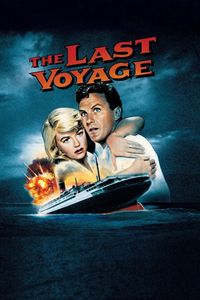
  • The Last Voyage (1960)

    The Last Voyage (1960)

    (On Cable TV, November 2020) It’s fascinating to dig into movie history and find early precursors of later trends. The disaster movie isn’t new and traces back its roots to silent cinema, but the very specific strain of 1970s disaster movies has a clear predecessor in 1960’s The Last Voyage, in which an aging ocean liner suffers catastrophic damage and starts to sink, trapping one of our protagonists under a steel beam. It’s not a perfect example of the form that Airport would formalize a decade later, but it’s close enough. It doesn’t get completely crazy like The Poseidon Adventure, but the intensity of the disaster steadily grows throughout the film—and the end sequence in which the survivors walk, then waddle through a progressively sinking promenade deck is suitably intense, made even more urgent by the very long duration of the shot. Perhaps the best decision made by writer-director Andrew L. Stone was to rely on an actual ocean liner destined for destruction as backdrop for The Last Voyage—the ship feels old and past its glory, making for an interesting change from most ocean disaster films taking place on maiden voyages, and imparting quite a bit of faded golden-age atmosphere to the aged sets. Robert Stack decently plays a father trying to rescue his beam-trapped wife and keep his daughter calm—it’s a prototypical tough guy’s role, and he gets it. Meanwhile, Dorothy Malone does well in a role that has her stuck on the same set for most of the film, eventually with the complication of rapidly rising water. George Sanders is also remarkable as the ship’s captain, whose bad decisions only make a bad situation even worse. The suspense builds up despite being based on very familiar elements, and the colour cinematography helps in making the film feel closer to its 1970s inheritors. The Last Voyage is still a remarkably effective watch, even more so for being somewhat specific in its thrills, and not seeking to overwhelm viewers with a CGI frenzy of exploding stuff.

  • Viaggio in Italia [Journey to Italy] (1954)

    Viaggio in Italia [Journey to Italy] (1954)

    (On Cable TV, September 2020) I’m going to keep this short—writer-director Roberto Rossellini’s Journey to Italy is a good film, maybe even a great one, but not for me. Its depiction of a quarrelling couple well on its way to dissolution is depressing enough (although the film is working toward a better resolution), but the film’s loose, slow, episodic, almost improvisational quality isn’t the kind of thing I go out of my way to see. The black-and-white cinematography often stops the Italian scenery from being as impressive as it should be. I don’t quite dislike Journey to Italy—we get good performances out of Ingrid Bergman and George Sanders, the intrusion of the Vesuvius eruption into the narrative is clever, and there’s a travelogue-to-1950s-Naples quality here that’s interesting. But it’s not the kind of film I get enthusiastic about.

  • Foreign Correspondent (1940)

    Foreign Correspondent (1940)

    (On Cable TV, February 2020) As I make my way down Alfred Hitchcock’s filmography, I’m now way past the classics and into his lower-rated, lesser-known work. Most of the time, I can understand why the work is not included in his highlights—atypical, less mastered, not quite exploiting his own strengths as a director. Foreign Correspondent is recognizably not one of Hitchcock’s best works, but it’s easily in the second tier: suspenseful, thrilling, fast-paced and quite funny at times, it’s recognizably a Hitchcockian film. Following a journalist as he gets embroiled uncovering a spy ring in Europe on the eve of World War II, it’s a one-thrill-after-another suspense film with a romantic component and a striking conclusion. Joel McRae is up to his most likable self as the two-fisted newspaperman, while Laraine Day is lovely and spirited as the love interest (back when Hitchcock didn’t obsess over blondes) and George Sanders is also quite likable as the sidekick to the pair. There are a few centrepiece sequences in here—the much-anthologized “walking through a sea of black umbrellas” sequence shows Hitchcock at his visual best, whereas the final sequence set aboard an airplane brought down over the sea is still hair-raising and a masterpiece of 1940s special effects. The end sequence reminds us that the film belongs to the WW2 propaganda subgenre, with a stirring call to arms delivered in a way that would be echoed in later real-life war broadcasts. Foreign Correspondent remains a pretty good Hitchcockian film—not a classic, but certainly one of his better efforts and one in continuity with his entire filmography.

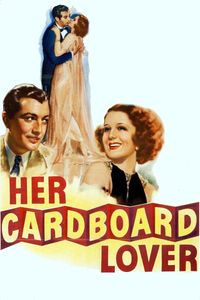
  • Her Cardboard Lover (1942)

    Her Cardboard Lover (1942)

    (On Cable TV, January 2020) Once you’re deep into classic Hollywood movies, you start picking movies for their stars and directors rather than their plot or historical importance. That’s how I ended up watching Her Cardboard Lover, a somewhat forgotten George Cukor film that nonetheless features the ever-cute Norma Shearer playing off George Sanders (in a typically antagonistic role) to the rather likable Robert Taylor. The plot of the film isn’t much to talk about—it’s the old-fashioned formula of one woman using a man to make another jealous. But it’s handled with enough whimsy to make it fun despite the familiarity. Some surprisingly enjoyable dialogue and repartee, especially between Shearer and Taylor, do keep things entertaining during the entire film. The two male leads even get into a very funny fight scene, which is somewhat atypical for the reserved Sanders. We can quibble about the lead female character’s flightiness and her overall romantic suitability when she’s happy to pit two men against each other, but Her Cardboard Special remains a romantic comedy that wraps up nicely—nothing special, but highly enjoyable.

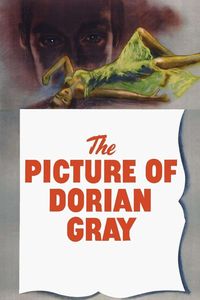
  • The Picture of Dorian Gray (1945)

    The Picture of Dorian Gray (1945)

    (On Cable TV, January 2020) Few things are timeless, but Oscar Wilde’s witty, acerbic dialogue comes close to standing out of time. While all of his bibliography is impressive, The Picture of Dorian Gray still stands among his best-known work given a narrative genre hook that literalizes a metaphor of universal currency. The idea of a portrait that ages while its subject doesn’t is well suited to the medium of film, where screen characters never age even though their actors do. This reflective funhouse mirror is enough to power this 1945 adaptation, which benefits from George Sanders’ snide skills in delivering some of Wilde’s best lines. The story may be familiar, but the execution is rather good. Writer-director Albert Lewin cleverly lets the story play out, but throws in a few shocks by portraying Dorian’s portrait in colour in the middle of a black-and-white film. (The film won an Oscar for cinematography) Wilde’s dialogue is quite good, with enough one-liners here and there to keep everyone happy—it’s a film worth listening to at least once. A very young Angela Lansbury shows up repeatedly crooning “Yellow Little Bird” (charming the first time, a bit annoying the third time). The inclusion of a supernatural explanation is not entirely satisfying, but the rest of The Picture of Dorian Gray happily shrugs off that issue.

  • Ivanhoe (1952)

    Ivanhoe (1952)

    (On Cable TV, November 2019) Technicolor-era historical Hollywood adventures don’t get any more exemplary than Ivanhoe, what with a 19th-century novel being loosely adapted into a Technicolor swashbuckler. It has more than its share of issues, especially from a contemporary perspective, but it also has quite a bit of charm. Robert Taylor and Joan Fontaine may star as the lead couple, but modern viewers may be forgiven for only having eyes for Elizabeth Taylor in an early yet striking supporting role. George Sanders is also up to his usual standards playing a villain. Otherwise, the rest of the film is a succession of sex appeal, sword fights, medieval jousts, and arena combat as a climactic bow. Ivanhoe is not to be trusted as a historical document, but it’s not a bad way to spend nearly two hours—the film is easy to take in, the hero is interesting (even a bit devious in his combat style), Taylor is luminous and it all builds to an effective action sequence in a film that has a few of them. As a competent Hollywood rendition of medieval adventure, Ivanhoe was nominated for three Academy Awards back then (including Best Picture) and you can see why it was both a commercial and critical success. This less-usual take on the Robin Hood legend is quite intentional, and it prefigures other films in that vein.

  • From the Earth to the Moon (1958)

    From the Earth to the Moon (1958)

    (On Cable TV, August 2019) Oh, what a terrible, terrible disappointment. I should probably come clean right away and admit that Jules Verne’s De la Terre à la Lune is one of my favourite novels. I must have re-read it three or four times at a decade’s interval (which reminds me that I’m overdue for another reread)—a childhood favourite that still works in adulthood due to its mixture of clipped humour and engineering details. In the right hands, it would make a fantastic movie. But From the Earth to the Moon director Byron Haskin did not have the right hands, or if he did, he wasn’t given what was necessary to do the novel justice. My disappointment is so acute that I’m not going to get into the details, but this 1958 version of the story is a dismal shadow of its true potential. It removes the fun and the spectacle of the original novel and replaces it with clichés and bad ideas. Getting rid of Michel Ardan is inexplicable given the theatricality of the character. Inventing “Power X” and cheaply demonstrating it in a boring quarry is a terrible idea. Adding an antagonist is useless. Screwing up the novel’s third act is a travesty. And so on. I’m usually tolerant when it comes to film adaptations and older movies but this is not acceptable. What a waste and what a disappointment. Too bad for George Sanders and Joseph Cotton, who usually do much better. From the Earth to the Moon is not even enjoyable on its own terms, let alone as an adaptation.

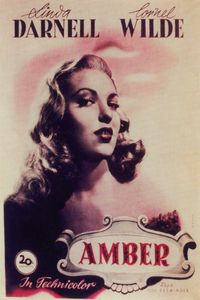
  • Forever Amber (1947)

    Forever Amber (1947)

    (On Cable TV, March 2019) Historically, Forever Amber was the anticipated Great Blockbuster of its time. Billed as the next Gone with the Wind, adapted from a salacious blockbuster, showcasing actors that the studio was grooming for stardom, it was Fox’s most expensive film at the time … something not help by a troubled production that saw incredible delays, director Otto Preminger taking over the ongoing shoot, and multiple actors (including its female lead) replaced midway through. It set opening week box-office records, although the overall returns for the film remained in the red due to the very high budget. All of this is immaterial to modern viewers encountering the movie absent from its production context. Fortunately, enough of the budget still shows up on the screen to impress. As a costume drama cranked to ten, Forever Amber benefits from its lavish colour cinematography, amazing costumes and a lead actress, Linda Darnell, who looks amazing in red hair and very detailed dresses. The stylized nature of the film, set in late 17th century England, helps it age gracefully as a historical recreation (albeit filtered through the lenses of the 1940s). George Sanders is also remarkable as Charles II. Plot-wise, the film isn’t quite as impressive: the melodrama is extreme (a lot of people die, all things considered), although the amount of not-so-softened sexual content is surprising coming from a film of its time—but it does make the film feel more modern than it is. (A curious facet of the Production Code years is that filmmakers could get away with more risqué material if they were adapting a best-selling novel.) The plot, as per the original book, is not meant to end well. Still, Forever Amber remains an impressive spectacle if you like costume dramas and enjoy the kind of overwrought style of Golden-age Hollywood.

  • Village of the Damned (1960)

    Village of the Damned (1960)

    (On Cable TV, October 2018) Most movies that start with a great premise don’t manage to live up to their roaring start, and while that’s largely true to Village of the Damned (which is quite clearly separated in two sections), both the beginning and the end of the movie manage to be effective in their own way. As the story begins, an entire English village falls unconscious at once, and any attempt to enter the perimeter around the village leads to the valiant explorers also falling down unconscious. The government grows concerned as the hours add up. The mystery remains intact once the villagers wake up and the perimeter is lifted … especially, months later, when it turns out that most women of childbearing age in the village are now pregnant. Fast forward a few years, and the mysterious brood decidedly isn’t acting normal, what with their uniformly blonde hair, detached affect and supernatural powers. As the evidence accumulates that these kids aren’t all right, it’s up to the village professor (George Sanders, in a somewhat atypical but welcome heroic role) to take action … even when the kids can read his mind. The climax is still remarkably effective even with somewhat primitive techniques. Admirably short at 77 minutes, Village of the Damned remains resolutely low-key in its effects and setting—the result is all the more effective as a demonstration of what’s possible with limited means and a few good ideas. After all, creepy kids remain creepy no matter the decade they’re seen in.

  • All about Eve (1950)

    All about Eve (1950)

    (On Cable TV, March 2018) There’s a deliciously impish quality to All about Eve that becomes apparent only a few moments in the movie, and remains the film’s best quality throughout. It’s a cynical look at showbusiness, triangulated between actors, writers and critics. Writer/director Joseph L. Mankiewicz can use rich material in his exploration of the dirty side of theatrical showbusiness, and his actors, in-between Bette Davis, Anne Baxter and George Sanders, are all up to the challenges of his vision. (Plus, a small role for Marilyn Monroe.)  All about Eve has a lot to say about fame, acting, age and even a touch of closeted homosexuality. It does so with considerable wit—the film is good throughout, but it improves sharply whenever George Sanders shows up as a waspy critic acting as an impish narrator. The film still plays exceptionally well today: showbusiness hasn’t changed much, and much of the film doesn’t deal in easily dated artifacts … although some of the social conventions have thankfully moved on. A bit like contemporary Sunset Blvd, All about Eve is a film built on wit and a great script, so it’s no surprise that it would stay so engaging sixty-five years later.