Glenn Ford

  • Human Desire (1954)

    (On Cable TV, September 2021) Fritz Lang directed what seems like a dozen film noirs and I’m slowly making my way through them. Human Desire is roughly up to the quality level of his other ones. It certainly plays with some of the big guns of the genre: a dangerous psychopath (Broderick Crawford in fine gruff form), a hero who struggles with temptation (Glenn Ford, bland but likable) and the femme fatale who orchestrates mayhem to her benefit (Gloria Graham, quite good). The stylistic interest of the film largely comes from a focus on railroads and trains that provide much of the visual and auditory motifs. There aren’t many wholesome characters to be found here, but in-keeping with noir standards, that’s the way we like it. Much of the rest is about as bland as the title. Human Desire is not necessarily a great noir, but it is a representative one — clearly in that tradition and satisfying to those who like the subgenre.

  • Blackboard Jungle (1955)

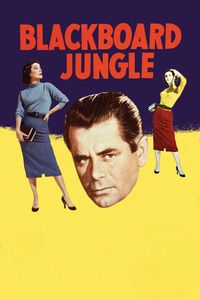
    Blackboard Jungle (1955)

    (On Cable TV, June 2021) I stand corrected — for as long as there’s been a definition of the teenager in the postwar economic boom, there have been movies about teenage delinquency and its obvious counterpart, the inspiring teacher film. Blackboard Jungle is part of that first cohort of movies warning parents about the teenage threat lurking at home and delighting teenagers who realized what they were capable of doing. On the one hand, it’s undoubtedly a film of its time in its period depiction of a tough New York City school, its teenaged hoodlums and the righteousness of its protagonist (Glenn Ford, quite likable) in trying to save the worthy kids and expel the bad ones. At the same time, there’s also a timeless quality to the hostility that the teacher faces from the students, the ways he tries to reach them through their façade, and the power plays going on in a class of many different students. It’s even surprisingly modern in depicting how teachers react to the constant stress of a confrontational classroom, the way third-parties can be harassed and how public comments can be twisted to discredit someone. Socially engaged, Blackboard Jungle works itself up to a gripping climax as a classroom lesson escalates to a knife fight between an incorrigible bad apple and a teacher who has decided he’s got nothing left to lose. Also notable for introducing the use of a pop song as the main theme (the all-time classic “Rock Around the Clock”), and one of Sydney Poitier’s early roles — in which he predictably excels. (He’d play the flip side of the student/teacher divide twelve years later in To Sir, With Love.)  Contemporary commentary on Blackboard Jungle shows how much the film pushed the envelope at the time, and how the studio took political hits for it. But at the same time, it’s a film that suggests what could have been had Hollywood had been just a bit more willing to engage with social issues at a crucial time, and what would have happened if the Hays Code had disappeared even a decade earlier.

  • The Gazebo (1959)

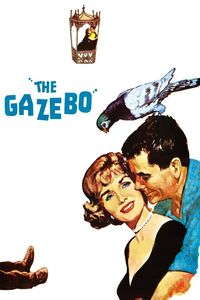
    The Gazebo (1959)

    (On Cable TV, May 2021) As far as late-1950s comedies go, The Gazebo is markedly darker than you’d expect — especially as it begins with a murder plot to ensure that the protagonist’s wife isn’t embarrassed by the release of nude pictures. That’s right — the hero shoots down a bad guy and spends the rest of the film trying to prevent events from further getting out of control. Glenn Ford plays the harried husband killing to protect his wife’s honour (especially considering that she’s played by Debbie Reynolds), but the script is aligned in his favour, as all the people harmed during the course of the film definitely deserved it. Amusing without necessarily being all that funny, The Gazebo arguably plays better when viewed alongside more serious criminal fare of the era — Alfred Hitchcock gets name-checked (indeed, there are similarities here with his The Trouble with Harry, since playwright Alec Coppel contributed The Gazebo’s original story to and handled screenwriting duties on Vertigo) and you can see the film as a slight film noir parody (albeit in colour and in a small town, so not really all that much). It’s not mandatory viewing, but it’s certainly watchable and even more so if you’re familiar with 1950s thrillers. The Gazebo’s got a bit more bite than other movies of the era, as the dark comedy it features would become more prevalent later on. But keep your expectations in check.

  • Pocketful of Miracles (1961)

    Pocketful of Miracles (1961)

    (On Cable TV, December 2020) I’ll go easy on remakes if the director of the original is the one remaking it, and here we have Pocketful of Miracles, Frank Capra’s remake of his own 1933 romantic comedy Lady for a Day. The story of a mob boss transforming a street vendor into a society madam for the purpose of impressing her marrying daughter remains the same, but some aspects of the film have been upgraded – the colour cinematography is easier to take in for modern audiences, and the camera has a greater degree of freedom here than in the early 1930s. The acting talent here is also quite a bit better: It’s hard to argue against Bette Davis as the Pollyannaed street vendor, and the cast (which also had Glenn Ford and then-girlfriend Hope Lange) includes an early appearance by Peter Falk and a screen debut for Ann-Margret as the vendor’s daughter. Still, it’s not hard to prefer the original version: Capra’s early enthusiasm is not reflected in the more workmanlike execution of the remake (which would end up being his last film) and the story, even as a conscious 1930s period piece, seems to fit more closely in Depression-era America than the early-1960s. This remake is also far too long for its own good at a staggering 137 minutes. Still, if that’s going to be Capra’s swan song, then it’s not a bad one: Pocketful of Miracles still manages to exhibit the writer-director’s faith in the ordinary Americans and his compassionate touch.

  • Torpedo Run (1958)

    Torpedo Run (1958)

    (On Cable TV, November 2020) As far as submarine movies go, Torpedo Run is slightly more melodramatic than most, harping on revenge through a WW2 submarine captain (Glenn Ford) explicitly gunning for the ship responsible for the death of his wife and children. The audience stand-in is his lieutenant, played by Ernest Borgnine, as he voices the doubts that the audience may be having as to his suitability for a task of such personal gravity. While this element drives Torpedo Run’s plot, much of the film itself is a fairly standard submarine film—executed with the cooperation of the US Navy and executed through then state-of-the-art special effects (nominated for an Academy Award). The mechanics of WW2 submarine life take a bit of a backseat to the drama, but this is otherwise an average war film, competently executed but overly familiar at times. Thematically, it still feels like a WW2 propaganda film even a decade and a half later—the personal vengeance is atypical (and would not have flown as a movie premise during WW2) but dovetails into the government’s war agenda, and the crimes of the enemies include shielding a warship with a transport filled by non-combatant prisoners of war. Ford and Borgnine do bring a bit of character work to the proceedings, and fans of the actors should be pleased by their performances. Otherwise, Torpedo Run ends up being a decent but unspectacular WW2 submarine movie—better than bad, more dramatic than most, but not as striking as others.

  • A Stolen Life (1946)

    A Stolen Life (1946)

    (On Cable TV, October 2020) All Bette Davis fans get twice as much for their money in A Stolen Life, considering that Davis here plays twins—a shy quiet artist and a gold-digging firebrand. The sisters don’t get along in the first place, but things get even worse with the shy one falls for a man, and the gold-digger moves in to steal the new guy. The film’s title finds its meaning when a horrible accident kills one sister and allows the second one to step into the other one’s life. As a romantic melodrama, it’s not bad—mostly thanks to Davis acting up a storm for two. In comparison, Glenn Ford merely does fine as the third point in this love triangle. The special effects really aren’t bad at all for a mid-1940s film. The narrative is a bit less impressive, though: Some subplots don’t go anywhere, and the ending is a drawn-out affair. Still, if you’re willing to swallow a few implausibilities, then A Stolen Life is quite entertaining. Davis apparently liked playing herself twice because she did so again twenty years later in Dead Ringer.

  • 3:10 to Yuma (1957)

    3:10 to Yuma (1957)

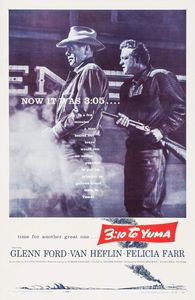
    (On Cable TV, February 2020) There aren’t that many westerns that could be adapted as one-room theatrical production, but 3:10 to Yuma fits the bill. While the film’s first half is filled with the usual Western thrills, the film finds its true purpose as two men—a criminal and an everyman—settle down in a hotel room while waiting for the train that will escort the criminal to jail, away from a small town. They talk, argue, and try to convince the other of their viewpoint and hash out other things in-between four walls. It’s not strictly a conceptual piece—there’s too much time spent outside that room—but it’s an unusual focus on a single location for a long time. The black-and-white cinematography is quite good and so is the period recreation. Still, it’s the verbal confrontation that sticks in mind at the end of the film, far more than the usual Western shootouts. Glenn Ford does well in an out-of-persona role as the villain—it’s true that the film needed an almost-heroic figure as its antagonist for his charm to have any meaning. Clean, simple and effective, 3:10 to Yuma remains a decent western even a few decades later — and a 2007 remake, executed in maximalist fashion but decent in its own right.

  • The Big Heat (1953)

    The Big Heat (1953)

    (On Cable TV, February 2020) At first, I couldn’t quite see in The Big Heat why it has earned such high regard as a film noir. I mean—sure, the film opens with a murder, and there’s a cute barfly dame being antagonistic toward our protagonist… but what about that protagonist? A veteran policeman, a solid husband with a loving wife, a wonderful little girl and a happy middle-class life? Where was the real noir? I shouldn’t have asked (or should have guessed that the happy home life only highlighted what he had to lose), because by the middle of the movie the plot explodes all domestic bliss, turning our protagonist into a vengeful rogue with a gun and no badge to stop him. The barfly is dead, and an even more dangerous woman enters the picture, her face half-scarred from burns. That’s the point where The Big Heat becomes noir, turning into a two-fisted anti-corruption tale that’s well handled through unobtrusive direction by Fritz Lang. It gets noirer the longer it goes on, culminating in an action-filled climax where all the pieces have a role to play. Glenn Ford is simply perfect as the lead character, with some able support from Gloria Grahame as a vengeful moll and Lee Marvin as the Big Boss. While the story clearly harms its protagonist, the ending offers a semi-unusual return to normalcy for him as he picks up the badge again. Noir rarely allows for the possibility of it being a detour into madness, but The Big Heat was a late-period entry in the genre, and remains successful largely because it does not clearly begin nor end in typical fashion.

  • The Four Horsemen of the Apocalypse (1962)

    The Four Horsemen of the Apocalypse (1962)

    (On Cable TV, August 2019) Sometimes, the best-intentioned projects mutate into a monstrous parody of themselves, and we know this about the 1962 version of The Four Horsemen of the Apocalypse because there is another version to compare it to: The 1920s original version of The Four Horsemen of the Apocalypse. In this case, we can see the worthwhile intention in updating a WW1 story about a family torn by war to a post-WW2 setting. Director Vincente Minnelli, already familiar with the logistical demands of musical movies, should have been an ideal taskmaster for a sweeping multi-year epic involving a large family over two continents. And yet, watching the remake of The Four Horsemen of the Apocalypse, the entire thing falls flat. As satisfying as it can be to see Nazis getting what they deserve, whether it’s a slap or a bullet, there’s not a whole lot to the film. Much of it seems to be discussions rather than actions, weighed down by interminable dialogues. Sure, it’s great to have Glenn Ford here, except that neither the role nor the style of the film does him many favours. The sets are fantastic, mind you—but there’s a strange detachment to the entire film, as if it was consciously holding back from getting into the thick of the action. At least Yvette Mimieux is there to add some interest: her character is the best that the film has to offer. The rest is ponderous, slow, far too well-mannered even for an expensive early-1960s colour production. Historically, The Four Horsemen of the Apocalypse is often remembered for having been one of the films (along with a colour remake of Cimarron which was actually decent enough) that hastened MGM’s decline into the 1960s. That’s a far heavier burden that this disappointing film should bear, but you can see in it the Hollywood studio malaise that was starting to exasperate moviegoers in the 1960s and would later lead to the rejuvenated New Hollywood.

  • Cimarron (1960)

    Cimarron (1960)

    (On Cable TV, July 2019) The original 1931 Cimarron is sometimes held up as one of the worst Best Movie Oscar-winners, and that’s both untrue and unfair—while the plot is scattered, it does begin with the anthology-worthy Oklahoma Land Rush sequence, grandiose and spectacular. Since the 1960 remake of Cimarron doesn’t have the Oscar-winning pedigree of the original, I watched it with an overriding curiosity—would it manage to top the original’s Land Rush sequence? Would it fix the original film’s third-act plot problems? It begins unpromisingly, spending too much time setting up its characters prior to the Land Rush. But the showcase Land Rush caps off the first act and present a credible colourful recreation of the event, complete with hundreds of horses and carriage wagons crossing the frontier in a mad dash. Many bone-crushing accidents quickly follow. Much of the original plot remains intact, save for a good number of improvements to the characterization and what feels like a snappier pacing. Alas, Cimarron—once again—seems overpowered by its charismatic male lead, here played by Glenn Ford. Ford’s character is likable, decisive, admirable … and completely steals the spotlight away from Maria Schell’s character, which is too bad because, as in the 1933 film, her character is the film’s protagonist as her husband increasingly disappears from the story, leaving her to pick up the task of colonizing the west. This remake does improve upon the original in several ways—including a far more nuanced portrait of Native Americans, a much better visual portrayal of a city’s development over twenty-five years, and a more satisfying end for the hero—but it does remain in the same generally unsatisfying league, somehow missing the extra spark that could have made the movie that much better. The problem may be a far too slavish attitude toward the original material, which doesn’t quite work as-is on-screen. No matter the reason, this Cimarron is, by virtue of colour cinematography and a snappier pacing, a bit more accessible than the original … but it could have been quite a bit better.
  • Gilda (1946)

    Gilda (1946)

    (On Cable TV, March 2019) Even after watching film noir movies for years, I’m still not all that sure about an exact definition for the subgenre. But that’s not a problem—far smarter people than me have also thrown up their hands in surrender at trying to provide a specific formula for noir/not-noir. The best I can do it to follow the crowd and ask myself: does it feel like noir? It doesn’t necessarily have to have Private Investigators chasing down criminals in American metropolises—in Gilda for instance, we find ourselves in South America, largely within a casino/mansion where an American expatriate gets involved with the casino owner and his new wife—who turns out to be an old flame. Add in a few German criminals, crunchy narration, some smouldering musical performances, gambling, a faked death, beat downs and a strong romantic antagonism and you’ve got quite a noir stew going on. The spectacular love-hate dialogue between the film’s two main characters is particularly successful, complemented by very good cinematography, lush when it needs to (such as the carnival scene) and visually complex throughout. Rita Hayworth gets the femme fatale thing down, not so much by gunning down male characters but by playing the dark bombshell to the limit—we even get her singing “Put the Blame on Mame” twice—once with her voice, the other with her entire body. It helps that her character is fiery, strong and an equal partner to Glenn Ford, who does well in a budding hustler role. But this is Hayworth’s movie—she easily outshines even the evocative South American casino setting. Gilda may not check all of the boxes of the traditional film noir, but it does so well on those checked boxes that it leaves quite an impression.