Gloria Grahame

  • The Glass Wall (1953)

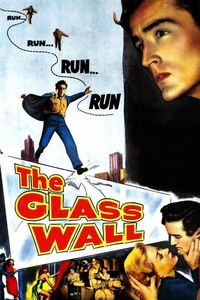
    The Glass Wall (1953)

    (On Cable TV, October 2021) While shown on TCM as part of their film noir showcase, I’m more likely to think of The Glass Wall as an immigration drama with a thriller edge. It begins as a Hungarian refugee is denied entry in New York City—despite being eligible for entry for having helped an American soldier during WW2. His deportation being imminent, he takes a chance and sneaks into the city to find the soldier he helped, hoping he may be able to help him establish his legitimate reason for claiming asylum. It does not go smoothly—a trip to Times Square to find his clarinet-playing friend in jazz clubs is complicated by run-ins with various people and an internal injury. Gloria Grahame plays the woman he befriends along the way. There’s some definite tension in trying to find his friend before the police find him, and the escalating level of despair he manifests. As the film goes on, it also becomes far more earnest about the plight of refugees—all the way to walking inside the then-new United Nations building (the titular Glass Wall) to address an empty room. It’s a bit much, but at the same time it clearly states the objectives of the film. The Glass Wall wraps up as a tight 80-minute thriller with a better-than-average social conscience, with some interesting 1950s NYC scenery along the way.

  • The Cobweb (1955)

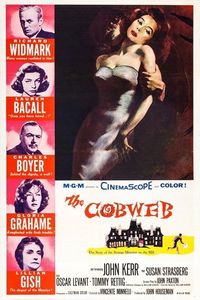
    The Cobweb (1955)

    (On Cable TV, September 2021) Unlike many other psychiatric institution movies, The Cobweb isn’t solely concerned about the therapy of its residents. Oh no — this film is about nearly everyone involved with the institution — patients, doctors, administrators and their spouses, as a question of drapes manages to ignite a near-vicious power struggle for the well-being of the institution. (The film is bookended by two title cards: “The trouble began” and “The trouble was over.”)  Richard Widmark stars as a workaholic doctor who gets involved in the trouble, and has to juggle patients, faculty infighting and marital troubles. The supporting cast is probably more interesting than you’d expect, what with the ever-beautiful Lauren Bacall and Gloria Grahame, a matronly Lilian Gish as well as an Oscar Levant as a patient. (Legend has it that Levant was incredibly difficult to work with, which feels entirely unsurprising.)  The Cobweb isn’t exactly a high-octane film — for all of the strife that it works toward, it all feels mild-mannered, even academic. Levant is underused in a role unusually close to his persona, while Bacall doesn’t have all that much to do either. Still, the film does offer a glimpse into mid-century mental health attitudes without quite delving into the usual clichés of the genre. It’s not that good but not that unbearable either, although careful viewing is required to remain invested in the ongoing story before it heats up to serious drama.

  • The Big Heat (1953)

    The Big Heat (1953)

    (On Cable TV, February 2020) At first, I couldn’t quite see in The Big Heat why it has earned such high regard as a film noir. I mean—sure, the film opens with a murder, and there’s a cute barfly dame being antagonistic toward our protagonist… but what about that protagonist? A veteran policeman, a solid husband with a loving wife, a wonderful little girl and a happy middle-class life? Where was the real noir? I shouldn’t have asked (or should have guessed that the happy home life only highlighted what he had to lose), because by the middle of the movie the plot explodes all domestic bliss, turning our protagonist into a vengeful rogue with a gun and no badge to stop him. The barfly is dead, and an even more dangerous woman enters the picture, her face half-scarred from burns. That’s the point where The Big Heat becomes noir, turning into a two-fisted anti-corruption tale that’s well handled through unobtrusive direction by Fritz Lang. It gets noirer the longer it goes on, culminating in an action-filled climax where all the pieces have a role to play. Glenn Ford is simply perfect as the lead character, with some able support from Gloria Grahame as a vengeful moll and Lee Marvin as the Big Boss. While the story clearly harms its protagonist, the ending offers a semi-unusual return to normalcy for him as he picks up the badge again. Noir rarely allows for the possibility of it being a detour into madness, but The Big Heat was a late-period entry in the genre, and remains successful largely because it does not clearly begin nor end in typical fashion.

  • The Bad and the Beautiful (1952)

    The Bad and the Beautiful (1952)

    (On Cable TV, August 2019) In the pantheon of Hollywood movies about Hollywood, The Bad and the Beautiful still stands tall as being emblematic of its era, right before the weight of studio producers crumbled before television, antitrust legislation, and the end of exclusive studio contracts. Kirk Douglas is in fine form as a movie mogul with numerous enemies, bringing three of them together so that he can convince them to work on his next project. But it’s a framing device, as the producer recalls his history with each one of his three listeners, leading to three shorter related stories about a director, a star and a writer. In each case, the protagonist plays the spoiler, pushing them to further heights even as he (as they put it) ruins their lives. As a way to take a multifaceted look at the way Hollywood worked up to that point, The Bad and the Beautiful is ingenious—it takes us in three different sub-worlds of Hollywood, loosely linked together. The tone is strictly melodramatic, which does add to the period charm. Douglas plays a magnificent bastard here, willing to sacrifice relationships in order to make movies … and then get the band back together. As befit a framing device holding together three shorter films, the ending is a bit weak, but that’s fine: this is very much a journey-is-the-destination film where the climax is less important than the scenes leading to it. At this point in time, it almost feels like comfort viewing—a paean to a lost Hollywood, but whose echoes can still be felt today.

    (Second viewing, Streaming, May 2025) Every year, I learn a little bit more about Classic Hollywood, and that in turn changes the experience of re-watching the films of that era.  A second looks at The Bad and the Beautiful is not quite the same.  Sure, Kirk Douglas is just as impressive as a life-altering studio mogul — but this time around, I get to appreciate Dick Powell in a later-career role unlike his earlier turns.  I get to take in Gloria Grahame’s short but striking role a Southern belle that the script heartlessly dispatches as being a distraction from creativity.  (Lana Turner is top-billed, but Graham, and to a lesser extent, Elaine Stewart, make more of an impression in a shorter time.)  I get to chuckle at the nod to Val Lewton’s Cat People, and revel in the glimpses of classic-era film-making.  There are quite a few touches of wit in director Vincente Minnelli’s direction, working with the script to punch-up some fake-outs (“It stinks!”) and amusing reveals (such as the pool dip).  Sure, The Bad and the Beautiful is melodramatic, uncomfortably dissonant with modern values, and perhaps too much in love with Classic Hollywood to deliver an honest conclusion.  But it’s fun, witty, an utterly splendid illustration of a specific era in film history, and a pretty good acting showcase.  It stands on its own as a story, but it becomes greater when measured against its era.