Ingrid Bergman

  • From the Mixed-Up Files of Mrs. Basil E. Frankweiler aka The Hideaways (1973)

    From the Mixed-Up Files of Mrs. Basil E. Frankweiler aka The Hideaways (1973)

    (On Cable TV, December 2021) The first hour of The Hideaways is borderline exasperating, as the film takes up the twee story of a boy and a girl escaping from their small town to hide in the Metropolitan Museum of Art. It’s the kind of precocious claptrap that, for some reason, rubs me the wrong way — and since some of the worst examples of the subgenre date from the 1970s, the film seemed built to annoy from the get-go. Things pick up slightly once the two kid protagonists discover a statue in the stockrooms of the museum that may be worth a small fortune. The two kids become obsessed with proving the value of the statue, which eventually brings them to the house of an elderly woman, and viewers to the far more interesting third act of the film. The Hideaways significantly improves the moment Ingrid Bergman walks into the picture, bringing not only her usual charm, beauty and class, but the film’s most interesting character in the form of an older woman with a secret. Her character eventually lays down the film’s most interesting philosophical point about knowing a secret and eventually revealing it. That comes too late in The Hideaways to save it from an overall bad impression, but it does rescue it from complete worthlessness.

  • Adam Had Four Sons (1941)

    (On Cable TV, December 2021) No one will ever mistake Adam Had Four Sons for anything but the straight-up domestic romantic thriller it aimed for — with a lovely governess (Ingrid Bergman, looking gorgeous) filling in for a dead mother and sniffing out a gold-digging harridan putting her claws into an easily flummoxed son. The story stretches over a few years, although much of the second and third act settles down in a shorter period after an extended opening featuring a great-looking Fay Wray as the soon-to-be-deceased mother. Then Susan Hayward takes centre stage as the adulterous, deceiving, booze-swilling, money-grubbing outsider who comes to steal the family fortune and seduce whoever she can to fulfill her role. (Meanwhile, our heroine is utterly chaste — but she does, as expected, ends up with the family patriarch once everything has been cleared up. The three lead actresses are unusually attractive here, but even that doesn’t do much to make up for the rather obvious script. This being said, there’s still some fun to be had even when knowing where it’s going: Hayward is deliciously evil here, and anticipating the melodramatic (melodomestic?) plot beats is almost as much fun as being surprised. Adam Had Four Sons is all rather pleasant in the end, with the bonus of seeing Bergman in an early Hollywood role—playing a Frenchwoman!

  • Designing Woman (1957)

    (On Cable TV, September 2021) At this point of my cinephile journey, I’ve seen the landmark movies, the classics, and the box-office sensations. All that’s left is a deeper and more scattered journey through the rest. That’s not necessarily a bad thing: “the rest” includes a number of solid commercial and critical successes that many people have enjoyed, even if they haven’t necessarily remained references throughout the decades. From time to time, you even get something that’s a lot of fun. Such is the case with Designing Woman, a cleverly subversive romantic comedy that pokes at 1950s clichés and offers enjoyable second-tier performances by a well-known cast. In this case, we have Gregory Peck and Ingrid Bergman (stepping in for, we’re told, Cary Grant and Grace Kelly — a downgrade for Grant-to-Peck, but an improvement for Kelly-to-Bergman) as a sports writer who meets an alluring woman while covering a golf tournament in California. They get married within a week (as often happens in classic Hollywood) only to then discover upon returning to New York City who they are. Or, crucially, that she’s a fashion designer with more money, class, clout and well-connected friends than he does. The resulting loss of panache from the male protagonist is very amusing, and the rift only gets bigger once they start entertaining their respective circles of friends (his: working-class schlubs; hers; insanely well-connected artists) in her (now their) apartment. That’s more than enough to fuel the first half of the film—the rest is taken up with old flames and threats from mobsters that have him lie and flee to protect her, and her suspecting the worst from his lies and his disappearance. Director Vincente Minelli can’t quite manage to make the second half as convincing and amusing as the first (especially with an ending that’s too abrupt to be satisfactory), but the entire film does work quite well. Peck sells the undermining of masculinity in hilarious fashion, while Bergman is an icon of elegance throughout. The framing device of “talking” to the characters after the fact does add a bit more comedy and suspense to the story, further showing that this was a film with clear and bold intentions. In other words, Designing Women is worth recommending — it’s another proof that the 1950s were far more self-critical than we think, and a great example of a Technicolor romantic comedy with more bite than expected.

  • Rage in Heaven (1941)

    Rage in Heaven (1941)

    (On Cable TV, February 2021) You can argue that Rage in Heaven is a film noir, but I see just as much kinship here with the domestic thriller subgenre of the 1940s, especially as a woman gets frightened by an increasingly unstable husband. But there’s more — a framing device that takes us to a French mental hospital, a subplot involving a family steel mill and a third act that’s all about a psychopath framing his romantic rival even in death. It’s a lot of stuff to fit in 85 minutes, and what holds the film together is more the casting than the plot. It’s tough to resist any 1940s film with Ingrid Bergman, and Rage in Heaven does pair her with a rather rare good-guy turn from George Saunders, while Robert Montgomery is a bit of an odd fit as an insanely jealous psychopath. The plot is lurid enough to be entertaining — but it’s not credible and that does harm the result. While Rage in Heaven is interesting enough, it’s a scattered film and one that probably should have been tightened up in production, or reworked entirely.

  • Indiscreet (1958)

    Indiscreet (1958)

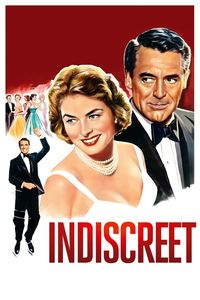
    (On Cable TV, February 2021) There’s a freshness of approach in Indiscreet that makes it one of Cary Grant’s most satisfying late-career films. At the time, the fifty-something Grant was branching out in producing his own films, and starting to struggle with the growing age gulf between him and his on-screen love interests. What makes Indiscreet special in the middle of such films as Houseboat and Charade is that it’s a romance between two middle-aged protagonists —and an age difference of merely eleven years between Grant and co-star Ingrid Bergman, practically insignificant by Hollywood standards. (By comparison, Grant/Hepburn was fourteen years, Grant/Day was seventeen years, and Grant/Loren was twenty years —not that they all played their age.)  This meeting-of-equals of the characters (him a respected economist, her a well-known actress) gives Indiscreet a level of maturity not often seen in romantic comedies of the time, as both of them have ghosts to exorcise before committing to each other. To be fair, I found Indiscreet’s first half more classically interesting than the second — the process in which both characters cautiously choose to enter a relationship and have fun in its early days (all the way to a synchronized split-screen scene, said to be the first film to do so) is more interesting than the increasingly contrived complications keeping them apart in the second half. Grant is his usual smooth self here, with Bergman looking as radiant as she usually does. As directed by Stanley Donen, the film is a bit lighter on laughs than you’d maybe expect, but it remains mostly lighthearted throughout, as the obvious exception of the climactic sequence in which everything seems lost (but isn’t). Indiscreet remains a good example of how polished the Cary Grant persona was at that point of his career (he simply has to appear for the characters to go “wow!”), and without the lingering problematic implications of him being involved with much younger co-stars.

  • Höstsonaten [Autumn Sonata] (1978)

    Höstsonaten [Autumn Sonata] (1978)

    (On Cable TV, November 2020) The paradox with Ingrid Bergman’s film is that I usually don’t like them very much, but I can usually find in them one or two things worth being impressed about. Autumn Sonata begins on what feels like a high note to me, as a narrator walks into frame and gestures at the protagonist he’s introducing—his wife, as played by the very cute Liv Ullmann in round glasses. But the best is yet to come, as the film takes care to build up the introduction of its other main character—her mother, as played by Ingrid Bergman (making this the only Bergman-Bergman film). She has come to visit to go over some old family tensions, and much of the film can be experienced as a steady ratcheting of tension until the spectacular make-no-prisoners verbal showdown between the two women, as they go over the mom’s neglect of her children, and the daughter’s feelings of inferiority when measured against the world-class renown of her mother. (Our narrator hears it all, but wisely steps away rather than intervene.) There are echoes of other Bergman movies here, as well as a number of his more annoying tendencies, but the film holds up for those moments of pure dramatic intensity between Bergman and Ullmann, with a too-long epilogue to wrap things up. I’m only watching Bergman movies because they keep popping up on best-of lists, but as far as these go, Autumn Sonata is more interesting than many others.

  • Viaggio in Italia [Journey to Italy] (1954)

    Viaggio in Italia [Journey to Italy] (1954)

    (On Cable TV, September 2020) I’m going to keep this short—writer-director Roberto Rossellini’s Journey to Italy is a good film, maybe even a great one, but not for me. Its depiction of a quarrelling couple well on its way to dissolution is depressing enough (although the film is working toward a better resolution), but the film’s loose, slow, episodic, almost improvisational quality isn’t the kind of thing I go out of my way to see. The black-and-white cinematography often stops the Italian scenery from being as impressive as it should be. I don’t quite dislike Journey to Italy—we get good performances out of Ingrid Bergman and George Sanders, the intrusion of the Vesuvius eruption into the narrative is clever, and there’s a travelogue-to-1950s-Naples quality here that’s interesting. But it’s not the kind of film I get enthusiastic about.

  • The Yellow Rolls-Royce (1964)

    The Yellow Rolls-Royce (1964)

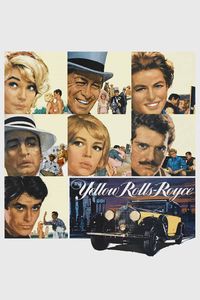
    (On Cable TV, September 2020) There are two ways of making a movie about an inanimate object, and The Yellow Rolls-Royce has picked the worst one. The best way is to depict the object as a character that has a beginning and an end, with several related trials along the way—it gets purchased, used, damaged, repaired, liked, lost, etc. The second way is far looser and consists in loosely stringing a few unconnected stories that all happen to feature the object. The Yellow Rolls-Royce would have been a lovely excuse for a multi-decade story about a car. Unfortunately, it ends up being the common thread between unconnected stories, taking us from the English aristocracy to a vacationing mobster and his moll, to revolutionaries in Nazi-occupied Yugoslavia. There is very little connective tissue nor progression between the three stories, which appears to be excuses to get as many stars in the film. To be fair, the cast is quite good: Rex Harrison and Jeanne Moreau get the ball rolling, as the Yellow Rolls-Royce is purchased by a pompous English aristocrat as a birthday gift for his wife. George C. Scott, Shirley MacLaine and Alain Delon push the ball even further in Venice, as romantic shenanigans complicate a summer holiday. Finally, the film hits its stride alongside Ingrid Bergman and Omar Sharif as she, a rich American widow, helps him, a resistance fighter, cross a national border and fight the Nazis. The Yellow Rolls-Royce can be worth a look if you’re a fan of these actors, or if you choose to focus on the third story and the very beginning of the first. Otherwise, it does feel like a disappointing mishandling of a potent premise. Too bad—I’m sure there’s still a heck of a movie to be told about the life of a car.

  • Cactus Flower (1969)

    Cactus Flower (1969)

    (On Cable TV, June 2020) The one thing that holds together the somewhat bland romantic comedy Cactus Flower is a fascinating trio of actors from very different eras of cinema—Ingrid Bergman, Walter Matthau, and Goldie Hawn in her first big-screen lead role. It’s quite a cast, and the film around them never quite reaches the potential of that trio. The story is a bit of a jumble, but largely about a dentist (Matthau) who keeps pretending he has a wife to avoid commitment in his affairs, except when he falls for a record-store clerk (Hawn) and has to find a pretend wife (Bergman) in a hurry to keep control over the affair. While the cast is amazing, the casting is more disputable—Matthau as a playboy is something I’ll shrug over, while Bergman may not be the most obvious pick as a screwball lead. Hawn does very well, though (she won an Oscar for it), fully capturing the hip 1969 Manhattan vibe that the film is aiming for—the extended sequence in a music store will delight who considers movies to be a fanciful time-travelling device. While often blander than expected, Cactus Flower does get a few smiles along the way, plus a jazzy take on the song “I’m a Believer.” It ends exactly how we expect it to, but the fun is in getting there. Plus, if you’re looking for a linchpin in your “Seven Degrees of Kevin Bacon” game, it’s a film that effortlessly takes you from the 1990s to the 1940s thanks to Hawn and Bergman.

  • For Whom the Bell Tolls (1943)

    For Whom the Bell Tolls (1943)

    (On Cable TV, September 2019) You could be forgiven for thinking, at first glance, that Farewell to Arms and For Whom the Bell Tolls are the same movie—after all, aren’t they both Hemingway novel adaptations featuring Cary Grant as a man who fall in love with a woman during wartime? Well, yes, but there are more than a few differences. For Whom the Bell Tolls, having been made ten years later, features colour cinematography, numerous exteriors, Ingrid Bergman (with short hair), more grandiose wartime sequences, fewer classical-Hollywood touches, and more assurance in how it presents its story. As a long (…very long…) look at the life of rebels during the Spanish Civil War, it spends quite a bit of time detailing life in the bush, tensions between combatants and the love story between our two leads. Cary Grant is his usual solid yet unusually bland self, playing opposite Ingrid Bergman but with both of them being outshined by Katina Paxinou’s harsh-talking hard-living character. (Paxinou won an Oscar for the role, and you can immediately see why.) Given that our protagonist is a dynamiter, there are a few explosions to make things far more interesting. Alas, the film will try anyone’s patience at nearly three hours complete with introduction and intermission.  In trying to adapt a novel as faithfully as possible, the script forgets that movies work differently and the entire thing feels far too long. Still, it’s well executed, occasionally moving, explosively exciting at times. But For Whom the Bell Tolls could have been shorter. And it does end on a note very similar to that of Farewell to Arms, triumphant Hollywood cues outshining tragedy and all.

  • The Bells of St. Mary’s (1944)

    The Bells of St. Mary’s (1944)

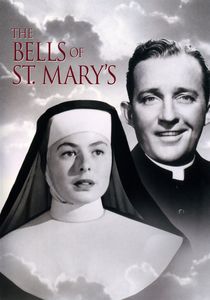
    (On TV, July 2019) Hollywood has been obsessed with sequels for a long time, and following up Going My Way’s success with The Bells of St. Mary is as good an example as any that 1940s cinema wasn’t immune to the impulse. Reprising Bing Crosby’s Oscar-winning turn as a likable priest sent to fix a troubled Manhattan religious institution (he jokes, he sings, he tolerates mild amounts of teenage hooliganism), this sequel pairs him with none other than Ingrid Bergman as a nun who also has a lot on her plate in teaching her students. (If you needed any proof that Bergman was a top-tier beauty, consider that she remains captivating here through her face and hands alone, never taking off her nun’s outfit.)  Much of the plot has to do with the school being threatened by a businessman building a factory next door and coveting the school’s ground for a parking lot. Other subplots revolve around the school’s students. But there is no nice way to say it: The Bells of St. Mary’s is an inferior sequel to the original Going My Way. Crosby is an immensely likable presence, Bergman is great, the film makes sure to go for a heartwarming ending and the religious content is toned down to the point of being nearly irrelevant, but the film remains considerably duller than its predecessor. The drama has become superficial melodrama, with fewer captivating moments and if the result never quite overstays its welcome, it still feels longer than optimal. It doesn’t help that the subplots are assembled mechanically, with cheap resolutions that seem to ignore basic human impulses. (That subplot about a wayward father reuniting with troubled daughter and fallen-on-hard-times mother … yeah, no.)  The Bells of St. Mary’s does have a special place in history as 1944’s highest-grossing film, but it’s also a cautionary tale of how even massive box-office successes can fall in obscurity if they’re merely based on copying better material.

  • Saratoga Trunk (1945)

    Saratoga Trunk (1945)

    (On Cable TV, February 2019) There are, even today, many reasons to see Saratoga Trunk. The best is probably seeing Ingrid Bergman at her most radiant, and playing opposite Gary Cooper. Otherwise, it can be fun to follow the plot of the story (adapted from a then-best-selling novel) as it moves from New Orleans revenge to Saratoga Springs husband hunting to transcontinental railroad brawling and such. There’s a lot of material crammed in the film’s 135 minutes running time. The production values of the film are high, with plenty of overwrought costume drama. (Flora Robson is a highlight.) It’s clearly from another era—never mind the blackface for one of the performers, how about the radically different social expectations for women? This being said, you can like melodramatic 1940s Hollywood productions without necessarily being entirely convinced by them: there’s a sumptuous nature to some of Saratoga Trunk’s sequences that’s pure Golden Age, and there are few better exemplars than Bergman and Cooper at it.

  • Spellbound (1945)

    Spellbound (1945)

    (Youtube Streaming, November 2018) Lost among the moniker “master of suspense” is the stone-cold fact that Alfred Hitchcock could be downright weird when it suited his purpose. In his quest for unpredictable thrills, Hitchcock’s career is crammed with ludicrous plot devices, unbelievable psychological quirks, formal experimentation and frequent return to basics. Some of his best and worst films are far away from reality, meaning that there’s little relationship between their eccentricity and their success. Sandwiched between the far more prosaic Lifeboat (1944) and Notorious (1946), Spellbound shows Hitchcock diving deep into psychoanalytical plot devices (something that would come up again later in his career) and coming up with surreal results. Literal surrealism, in fact, since there’s a dream sequence midway through the film that was designed by none other than Salvador Dali. The man-on-the-run plot feels familiar to Hitchcock fans (echoed in, say, North by Northwest), but it allows stars Gregory Peck and Ingrid Bergman to develop some pressurized chemistry. The details of the plot are less important than the meticulous details of its execution, and the way the film becomes just a bit more straightforward in time for its conclusion. There’s a memorable moment near the end that still jolts viewers through a combination of an obvious practical effect and a flash of colour. This isn’t one of Hitchcock’s finest films, but it’s nowhere near the bottom either—although it’s perhaps more fascinating as a prototype of later Hitchcock movies and a reunion of some very different artists than a wholly pleasing thriller in its own right.

  • Notorious (1947)

    Notorious (1947)

    (On DVD, September 2018) Alfred Hitchcock, Cary Grant and Ingrid Bergman. I could just stop here and that’s all you’d need to know about Notorious. If you really want to know more, consider that it’s a romantic suspense thriller in which an American agent asks the daughter of a disgraced man to offer herself as bait to enemy agents, with the complication that he himself is falling for the woman. (If this sounds familiar, it’s because it’s been re-used in many, many other movies such as Mission: Impossible II) But, of course, the plot is the least of the film’s strengths, what with Hitchcock gleefully messing with the conventions of the romantic thriller and the limitations of the Hays code to deliver a two-minutes on-screen kiss. It’s good fun, especially when you measure today’s expectations against what’s shown in the film. (Ten minutes in, and there’s a drunk-driving sequence that would be flat-out unacceptable today.) The ending is a bit abrupt but no less satisfying. Grant and Bergman are at their respective best here, even though they’re both playing darker version of their usual persona. Still, Notorious remains a worthy Hitchcock thriller from his black-and-white Hollywood phase.

  • Gaslight (1944)

    Gaslight (1944)

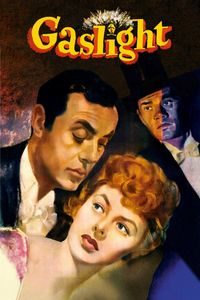
    (On Cable TV, April 2018) The term “gaslighting” seems to be everywhere these days thanks to the truth-denying efforts of the current US administration, so why not go back to the source that named the issue? Fortunately, there’s a lot to like in Gaslight beyond the terminology—this story of a woman being deceived and endangered by her husband remains a really good thriller today. Ingrid Bergman is as attractive as ever as the heroine, while Charles Boyer handles the transformation of his character from attractive stranger to an abusive husband very well. An 18-year-old Angela Lansbury shows up in a small role. The film’s cinematography is notable in that it gradually transitions from a brightly lit romance to a stark chiaroscuro Gothic (or noir) thriller as the story evolves. The suspense is gripping, and the use of mystery does help propel the narration forward. Director George Cukor is best-known for comedies, but he was equally adept at adapting novels to the screen and Gaslight is a perfectly acceptable thriller. There were a fair number of women-in-domestic-distress thrillers during the 1940s but Gaslight holds its own against most of them.