Ish Kabibble

  • Playmates (1941)

    (On Cable TV, April 2022) Alas, I’m getting to the end of the Kay Kyser filmography. Kyser was a most unlikely movie star – a bookish band leader who parlayed success as an entertaining radio show host into a short-lived but substantial movie career spanning thirteen titles (nine of them feature films) in merely six years, playing himself in all but one of those films. Kyser had a distinctive, almost underwhelming screen presence – an academician somehow presented as a leading man. One of Playmates’ biggest assets is how it plays on this dichotomy, overtly presenting Kyser as someone in need of acting lessons and positive news stories. The other asset of the film is his co-star – American acting legend John Barrymore in his last film, playing a bombastic caricature of himself as a puffed-up thespian reduced to giving acting lessons to Kyser. Their water-and-oil mixture powers much of the film as Barrymore chews scenery under Kyser’s amused stares. Additional entertainment comes both from Lupe Velez in her usual scene-stealing fiery persona and the usual Kyser acolytes (notably bowl-haired Ish Kabibble, accompanied by attractive Ginny Simms as his band’s assigned lead singer). But the more you know about the players involved, the more there’s a tragic undertone to Playmates – after all, both Barrymore and Velez would be dead a few years later (for different reasons) and Barrymore fans usually wince at the thought of his last film being spent playing second fiddle to Kyser and parodying his own tattered image. But on a surface level, Playmates does get a few laughs (as well as one impressive sequence, played completely straight, of Barrymore delivering the sole filmed version of his much-lauded rendition of Hamlet’s best-known soliloquy). It’s not high art, and it loses quite a bit of steam between the end of its first act and its conclusion, but it delivers what’s expected for Kyser fans and a certain kind of Barrymore devotee. For all of the finality of this being Barrymore’s last screen performance, I’m more concerned that I‘ve got only one more Kyser feature film to watch.
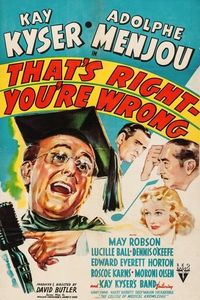
  • That’s Right—You’re Wrong (1939)

    That’s Right—You’re Wrong (1939)

    (On Cable TV, October 2021) It’s amusing that TCM presented That’s Right— You’re Wrong as part of a Lucille Ball retrospective, because once the film begins, it quickly becomes obvious that this is a Kay Kyser vehicle with a little bit of Ball as a (very) supporting character. Not that I minded—In the extended pantheon of ephemeral Hollywood stars, Kyser was an unusual figure and an unlikely movie idol. Soft-spoken, not particularly attractive nor that good of an actor, he nonetheless starred in more than half a dozen pictures, usually (but not always) playing himself as the leader of the Kollege of Musical Knowledge, a music-themed radio game show. As the first film to translate Kyser’s radio popularity to the big screen, That’s Right— You’re Wrong begins and ends with a re-creation of the game show in front of a live audience. In-between, we get Kyser and his bandmates having adventures in Hollywood as a studio tries to tailor a film for them, and the wackiness of the environment transforms them into parodies of themselves. I had quite a bit of fun watching it, but keep in mind that I’ve been something of a Kyser fan for a while: Ever since wondering how he became the star of Swing Fever, I’ve seen six out of his nine feature-length films. (It probably says it all that I don’t only recognize Kyser on sight, but also bandmates such as the lovely Ginny Smith and the deadpan Ish Kabibble.) Despite his underwhelming acting talent (something openly lampooned in a very funny “screen test” sequence), Kyser does have a very likable presence, and he’s never more at ease on the big screen as when he’s playing himself as the professorial host of the Kollege of Musical Knowledge (albeit spelled with a C), having fun with the guests and spouting his catchphrases. (It’s actually fun for a twenty-first century viewer to try to follow along, so obscure are now some of the references.)  The rest of That’s Right— You’re Wrong is hit-and-miss—it works as a Hollywood satire, as Kyser fights against a studio executive played by Adolphe Menjou, but it’s far too often a vehicle that’s more interested in showcasing Kyser in a format familiar to then-viewers of his show. It’s rather wonderful that two of his “shows” are captured that way, even if the action stops dead during that time. For those unfamiliar with Kyser, this is a great introduction to the character and why he attracted Hollywood’s attention as a celebrity DJ bandleader. The comedy is amusing enough to entertain (Ball’s finest moment is in the aforementioned “screen test” sequence), although I suspect that you have to like Kyser’s very unusual charm to fully appreciate That’s Right— You’re Wrong.