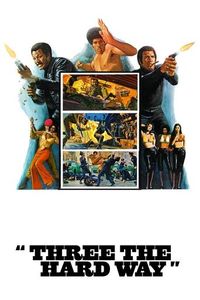
Three the Hard Way (1974)
(On Cable TV, November 2021) When people praise the fun of blaxploitation, they often talk about Shaft, but I think they really mean films like Three the Hard Way. I suppose there’s some irony in that Shaft, from Gordon Parks père, is a studied, rather serious cool, while Three the Hard Way, from Gordon Parks fils, truly plays into the exploitation elements. Macho male leads, sexy actresses (go ahead and try to pick between Sheila Frazier and Marie O’Henry), Kung fu fighting (making explicit the connection between two strains of exploitation films), more action sequences than was the norm in the mid-1970s, some delicious urban style and an elaborately ludicrous premise. We’re way beyond the usual inner-city crime thrills here: This is a film about defeating a white supremacist plot to kill non-white Americans through a genetically engineered virus. Fortunately, Three the Hard Way goes about it in such an over-the-top way that it’s much easier to cheer for the systematic slaughter of dozens of white racists than to be too upset about the idea. Led by Jim Brown and supported by Fred Williamson and Jim Kelly, the cast is not just about preventing genocide, but looking terrific while doing it. Martial arts moves are supplemented by an arsenal so large that it takes a plane to carry it all. The action scenes, explosions and fights are numerous, although Parks’ low-budget, early-days-of-the-action-genre direction has more old-school charm than real immersion: it’s all too easy to spot where cuts are meant to masquerade bad staging… and even easier to spot where the staging doesn’t work even with careful cutting. (There’s a jeep explosion filmed from two angles that’s supposed to be two separate explosions, for instance…) But this is not a film made for technical prowess: it’s a slam-bang exploitation film done with generous means for the subgenre and an accordingly larger scope. The three leads are quite likable, leading to considerable sympathy for them as they mow down scores of unrepentant white supremacists. But it’s really the period feel of mid-1970s black Los Angeles that makes the film work: the style, fashion, and attitudes are something that has been parodied often (Undercover Brother owes a deep debt to Three the Hard Way) and integrated into an entire aesthetics, but it’s great good fun to get back to the source of it all. The copious amount of sex and violence means that it’s not a film for all audiences, but blaxploitation fans will recognize the pure undiluted thing here.