John Cleese

  • An American Tail: Fievel Goes West (1991)

    (On Cable TV, October 2021) After taking on the classic immigrant experience in An American Tail, the sequel goes after another piece of Americana in sequel Fievel Goes West. As the title suggests, the Mousekewitzes decide to head west after getting tired of the limited opportunities in New York City. As in the prequel, their journey finds young Fievel separated from them, learning valuable life lessons along the way. Taking on familiar western tropes with more enthusiasm than innovation, Fievel Goes West seems content to follow a very classical way of making animated movies, with plenty of songs and dances to go around. Some of the musical numbers are not bad: I’m particularly fond of the short “Rawhide” sequence. Some celebrity voices are also ear-catching: John Cleese turns in a fun villainous performance, while James Stewart’s unmistakable drawl is here heard for the last time. It’s family entertainment in a comfortable old-school mould, perhaps a bit more superficial and fast-paced than other similar films, but clearly having fun with the conventions of westerns. Fievel Goes West feels less profound but more fun than its prequel, which will strike some as ideal and others as a step down.

  • The Divided Brain (2019)

    The Divided Brain (2019)

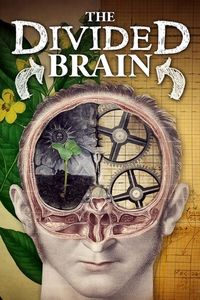
    (On Cable TV, September 2021) Extraordinary claims require extraordinary evidence, so when The Divided Brain takes its intriguing findings about the left/right hemisphere divide and starts applying them to society at large, the leap from evidence to conclusion is just too high to follow comfortably. Much of the film is adapted from the works of psychiatrist Iain McGilchrist (specifically his book The Master and His Emissary). McGilchrist is notably not a neuroscientist but his review of available evidence should be familiar enough: The left hemisphere of the brain is focused on details, while the right hemisphere is focused on the whole. The film (unlike, apparently, the book) doesn’t spend a lot of time on those neurobiological fundamentals — it’s far more interested in the second and far less convincing part of McGilchrist’s thesis: That western society, in general, has grown far too detail-centred at the expense of looking at the whole picture, and that state of affairs is squarely to be blamed on… wait for it… the divided brain. Now, I’m open to new ideas — I have a regrettable tendency to latch on to new cool concepts and apply them indiscriminately to all sorts of different areas as long as they give me the impression of knowing something that others don’t yet. (Fortunately, I have resisted most conspiracy theories so far.)  But there’s a leap in The Divided Brain that I find suspicious — and it’s reinforced by some curious choices that make the thesis seem all the more superficial. By the time the interviewees blame all of western society’s ills on the divided brain (while predictably praising other modes of more primitive thought), they all sound like cranks moaning and complaining about what they don’t like about life, and latching on this single idea as a universal explanation. Adding John Cleese as an interviewee and colour commentator makes the film funnier but not necessarily more credible when it’s already dubious. I may end up being more favourable to the thesis if ever I read the book, but I’m not feeling like it: Having looked at my general impression of the film rather than focusing on its details, I’ve come to an intuitive whole-picture skepticism about The Divided Brain.

  • The Very Excellent Mr. Dundee (2020)

    The Very Excellent Mr. Dundee (2020)

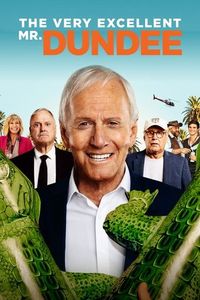
    (On Cable TV, July 2021) You have to have some sympathy for entertainers who, after a lifetime of hard work, personal development and multiple projects, still end up recognized for one single thing. Paul Hogan may have had quite a varied career in Australia, but his North American legacy will forever remain playing “Crocodile” Dundee, and so The Very Excellent Mr. Dundee ends up being a meta-Hollywood comedy that sees the 80-year-old wrestle with his unescapable legacy. Hogan was old back in 2001 with the third Dundee film — he’s even older here and looks like it. Perhaps the film’s best moments are allowing a few fellow senior citizen comedians to poke fun at the passing of fame by playing “themselves” — John Cleese shows up as a maniacal ride-share driver to make ends meet; Chevy Chase as an egomaniac; Wayne Knight as a tap-dancing singer; and Olivia Newton-John as something like window dressing. Hogan’s character himself is quite unlike his own best-known character — mild, gaffe-prone, and trying to retire peacefully even as others try to bring him back, often speaking from a position of ignorance. Much of the film’s structure is cyclical, with Hogan exploring the world of 2021 and committing a series of faux pas that land him on the news as the worst person ever. That gets old quickly (especially when the gags are stretched-out and not all that funny in the first place), even as other moments in the film work relatively well. I did like Cleese’s role and some of the comical flourishes poking fun at modern Hollywood. This being said, there is something a bit awkward about a film built around an older man’s lack of comfort in the world — a film about retirement in which Hogan shows up with his first starring role in a decade. I smirked a few times at The Very Excellent Mr. Dundee and it ranks as one of the weirdest legacy sequels so far, so it’s not all that bad — but there are plenty of missed opportunities along the way for a more incisive take on aging stars and whether they should retire once and for all.

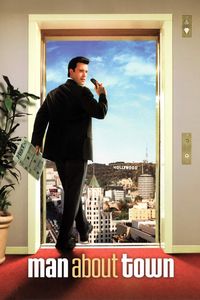
  • Man About Town (2006)

    Man About Town (2006)

    (On TV, March 2021) I thought I had seen most movies in Ben Affleck’s middle period, but somehow Man About Town had escaped me. I can understand why: Released straight-to-DVD at a time when I was watching most new releases theatrically, it’s also a curiously hermetic industry-insider film with no way for outsider audiences to sympathize with the results. The problems start early on, as the film sets itself up as the middle-age crisis of a Hollywood talent agent (the not-yet-middle-aged Affleck) striking him just as he’s following a journalling class at the local self-improvement establishment. Suddenly, his wife is having an affair, a journalist is threatening to expose long-buried professional secrets and he feels that (horrors!) money, success and expensive cars aren’t the most important things. Revealingly enough, screenwriters are the film’s villains. If this all sounds like a Hollywood agent’s idea of a perfect film project, you may start to understand the way Man About Town feels like a dispatch from an alien planet. This seems to be a film made for Hollywood agents, and while they number in the thousands, the film doesn’t do enough to reach audiences outside that circle. As a work of movie industry inner-gazing, it’s far more irritating than most other entries in the genre: the protagonist is not particularly likable from the onset and he doesn’t grow any more sympathetic through the film, most of which complications fall under the category of rich-person problems. What’s a bigger shame is that the cast assembled here is actually not too bad. John Cleese is typically good as a teacher who acts as a catalyst for the action, while Bai Ling plays crazy like no other actress. Other familiar names pepper the cast, further reinforcing the insider outlook of the film. Man About Town is often a baffling film, but I suppose that when Hollywood makes movies about itself for itself, it can baffle everyone else.

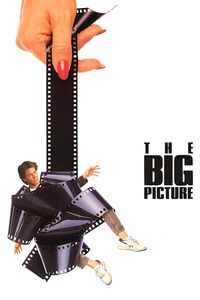
  • The Big Picture (1989)

    The Big Picture (1989)

    (On Cable TV, September 2020) The premise of The Big Picture will be intensely familiar to anyone who’s ever seen a Hollywood satire: Smart Midwestern student filmmaker earns the attention of Hollywood producers, is gradually coopted by the studio system until he’s no longer himself, loses it all and fights to get to do it his way. That plot outline could be written on a napkin, but it’s not the point of the film. The point of it is the visual humour that writer-director Christopher Guest injects in his narrative, as our protagonist (a very likable Kevin Bacon) can’t help but supplement what’s happening to him with imagined spots heavily inspired by Hollywood classic movies. Tons of small visual jokes pepper the story, challenging viewers to pay attention. The cast can be surprising at times, especially when it comes to smaller roles: Teri Hatcher looks amazing as an opportunistic actress, John Cleese (sans moustache) plays an American bartender, Elliott Gould has a few moments as an imaginary prosecutor, Jennifer Jason Leigh is a wacky artistic type, Martin Short gets to play the stereotype of a talent agent, and Fran Drescher shows up as a trophy wife. Clearly produced as a satire of Hollywood for Hollywood people rather than the general public, The Big Picture is noteworthy in Guest’s filmography for not being a mockumentary, but rather a full narrative film, with plenty of imaginary asides. It’s quite a bit of fun, and probably ranks as one of those Hollywood satires that not enough people have seen. It’s well worth a look, and not solely as a filler for Guest completionists.

  • Silverado (1985)

    Silverado (1985)

    (In French, On Cable TV, February 2020) By now, even the tiny number of Westerns that I’ve seen (compared to the entire corpus) is enough to last me a lifetime, or at least establish clear eras in Hollywood Westerns. There’s the innocent period (until 1939’s Stagecoach) where Westerns were cheap and easy to shoot in Hollywood’s backyard. There’s the heroic period (1940s–1950s), which shaped the myths of the genre, followed by the revisionist period (1960s–1970s), which did everything it could to question the heroic era of Westerns. By the 1980s, however, anything could happen in those now-rare Western films—movies that either celebrated or condemned the genre. Silverado, thirty seconds in, clearly announces its filiation to a more classical idea of westerns, although one that consciously exploits the iconography of the heroic period. As the opening shootout of the film ends and our protagonist opens the door of the dark cabin in which it took place, the camera crosses the threshold and the image expands to the limits of the widescreen frame to take in a gorgeous look at the American west in its most iconic glory. The credit sequence follows the protagonist by framing him against picture-perfect western backdrops and sets the tone for a film that reconstructs a fun kind of western, filled with good and bad guys shooting it out over cattle rights and revenge over past transgressions. Writer-director Lawrence Kasdan clearly wants to have a blast doing this film, and so Silverado never lets an occasion go to feature power chords, striking images and self-aware dialogue—or all three, such as when Danny Glover’s character holds up two rifles and says, “This oughta do.” Silverado manages to walk a fine line in recreating classic westerns with gusto yet without falling into the excesses that many imitators would adopt—it’s got action but few obviously over-the-top scenes; it doesn’t take itself too seriously without being a parody; and it finds an entertaining balance between drama and action. The story is very familiar, but it’s really a vehicle for Kasdan to show off that he could direct a straight-up western, and that works well enough. Special mention should be made of the ensemble cast, which features many actors what would become much bigger a few years later: Kevin Kline is a perfect example of civility in an uncivilized world (only topped by an unrecognizably bearded John Cleese as a merciless sheriff), Linda Hunt is a welcome bit of eccentricity, Jeff Goldblum pops up a few times, and a then-unknown Kevin Costner is a revelation here as a cocky gunslinger. Silverado ends up being a pleasant surprise: an unrepentant western not interested in critiquing the genre as much as in playing according to its rules. In many ways (including the gorgeous cinematography), it does feel like a more modern 1990s film. But no matter when it’s from, it’s still quite a bit of fun to watch today.
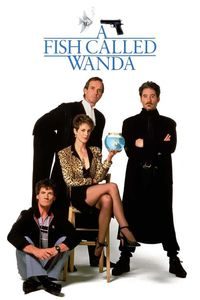
  • A Fish Called Wanda (1988)

    A Fish Called Wanda (1988)

    (On DVD, August 2017) Is A Fish Called Wanda overhyped, or was I just in the wrong mood for it? No matter the reason, I’m tempted to label this acknowledged classic as mildly amusing and leave it at that. The fault isn’t with the actors: John Cleese is in fine full persona as a stiff upper-lip barrister, seduced by a curiously sexualized Jamie Lee Curtis as part of a larger robbery plot. Various quirky characters populate the edges of the film, none more forcefully than Kevin Kline as a grossly caricatured American villain. The script is densely plotted for a comedy, and it deftly mixes physical comedy with fine repartee (the apology moment is a quote for the ages). The direction is sometimes more dynamic than expected, and that may be a clue to A Fish Called Wanda’s more humdrum reception today: What may have been striking back in 1988 is the norm today. I may have been partially inoculated to the film’s charm by having watched its “equal” Fierce Creatures a few months ago—the two films share the same sensibilities, and the first one seen may end up feeling like the better of the two. Still, it’s not as if I disliked A Fish Called Wanda: I merely found it good but underwhelming, and there are worse critical assessments out there.

  • The Pink Panther 2 (2009)

    The Pink Panther 2 (2009)

    (On TV, March 2017) The law of diminishing returns is fully operative in discussing The Pink Panther 2, second in a reboot series starring Steve Martin as Inspecteur Clouseau. Much of the surprise of the first movie is gone, replaced by an expansion of the story that, to its credit, doesn’t try to ape the first film too much. Here, a genius thief named The Tornado is stealing precious artifacts around the world—it’s up to a team of criminal investigators, including Clouseau, to catch the villain. But bigger doesn’t necessarily mean better, and as the investigation goes to Rome and then back to Paris, The Pink Panther 2 struggles to remain interesting. It pains me to say that, as much as any movie with Aishwarya Rai is like a little bit of sunshine, she doesn’t bring much to the movie—and neither do reliable performers like Alfred Molina or Andy Garcia. Even returning players such as Jean Reno and Emily Mortimer aren’t given much to do … although John Cleese may be a little bit better as Kevin Kline’s replacement. Few of the gags in this sequel are as inspired as some of the ones in the first movie, and while the rather good conclusion also does much to focus the film’s impression, it does come a bit too late to be truly effective. Eight years later, it does seem as if the Steve Martin Pink Panther reboot series ended there and I’m not seeing anyone bemoaning that fact.

  • Fierce Creatures (1997)

    Fierce Creatures (1997)

    (On Cable TV, September 2015) So it turns out that I was in the mood for a farce and didn’t even know it.  Upon its release, Fierce Creatures soon became known as “the not-as-good companion film to A Fish Called Wanda”, featuring many of the same cast and crew and resonances in plotting.  Not having seen A Fish Called Wanda yet (this will change soon), that freed me to enjoy Fierce Creatures on its own merits and while not all of it works as well, it does have considerable charm and strong moments.  Perhaps the most refreshing thing about the film (besides the zoo environment, and the sympathetic role given to the animal minders) is how clever the script can be in acknowledging and responding to comic clichés.  The first half of the film, for instance, has a ton of dumb plans that end up easily detected and defused by the protagonist: in lesser films, those dumb plans would have carried the day.  (It also heightens the stakes for the film’s last fifteen minutes, in which another dumb plan it set up –will it be detected and defused as well?)  Otherwise, the film features strong roles for John Cleese as the gradually sympathetic protagonist and Kevin Kline as two imbecilic antagonists, while Jamie Lee Curtis unusually plays up her sex-appeal.  The innuendos work, the sight-gags can be very funny and if the film’s first fifteen minutes feel a bit disconnected, much of the film is pleasant enough to watch, building up to a few good set-pieces. (The running gag about the protagonist’s perceived insatiable sexual appetite gets funnier and funnier.)  Nearly twenty-five years later, Fierce Creatures remains a well-executed comedy that stands on its own.

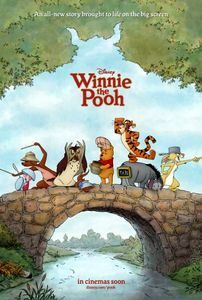
  • Winnie the Pooh (2011)

    Winnie the Pooh (2011)

    (On Cable TV, April 2012) There’s a common rhetorical defense against unfavorable reviews of bad children’s movies that goes approximately like “But it’s for kids!” as if the young ones deserved swill and as if adults weren’t somehow involved in the process of creating and viewing these films.  Of course, the truth is that kids deserve the best just as their parents do, and that parents will end up watching the same films as their young ones.  Why settle for less?  Such it is that a well-made kid’s film like Winnie the Pooh can charm adult audiences while still appealing to its core audiences.  Whimsical, good-natured and rarely dull to watch, this newest Disney-branded adaptation of A. A. Milne’s stories is a complete success.  The 2D animation (with a bit of CGI help and a subtle live-action framing) seamlessly transfers Pooh’s iconography to the screen, while the voice talent (including John Cleese as the narrator) strikes all the right notes.  The story itself is a charming framework in which the character’s personalities are given a chance to shine.  Adults will be especially amused by the meta-textual interludes in which the film plays with storytelling conventions and the transition from page to screen, but the entire family will enjoy the film.  Winnie the Pooh runs a bit short at a mere 63 minutes, but it’s a complete success reflected by its gentle self-assurance.

  • The Out-Of-Towners (1999)

    The Out-Of-Towners (1999)

    (On VHS, June 2001) Midwest yokels come to New York City and are quickly out of their depth! How funnier can it be? A lot funnier, easily. Goldie Hawn and Steve Martin reprise their usual screen personae, adding nothing and screaming a lot with scarcely any indication of how good they can be in other types of roles. John Cleese is a hoot as usual. The various plot points are pretty much predictable in advance, and aren’t all that skilfully executed either. For a film about New York, there isn’t a whole lot of scenery. There have been worse films, there have been better films, so there isn’t any cause for concern if ever you pass by The Out-Of-Towners and don’t pick it up.

    (Second viewing, in French, on Cable TV, December 2018) Watching The Out-Of-Towners remake right after the 1969 original only underscores how much more slap-sticky is the remake. Gone are the more serious undertones and barely-repressed desperation of the original. Instead, we get Steve Martin and Goldie Hawn hamming it up as much as they can stand. The result actually is reliably funny, although unsubstantial to a point where I didn’t even realize I had seen the film seventeen years ago. One good point in favour of the remake: the much more active role given to the female lead — it sure helps that Hawn can be reliably funny on a dime. There’s a surprising cameo appearance from pre-America’s-Mayor, pre-Crazy-Pundit Rudy Giuliani.