Judy Holliday

  • Bells are Ringing (1960)

    Bells are Ringing (1960)

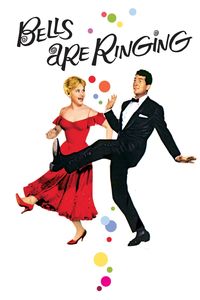
    (On Cable TV, January 2021) In cinema history, Bells are Ringing is noteworthy for being the final film of two well-known names. It was actress Judy Holliday’s final film before her death a few years later. Perhaps more significantly, it was Arthur Freed’s last musical film as the head of the famous MGM Freed Unit, which was responsible for putting together a twenty-year run of many of the most celebrated movie musicals of Hollywood’s Golden Age. This aura of finality seems appropriate, considering the tired nature of the results on-screen. Adapted from a Broadway play with the usual problems of stage adaptations relative to original musicals, Bells Are Ringing is far more laborious to watch than you’d expect. Despite a mildly amusing premise about a Manhattan answering service operator getting drawn into the lives of her clients, it’s a surprisingly mild and unremarkable musical. While Holliday is not bad and Dean Martin adds much to the film as its male lead, the comedy is perfunctory, the songs are not memorable and the entire thing leaves without having left much of a trace. Of course, musicals were fast declining by 1960 and films like Bells are Ringing certainly contributed to this decline—there’s little here to reflect the heights of the form in the previous decade: little wit, little invention, little cinematic quality—and this from otherwise dependable director Vincente Minelli. I’m certainly not saying that Bells are Ringing is a bad film—but it’s average in wholly forgettable ways, which represents an underwhelming end of the line for the producer responsible for such all-time classics as Easter Parade, Singin’ in the Rain and The Band Wagon.

  • The Marrying Kind (1952)

    The Marrying Kind (1952)

    (On Cable TV, September 2020) According to contemporary accounts, audiences didn’t quite know what to make of The Marrying Kind’s blend of comedy and drama, as it worked its way backward in flashbacks from the divorce court to show the strains of an ordinary marriage. Helmed by George Cukor, the film showcased funny scenes in between more dramatic ones, and I can understand how unpleasant it must have felt for critics and audiences back then to sit through what feels like ninety minutes of arguments between husband and wife. But there’s been a critical re-evaluation of the film by later generations, helped along by a growing familiarity with movies blending comedy and drama—we can draw parallels with 2019’s Marriage Story as a sombre film with darkly comic moments, and quite a few romantic comedies willing to showcase more serious moments on their way to a happy conclusion. It’s not a stretch to say that modern audiences are more sophisticated about their movies—or at least that they’ve seen many kinds of tones and moods. As a result, The Marrying Kind does work relatively well today: The unusual flashback-filled structure is more interesting than most similar films of the time, Cukor makes good use of ironic visuals to counterpoint spoken narration, and there’s an attempt to depict an unglamorous reality at work here. Far from the idealized portrait of marriage and archetypical characters, here we have two people struggling to make it work, suffering humbling setbacks and yet building something together. Judy Holliday does well as the wife, while Aldo Ray is sometimes a bit caricatural as the husband. Still, their work does find a happy compromise between the attempt at realism and the glossiness of studio pictures at the time. It’s a bit too dark to be fully enjoyable, but it will be interesting for those looking for evidence that the studios knew about real life even at the beginning of the glossy glam 1950s.

  • It Should Happen to You (1954)

    It Should Happen to You (1954)

    (On Cable TV, June 2020) No matter whether you’re talking about 2020s influencers or 1950s aspiring actresses, the lure of instant fame is evergreen, and It Should Happen to You offers a time capsule of what that looked like in mid-twentieth century America. The hook lies in having an obscure young woman taking out a billboard in her name, hoping that the publicity will lead somewhere. Against all odds, it works—and she quickly finds herself in a romantic triangle between a well-off executive and a more modest filmmaker. The unusual premise quickly leads to a far more conventional romantic comedy, but there are enough known names in the production to keep things interesting. Under George Cukor’s direction, we have Judy Holliday as the young not-so-smart ingenue, being wooed by Peter Lawford and Jack Lemmon in his movie debut. While some of the film’s initial intentions get lost in the shuffle, the film ends on a funny and romantic note. The black-and-white cinematography highlights It Should Happen to You’s old-fashioned atmosphere (at times, it feels like a late-1930s film): Maybe Cukor, as competent as he was, couldn’t quite bring himself to shoot the material in colour and reflect the slightly dourer 1950s—ah, colour footage of those Manhattan locations would have been something to see! The actors are all charming in their own way: while I’ll confess never quite getting the fascination for Holliday’s persona, she does well here. While not a waste of time, It Should Happen to You certainly does feel as if it’s restraining itself—although, considering that it’s about advertising in the mid-1950s, we’re already getting quite a lot.

  • Born Yesterday (1950)

    Born Yesterday (1950)

    (On Cable TV, October 2019) There’s a deceptive simplicity to the premise of Born Yesterday: from afar, it’s a standard Pygmalion spinoff, what with a journalist being asked to educate the girlfriend of a businessman. But it’s in its execution that the film proves to be quite a bit more than expected. For one thing, the film (which takes place in Washington) doesn’t miss an opportunity to link personal virtues to political values—the coarse businessman who slaps his wife is proved to be a criminal who aspires to fascism (how familiar!), and the ingenue who learns better about the bedrock principles of the nation uses that knowledge to emancipate herself from a bad situation. Then there’s Judy Holliday, who comes across (though a grating voice and uncouth manners) as a hopeless self-obsessed hick but eventually proves herself as smart as everyone else—and do so in an almost imperceptible manner, making us care before we even know it’s happening. William Holden and Broderick Crawford also provide good performances to round up the lead trio. The script is a bit blunt at times and certainly predictable overall, but it does have moments of cleverness and humour, good dialogue and effective directing. Handled by veteran George Cukor, Born Yesterday proves to be a solid comedy with a timeless message, a still-impressive lead performance and a political message that really wouldn’t be out of place in a Frank Capra film.