Julie Andrews

  • S.O.B. (1981)

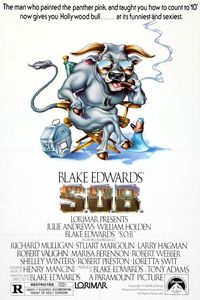
    S.O.B. (1981)

    (On Cable TV, May 2021) I’m not saying that Hollywood is a terrible place, but I am saying that you don’t see signers writing diss songs about their record labels, and you don’t see authors write tell-all novels (much) about the publishing world. But movies from writers and directors complaining about Hollywood? Ho boy, I hope you’ve got a week of free time because they keep piling up. One semi-classic case in point is Blake Edwards’ S.O.B., which follows a movie producer (played by Richard Mulligan) left suicidal by a spectacular flop. His comeback solution is to reshoot his ailing film as a soft-core musical featuring his glamorous wife in the nude. The meta-joke here is that he is based on Edwards, and the actress is played by Julie Andrews, who was Edwards’ wife and also had a squeaky-clean image. When she does appear nude, it’s as much a shock for audiences as for the film’s characters. S.O.B. is surprisingly mean-spirited, and it’s a measure of how much it’s intended as an insider’s critique that it focuses on a producer rather than the more public-facing actors or directors. Hollywood here is depicted as an uncaring, mercenary community of back-stabbers who don’t really care about others except for their success. It’s biting, which is made even worse by the matter-of-fact way in which it’s portrayed. The film got very mixed reviews upon release (with its script nominated for both an Oscar and a Razzie), but has aged quite well as a period piece that still has something to say. While not outright funny throughout, S.O.B. is decently amusing and finds its place somewhere alongside The Player and many other examples of Hollywood acidly commenting upon itself.

  • Torn Curtain (1966)

    Torn Curtain (1966)

    (On Cable TV, November 2020) With Torn Curtain, I have reached the end of Alfred Hitchcock’s second tier of films—I think that the only remaining movies I haven’t watched by him are the practically obscure The Paradine Case, Under Capricorn, and after that we get into 1930s British movies and 1920s silent films. Working from a popularity-based list, I am clearly going backward through quality as well: Made between Marnie and Topaz, Torn Curtain is clearly not among Hitchcock’s best, although it does have a few highlights. The best one of those is something I either somehow didn’t know or had forgotten: Paul Newman in a Hitchcock film?! He’s clearly not the best choice for the kind of cool thriller that Hitchcock did best (and it’s easy to confuse the opening minutes of Torn Curtain with that of The Prize), but much of his innate charm still makes quite an impression. On the other hand, Newman being Newman means that we’re not fooled when the film tries to make him a traitor defecting to the east. Fortunately, that’s not meant to be a twist—and that’s part of the film’s problem, as it keeps going on long after a blackboard combat that should have been the climax of the film. There are sequences that fare better, but even in those moments, the specifics don’t quite match the desired impression—I get that the kitchen sequence is meant to drive the point home that it’s hard to kill someone, but there are about six different better weapons on the set to finish off the guy than sticking his head in an oven. Julie Andrews is there but fails to make much of an impression as the woman who follows her fiancé deep behind the Iron Curtain and back. It’s no secret that Hitchcock did better on more personal movies than when he tried to go geopolitical (Topaz would confirm that a few years later) and so Torn Curtain seems a bit scattered compared to his better movies—it’s still watchable, but not always compelling.

  • Thoroughly Modern Millie (1967)

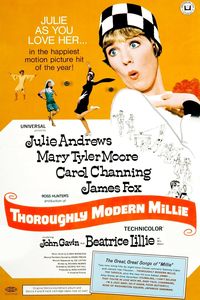
    Thoroughly Modern Millie (1967)

    (On Cable TV, February 2020) Common wisdom has it that the 1960s were terrible years for the movie musical, but I don’t quite agree with that—the overly serious 1970s were far worse, and there are plenty of enjoyable 1960s musicals to be watched now… even if the box-office receipts at the time were less than the studios expected. Thoroughly Modern Millie is a particularly fun and weird take on the genre. It’s a sixties-style musical set in the 1920s, with a flapper protagonist played by Julie Andrews. (I’m not a big fan of Andrews, and was particularly amused to find that the opening makeover number makes her less attractive and closer to her persona at each step.) Despite my own reservations about Andrews (legend has it that Mary Tyler Moore was intended to be the film’s lead until Andrews signed up, at which point the film was recentred around her and made into a musical), the result is a fun farce with inventive musical numbers. I quite liked the xylophone dancing in “Jazz Baby,” or the entire “Tapioca” number, which best showcases the exuberant filmmaking of the movie. Going well beyond musical numbers, there are flashy scene transitions through irises in/out, title cards to tell us what the heroine thinks as she looks at the audience and a lot of practical comic effects (such as an apple deflating). The twice-stylized 1960s execution and 1920s setting make for a doubly interesting viewing experience. As a farce, it’s probably a bit too long for its own good at more than two hours and a half (weariness sets in the second half), and the easy Asian stereotypes have not aged well at all. Still, it’s cute and fun most of the time—I would have preferred Mary Tyler Moore than the androgynous Andrews as a heroine (while keeping Stockard Channing as the film’s MVP), but Thoroughly Modern Millie remains a fun farce, amply earning a spot on a list of good 1960s musicals.

  • Victor Victoria (1982)

    Victor Victoria (1982)

    (On Cable TV, June 2019) Director Blake Edwards built his career with bigger-than-life comedies, so the gender-twisting outrageousness of Victor Victoria does make quite a bit of sense coming from him. See if you can keep up: In 1930s Paris, a gay man convinces a woman to impersonate a man impersonating a woman in a transvestite cabaret show. (We’re deep in Philip K. Dick’s fake-fake territory here.) Still, the film itself is a decent amount of fun. Julie Andrews stars as the woman asked to play a woman, but much of the spotlight goes to Robert Preston (and his great voice) as an aging gay man—his character is treated with some respect (within the confines of a 1982 film taking in place in 1934, that is), helping the film age more gracefully than most contemporaries. There are shades of Cabaret here (especially considering its inspiration, a 1933 German film) but don’t worry: Victor Victoria doesn’t have Nazis and ends on a far more cheerful note. It definitely comes alive during the funny cabaret sequence, especially when they result in musical numbers. The best is saved for last, with a deliberately over-the-top final sequence. While I’m not enthusiastic about Victor Victoria, it’s an easy film to watch and the cheerful atmosphere makes it all feel far more bearable than other comparable films (or musicals) of the era.

  • Hawaii (1966)

    Hawaii (1966)

    (On TV, July 2018) Box-office success is fleeting, and you just have to go back fifty years in Hollywood history to find Hawaii, then the second-biggest-grossing movie of the year and now almost entirely forgotten by history. Adapted from a single chapter in James Michener’s eponymous novel (far too long to entirely adapt to the big screen), it’s about the adventures of a missionary trying to settle in wild Hawaii with his new bride. If you’re expecting a rousing adventure story, though, temper your expectations: The film is heavy on religious fervour leading to dumb decisions leading to characters dying—to the point where the film’s religious credentials become almost suspect. The ending is particularly bittersweet. It has not aged particularly well: the movie is ponderous, moralistic, scarcely entertaining to watch and clearly belong to the Old Hollywood era that would be annihilated barely a year later. Max von Sydow and Julie Andrews star as the lead couple, but neither of them are particularly well used. It technically qualifies as an epic film by dint of taking place over decades and a staggering 186 minutes, but there isn’t much spectacle nor complex plot in the film. Frankly, it’s an ordeal to watch these days—although the treatment of the Hawaiian population and myths is slightly more respectful than you’d expect. What will reviewers think of today’s box-office hits in fifty years?

  • The Sound of Music (1965)

    The Sound of Music (1965)

    (On TV, December 2017) “There are a lot more Nazis here than I thought” applied to a surprising number of political headlines in 2017, but it’s still a valid commentary on The Sound of Music. While everyone remembers Julie Andrews skipping through the Alps, first-time viewers of the movie may be surprised at the number of Nazis in the film and how prominently they figure in the film’s third act. This being said, much of the film’s first half (and at nearly three hours, it’s a very, very long film…) is indeed about Judy Andrews and singing in the Alps. (Weeks later, I’m still unaccountably humming “Do [e], a deer, a female deer…”)  I’m hit-and-miss on musicals, my biggest gripe being that the pacing on musicals grinds to a half during songs. The Sound of Music is a near-perfect example of that issue: The film moves glacially even during spoken segments, and whenever the music starts, well, you can take a break. This being said, it’s not a bad film—Andrews is quite good, and so is Christopher Plummer in the lead male role. The dramatic component becomes more urgent in the film’s Nazi-infested second half, reflecting (some of) the von Trapp family’s real-life story as they escaped Austria to sing in allied countries. It’s a generally good time, although I can best imagine repeated viewings of this film as background noise.

  • The Princess Diaries 2: Royal Engagement (2004)

    The Princess Diaries 2: Royal Engagement (2004)

    (On TV, May 2017) There really isn’t a whole lot to say about The Princess Diaries 2: Royal Engagement, other than it does take up the Disney Princess wish fulfillment of its target audience even beyond the high-water mark of the first film (but seriously: a lavish princess slumber party?). The plot is clearly for the kids (this is a movie in which the villain quickly announces himself sotto voice to the audience) and quickly cycles through an episodic series of misunderstandings and dirty tricks. Anne Hathaway stars, making everyone a bit nostalgic for the phase of her career when she could play the bubbly long-haired ingénue: as of 2017, it’s been awhile since we’ve seen her in anything but a series of increasingly dour roles. Also notable is Chris Pine as a love interest, young but already charismatic back then. Julie Andrews gets a few laughs, while John Rhys-Davies doesn’t get much to do but sneer as the villain. Much of the film is tough to review for a middle-aged man, as it’s clearly meant for pre-teen merriment. There’s some lip service paid to deflating the idea of an arranged royal marriage, but it’s almost immediately undercut by the romance between the lead couple. Ah well; everyone goes into this movie for proxy royal thrills rather than enlightenment about the tension between love and duty. The Princess Diaries 2: Royal Engagement is a perceptible step down from the first film, but it should still please those who liked the first film a lot.

  • Mary Poppins (1964)

    Mary Poppins (1964)

    (In French, Video on-Demand, September 2015) I had seen bits and pieces of Mary Poppins over the years, but never the entire thing from beginning to end.  So it is that “I can see why this is a classic” jostles with “wow, this is a long movie” as my first conclusions.  Clocking in at nearly 140 minutes, Mary Poppins unevenly goes from one set-piece to another, flirting with plotlessness before finally delivering something near the very end.  It’s obviously a musical, meaning that is comes with a Bollywoodian intent to cover all emotional bases during its lengthy running time, no matter the loss in economical storytelling along the way.  There’s also an argument to be made that in 1964, audiences were far more accepting of a meandering movie experience and that today’s 90-minutes feature competes with far many more entertainment options.  So be it –let’s simply say that the film often drags.  Still, it would be churlish to ignore the reasons why Mary Poppins remains a cultural touchstone: the charm of it all, the great performances by Julie Andrews and Dick van Dyke (whose physical energy in the film remains astonishing), plentiful special effects, the catchy tunes, the family-first message, the set-pieces that do work well.  (My own favourites include the partially-animated Jolly Holiday, Supercalifragilisticexpialidocious (of course) and the rooftop Chim-Chim-Cheree)  Must of the film feels dated, but in doing so has acquired a further patina of whimsy that can’t be replicated by modern films.  (Well, except for the use of suffragette activism as a motivation for a mother ignoring her kids –that’s even more annoying than it must have been at the time.)  While I itch for some editing power in making this film more focused from beginning to end, the end result is still a classic for the ages.  Note: The French version may be competently translated, but it’s nowhere near the catchiness of the original English soundtrack.

  • The Princess Diaries (2001)

    The Princess Diaries (2001)

    (On TV, sometime around June 2005) I’m pretty sure I’ve seen this film in the mid-noughties, but it doesn’t come up in a search of my archives as of late 2014, so here goes nothing as a placeholder: The Princess Diaries is an amiable Pygmalion-lite comedy of manners in which a ordinary teen discovers that she is the heir of a throne of some sort. The premise isn’t nearly as important as the various gags and moments as our ordinary teenager is socialized to aristocratic standards. The most noteworthy thing about The Princess Diaries is a early star-making performance from Anne Hathaway, with an able supporting turn by Julie Andrews. Otherwise, this pretty much plays out like the Disney film it is. It’s likable without being deep or meaningful, and that’s all it truly needs to be.