Laraine Day

  • My Dear Secretary (1948)

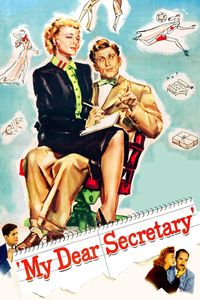
    My Dear Secretary (1948)

    (On TV, April 2021) There’s not a whole lot worth remembering about My Dear Secretary. From the title, we can suspect it’s going to be some hideously sexist romantic comedy, and the result doesn’t disappoint much, although (in keeping with Hollywood standards), there’s a bit more equality and reciprocity to make most viewers happy. At 94 snappy minutes, it barely has an impression to make, and the light subject matter doesn’t help. On the other hand, it is a film about novelists, and I can seldom get enough of those — and better yet, it’s a lot of fun seeing young and dashing Kirk Douglas as an author discussing matters of writer’s block and acting a cad whenever the screenplay gives him the latitude to do so. The initially one-sided relationship that begins when he hires a young intelligent woman as his secretary gets far more interesting when they end up marrying, she ends up being a better writer, they start having affairs and she ends up hiring a (male) secretary of her own. But don’t fret — My Dear Secretary goes back to enduring love by the time the credits roll. On the one hand, this is very familiar material with a few late-film twists and turns. On the other, Douglas is worth watching as a surly novelist, there are a few inspired lines of dialogue, and Laraine Day gives as good as she gets as his secretary-then-wife-then-competitor. Due to the terrible image and sound quality of the (public domain) version shown on TV, I’m probably going to watch this again in the future for a better experience, and we’ll see if familiarity breeds contempt. This is not such a bad pairing with the almost-contemporary Adam’s Rib even if the two are not in the same league.

  • Foreign Correspondent (1940)

    Foreign Correspondent (1940)

    (On Cable TV, February 2020) As I make my way down Alfred Hitchcock’s filmography, I’m now way past the classics and into his lower-rated, lesser-known work. Most of the time, I can understand why the work is not included in his highlights—atypical, less mastered, not quite exploiting his own strengths as a director. Foreign Correspondent is recognizably not one of Hitchcock’s best works, but it’s easily in the second tier: suspenseful, thrilling, fast-paced and quite funny at times, it’s recognizably a Hitchcockian film. Following a journalist as he gets embroiled uncovering a spy ring in Europe on the eve of World War II, it’s a one-thrill-after-another suspense film with a romantic component and a striking conclusion. Joel McRae is up to his most likable self as the two-fisted newspaperman, while Laraine Day is lovely and spirited as the love interest (back when Hitchcock didn’t obsess over blondes) and George Sanders is also quite likable as the sidekick to the pair. There are a few centrepiece sequences in here—the much-anthologized “walking through a sea of black umbrellas” sequence shows Hitchcock at his visual best, whereas the final sequence set aboard an airplane brought down over the sea is still hair-raising and a masterpiece of 1940s special effects. The end sequence reminds us that the film belongs to the WW2 propaganda subgenre, with a stirring call to arms delivered in a way that would be echoed in later real-life war broadcasts. Foreign Correspondent remains a pretty good Hitchcockian film—not a classic, but certainly one of his better efforts and one in continuity with his entire filmography.