Liev Schreiber

  • RKO 281 (1999)

    RKO 281 (1999)

    (In French, On Cable TV, May 2020) It makes perfect sense that one of the most famous movies of all time would spawn its own making-of TV movie. No, not a documentary—a full scripted drama with enough good actors to make this a prestige TV event. Yes, RKO 281 is a slick dramatization not only of the making of Citizen Kane, but the subsequent thunderstorm of disapproval that came from media mogul William Randolph Hearst, who was convinced the film was an attack on him and his girlfriend Marion Davies. As someone with a fair amount of knowledge about the film and its era, I was very happy with the result, even if I knew where the story was going. Some very impressive means have been spent to come up with convincing period details, and the cast is almost pitch-perfect for their roles—Liev Schreiber as Orson Welles? John Malkovich as Herman J. Mankiewicz? James Cromwell as William Randolph Hearst? Melanie Griffith as Marion Davies? RKO 281 is one wonder after another. Sixty years after the events depicted, the film pulls no punches: Hearst is the villain, and Hedda Hopper is the henchwoman. It all culminated, as film buffs know, in the dumbfounding decision to give that year’s Best Picture Academy Award to How Green Was My Valley—although this, curiously, is not in the film considering that RKO 281 ends soon after Citizen Kane’s premiere. (Maybe RKO 281 knew that biting the hand that hands over the Oscars was not a good idea, even for a 1999 TV movie.) It’s certainly not perfect (there are anachronisms and simplifications and not enough attention paid to the artistry of Kane) but it’s a decent dramatization, even if everyone will know not to take it as a documentary. Some special editions of Citizen Kane on physical media include this film as a bonus, and it’s a good one.
  • Mixed Nuts (1994)

    Mixed Nuts (1994)

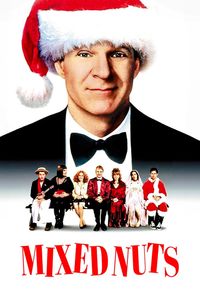
    (In French, On Cable TV, May 2020) I’m somewhat nonplussed by Mixed Nuts. It’s a weird, very Americanized adaptation of the pitch-black French Christmas comedy classic Le père Noël est une ordure (which I haven’t seen in ages), set in snowless Los Angeles on Christmas Eve. Much of the weirdness is due to it being pulled in two different directions—the very dark comedy of the original (which ends with body parts of a serial killer being wrapped up in Christmas packaging and fed to zoo animals) and the innocuous audience-friendly style of writer-director Nora Ephron. I mean—this doesn’t feel like an appropriate match, and it isn’t. What were they thinking? This is the kind of premise (dark comedy hijinks at a suicide prevention hotline on the day before Christmas) that calls for a low-budget anarchic approach, not a glossy Ephron-style comedy. This is nowhere as dark as it should be, and it’s wrongly engineered for guiltless Christmas cheer. The high-budget slick approach also ensures that the film is made to be safe, and that, in turns, means that its approach to two sensitive topics—mental health and transgenderism—now feels half-outdated rather than transgressive. (It’s not as bad as it could have been—Liev Schreiber’s transwoman character is treated with some respect—but it clearly wouldn’t be remade the same way today.) As a result, the comedy feels both forced and neutered, and the laughs usually take the form of mildly amused smiles. But even then, as the film’s title jokes on my behalf, Mixed Nuts is also a grab-bag of other, more interesting bites: The cast is admittedly impressive, with a mixture of names that were familiar at the time (dark-haired Steve Martin as the hotline director, Rita Wilson as the attractive co-worker with a crush, Juliette Lewis, Madeline Khan and Rob Reiner), and other ascending actors used in sometimes small roles (Adam Sandler doing ukulele, a Steven Wright cameo, Parker Posey and Jon Stewart as rollerbladers, Haley Joel Osment and others.) Martin and Wilson, in particular, get nice roles even in the middle of a confused comedy. Still, The biggest takeaway I’m getting from Mixed Nuts is that I need to re-watch Le père Noël est une ordure soon.

  • The Omen (2006)

    The Omen (2006)

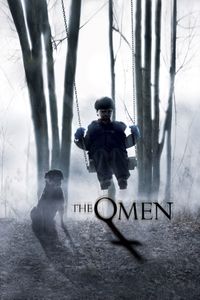
    (In French, On Cable TV, March 2020) Exactly no one will be surprised by this remake of The Omen, and it almost seems by design—More akin to a theatrical revival than a new movie, this update changes very little to the 1976 script (to the point where original screenwriter David Seltzer got the sole writing credit respite a few rewrites without his input!) and essentially updates the actors, cinematography, direction and setting to 2006 standards. As a result, it does feel slicker than the original (the dog attack sequence isn’t quite so ridiculous, for one thing) but loses almost all of its authenticity… if that’s the right word. Not that I’m a big fan of the original—which may account for my not-pleased-nor-displeased disposition toward this remake. It’s almost interesting (like the 1998 Psycho remake) to see essentially the same script given a new coat of paint and taken out for a spin. If nothing else, a double bill of both the original and the remake, while tedious, would be instructive as to how filmmaking evolved in three decades even as the themes of the original have held up. Going back to the theatrical revival analogy, well—why not? For director John Moore, isn’t it better to redo what seemed to work well in the first place than to take chances with modifications that don’t pan out? Despite my lack of affection for the original, it’s rather neat to see Julia Stiles, Liev Schreiber and Mia Farrow step into these well-established roles for a film. It’s not that good, but then again: The Omen’s over-the-top histrionics can be reasonably entertaining, and if the remake doesn’t bring anything new, maybe it does have familiarity to its credit—although by 2020, with immense streaming libraries that can include the original, it remains to see whether there’s a reason for 2006’s The Omen to exist. Aside from, let’s admit it, the rather amazing “2006-06-06” release date.

  • The Painted Veil (2006)

    The Painted Veil (2006)

    (On DVD, January 2017) I had convinced myself that I was going to get a talky dull historical drama with The Painted Veil, which explains why its long and dull first act wasn’t much of a surprise. Another estranged couple in colonial times, playing dirty tricks on one another in an effort to win an ongoing argument against a lush south-Asian backdrop. That’s what I was expecting. What I wasn’t expecting was for the movie to become steadily more engrossing from the moment that the couple sets foot in the small village where most of the story will take place. There’ a great “I’d rather infect myself than spend more time with you” scene that’s remarkably funny, but it’s also the spark that rekindled my interest in the film. Things get more dramatic as disease spreads around the village and political problems rise up just as our lead couple learns to love themselves again. Ed Norton and Naomi Watts are both quite good in the lead roles (with Norton having the harder job of making his character impossible and then softening up), with noteworthy supporting presences by Toby Jones and Liev Schreiber. The cinematography is suitably exotic, and there’s a sobering use of “À la Claire Fontaine” in the soundtrack for those who understand French. The Painted Veil amounts to better film that I was expecting—a reasonably entertaining historical drama at a time when I was bracing myself for a dull one.

  • Spotlight (2015)

    Spotlight (2015)

    (On Cable TV, June 2016) At first glance, Spotlight doesn’t look like the most exciting movie of the year. It’s meant to tell the true story of investigative journalists who spend months uncovering a systematic pattern of child abuse by Boston-area priests and attempts to cover up the scandal. That’s not exactly gripping stuff, and the first few minutes of the film don’t promise much more by focusing on a newsroom and Tom McCarthy’s sober (i.e.: not flashy) directing style. But here’s the strange thing: after a while, once the introductions are out of the way, Spotlight starts getting better. Much better. Along with the journalist heroes of the film, we start getting absorbed in the scandal they’re uncovering. As they chase down clues, we start sheering for those characters in all of their quirkiness, drive and doggedness. In its own quiet way, Spotlight has a few devastating sequences, whether it’s interviews with abuse survivors, encounters with the guilty priests, or a disembodied voice suggesting that the magnitude of the scandal is far, far higher than anyone would suspect. It builds and builds, passing over 9/11 and accusations being hurled back at the investigative journalists, until a satisfying revelation of the scandal … followed by a few devastating title cards as epilogue. Spotlight may discuss a church scandal, but it’s not an anti-religion film: Not only does it give voice to practising Catholic characters, it’s far more vital as a celebration of the power of investigative journalism. In its own low-key way, Spotlight is a terrific spiritual successor to All the President’s Men: In a fair world, this film would lead to scores of young people enrolling in journalism school in order to make the fifth estate even stronger, better and more relevant to the nation. Instead, we’re left pondering the devastating impact of the Internet on newspaper closures, the drive away from in-depth journalism and toward click-bait media. Spotlight isn’t flashy, but it does have a fair number of compelling performances, for the always-excellent Mark Ruffalo as an intensely driven journalist, to Michael Keaton further enjoying a later-career renaissance as a sympathetic editor, to Rachel McAdams as a sensitive investigator and Liev Schreiber as a surprisingly enlightened manager. The script is a wonder of efficiency, as it manages to make document analysis compelling and lays down its scandalous revelation like a nightmarish horror movie. Best yet: the film reportedly stays faithful to the facts of the events. Spotlight may or may not be the best movie of the year as exemplified by the Academy Award it got, but it’s in many ways one of the best-controlled of them, one of the most quietly engrossing and one of the most surprising. It certainly qualifies as must-see viewing.

  • The Last Days on Mars (2013)

    The Last Days on Mars (2013)

    (Video on Demand, March 2014) That’s it: I’m declaring a plague of kudzombies, as the undead are proving as invasive as kudzu in taking over just about every possible movie genres and premises. After The Colony, The Last Days on Mars is the latest science-fiction film taken over by a zombie invasion, leaving an interesting premise devoured by familiar elements from another genre. It starts promisingly enough, with a relatively realistic depiction of a Martian expedition. (The setting is obviously terrestrial down to the gravity, but then again this is a low-budget film.) Tension mounts as one of the scientists discovers life under the surface… but then the small cast starts being devoured by the undead and we’re back to the old zombie plot template. I mourn the film that could have emerged from the first few minutes, because the rest is pretty much seen-this-done-that under red skies. The science-fiction elements get marginalized quickly until we’re left with the basics of the good old infected-or-not lifeboat scenarios, with characters that should be used for more interesting things. The Last Days on Mars isn’t a bad movie by itself, but it quickly heads for too-familiar tropes at a time where the zombie theme itself is getting tedious by sin of simple over-exposure. Too bad; Liev Schreiber is credible as a panic-prone astronaut, while the other actors all get a few interesting scenes to themselves. The special effects are decent for a low-budget non-Hollywood production, the direction has its moments and the visual look of the film does much to reinforce its attempts as hard-SF. Still, none of this is a match for the powerful stench of Yet Another Darned Zombie Movie that eventually stinks up the whole thing. Can zombies just go away now?

  • Goon (2011)

    Goon (2011)

    (On Cable TV, August 2013) What could be more Canadian than a comedy about hockey? Here, Seann William Scott turns in one of his best performances as Doug, a somewhat dim-witted bouncer who unexpectedly proves to be a more-than-competent hockey enforcer.  The role of goons in hockey isn’t glamorous –essentially, they’re there to protect more talented players or to target opposing players–, making Goon’s frequently sweet-natured off-ice atmosphere seem all the more remarkable.  While the film doesn’t shy away from bloody violence, Scott’s performance as Doug (a really nice guy who just happens to be good at fighting) is enough to balance the excessively profane comedy most frequently mouthed by co-writer Jay Baruchel.  Goon is relatively well-shot, decently scripted (especially in the details) and benefits greatly from Liev Shreiber’s late-film appearance as a veteran goon.  While the ending is abrupt, the romance less than convincing and some of the profanity/gore is excessive, Goon remains a bit of a pleasant surprise, and something that Canadians won’t be too embarrassed about.

  • Salt (2010)

    Salt (2010)

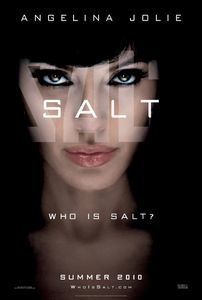
    (In theaters, July 2010) There is something both successful and not quite satisfying in this Cold War espionage thriller throwback.  The straightforward revival of Russians sleeper agents as antagonists in Salt is amusing (even more so given recent news items seemingly custom-made to market the movie), whereas the good old suspense mechanics of assassinations and chases are competently handled.  After The Recruit and Law Abiding Citizen, screenwriter Kurt Wimmer is quickly becoming a reference for thrillers with just enough twists to be interesting, whereas director Phillip Noyce is good but not great as an action director.  (Sadly, the post-Bourne editing is often too frantic to be effective: There’s one over-the-shoulder shot of the heroine jumping down from one vehicle to another that would have been gripping as a one-shot, but is stupidly cut in two by a meaningless insert.)  As for the actors, the three lead characters seem ready to play according to type: Angelina Jolie as the capable action heroine no matter the hairstyle, Chiwetel Ejiofor as the stand-up guy you can depend on, and Liev Schreiber as the one you can’t completely trust.  In terms of pacing, Salt’s forward rhythm is undermined by unexplainable lapses: What should have been a full-speed-ahead action spectacular is slowed down by moody pauses and too-lengthy flashbacks that approach parody at times.  Preposterous plot problems can be forgiven in the name of pure thrills, which is fortunate given how the cheats become bigger and bigger as the film moves in its final act.  When it works, Salt is pure summer entertainment, going back to solid stunts rather than an overuse of CGI.  It’s fun rather than ambitious, solid rather than innovative, and just insane enough to make something palatable from Cold War plot elements we thought dead and buried.  Expect a sequel.

  • Repo Men (2010)

    Repo Men (2010)

    (In theatres, March 2010) In a generous mood, I would probably praise Repo Men for its satiric vision of a future where synthetic organ transplants are common and expensive enough to warrant repo men going around repossessing deadbeats, leaving them, well, dead on the floor.  I would congratulate Jude Law, Liev Schreiber and Forrest Whittaker for thankless roles playing unsympathetic characters and Alice Braga for something like a breakthrough role.  I would say something clever about the film’s forthright carnographic nature.  I may even have something affable to say about Eric Garcia, who sort-of-adapted his own novel for the screen (the story, as described in the book’s afterword, is far more complicated) and wrote one of the most bitterly depressing movie ending in recent memory.  Heck, I would point out the numerous undisguised references to Toronto (where the movie was shot): the inverted TTC sign, the Eaton center complete with Indigo bookstore, the streetcars, even the traffic lights and suburban streets.  But I am not in a generous mood, because Repo Men is an unpleasant and defective attempt at a satirical action SF film that fails at most of what it attempts.  The characters are unlikable, their actions are despicable, the chuckles are faint and the Saw-inspired gory violence isn’t warranted by anything looking like thematic depth.  It is a literally viscerally repulsive film, and even trying to play along the grim sardonic humour gets increasingly difficult to swallow during self-congratulatory action sequences.  Once the film’s none-too-serious credentials are established, it’s hard to care –and that includes a wannabe-romantic sequence in which internal organs are exposed and fondled.  The ending wants to be witty, but it just feels absurd before it is revealed to be cheaply cynical.  The Science Fictional elements don’t even fit together and the result is a big bloody bore.  Instead, just give me another shot of Repo: The Genetic Opera!: at least that film knew how to balance arch seriousness with a sense of camp.  The irony is that Garcia’s novel is actually quite a bit better than the film –don’t let the adaptation scare you from a novel that does what the film wanted to do in a far more palatable fashion.