Luis Buñuel

  • Tristana (1970)

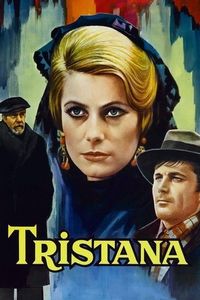
    Tristana (1970)

    (On TV, November 2021) I know just enough about Luis Bunuel’s filmography to expect the unexpected — from the wild surrealism of his earliest films to the more controlled comedy of his last, to the melodrama of his Mexican period and the satire of his Spanish years, who knows what you’ll get with each new film? In Tristana, I certainly got bits and pieces of nearly everything else in his career: intense melodrama with perverted material, social critique, distasteful cruelty, a battered protagonist, and restrained direction despite the lurid subject matter… it’s a surprisingly quiet (even glacially-paced) film but it has quite a bit of material to chew on. Catherine Deneuve is interesting here, zigzagging her own image as a beautiful woman in various ways that run counter to what viewers may expect. I can’t say that I liked Tristana (can one really like Bunuel films?) but it’s intermittently interesting and certainly one of the purest expressions of Bunuel’s lifelong obsessions as put on film.

  • Abismos de pasión [Wuthering Heights] (1954)

    Abismos de pasión [Wuthering Heights] (1954)

    (With French Subtitles, On TV, October 2021) I got interested in Abismos de pasión because it’s directed by Luis Buñuel, but there’s a lot of fine print to read in his bibliography—it’s not all surrealism and wild concepts, and his mid-1950s Mexican phase is far more conventional than most of his other work. Still, conventional isn’t necessarily boring, and so Abismos de pasión ends up being a Mexican retelling of Emily Brontë’s classic Wuthering Heights, transplanted in a countryside much unlike the rural English estates of the original. Then there’s the execution, because when Buñuel decides to go for melodrama, he truly commits to it—the performances are emotionally heightened to an almost parodic degree, and the in-your-face score practically becomes a character in itself, telling the viewers not just how to feel, but giving them permission to go all-out on the love, the tears and the indignation. Despite a relative paucity of plotting, Abismos de pasión is a wild ride in barely 90 minutes, all the way to the overwrought shotgun finale. This is clearly nowhere near the top of my favourite Buñuel films, nor is it anywhere near most critics’ assessments of his work, but it does have a few things going for it.

  • El ángel exterminador [The Exterminating Angel] (1962)

    El ángel exterminador [The Exterminating Angel] (1962)

    (On Cable TV, November 2020) Much as I go back-and-forth on Luis Bunuel’s movies, I went back-and-forth on The Exterminating Angel throughout its duration. After a mystifying introduction to the characters, the premise reveals itself: our dozen high-society characters are suddenly unable to leave the living room of the mansion in which they’ve gathered. Why they can’t leave is unimportant, which is completely in-keeping with the kind of surrealism that Bunuel practised, but somewhat at odds with contemporary audiences more used to a genre explanation, as perfunctory as it is. (I sometimes think that the best thing that genre literature brought to the world was a way to anchor metaphors into some kind of rationality, even in fantasy fiction. Zombies may be a great way to discuss the mindless conformity of the modern world, but they are also interesting in their own right as mortal threats, and it’s that duality of genre fiction that makes it both accessible and profound depending on the level sought by creator and audience.) Knowing that The Exterminating Angel will never explain its situation, the film is free to go through the motions of its plot, as its subjects are in extended captivity: the lies, the loathing, the contempt, the violence—as mayhem plays out in a gilded living room, it’s obvious that this is meant to have deeper levels of interpretation. If you’re not interested in playing Bunuel’s’ game, however, the film is only intermittently interesting. By the time it concludes with the ill-justified freeing of its characters, it’s both interesting and not interesting at the same time: in the nebulous fog of surrealism, something happened but it seems ripe to be swept under the rug with few repercussions nor any reason to care. The premise of The Exterminating Angel has been reused many times in many other places, but the original could use a bit of tightening up as well.

  • Los olvidados [The Young and the Damned] (1950)

    Los olvidados [The Young and the Damned] (1950)

    (YouTube streaming, June 2020) Consecrated cinema classic The Young and the Damned does have a few things going in its favour. For one thing, there aren’t that many movies set in late-1940s Mexican slums. For another, there aren’t that many strictly neorealist films in writer-director Luis Buñuel’s filmography—while the film does sport one surreal sequence halfway between reality and dream, much of the film is as gritty and realist as possible, fully embracing the life and environment of its street-urchin protagonists on their way to becoming hoodlums. At 88 minutes to present a full-featured narrative (not always a given in Bunuel films!), The Young and the Damned doesn’t overstay its welcome. The film is resolutely not that optimistic about human nature and can occasionally become harrowing viewing. But, after generations of film critics have designated this as a classic, is it still worth a look? Probably. Maybe, if you can tough it out.

  • L’âge d’or [The Golden Age] (1930)

    L’âge d’or [The Golden Age] (1930)

    (YouTube Streaming, March 2020) Hark, dear viewer, and abandon all hope of making sense of L’âge d’or. Notable for it being a collaboration between famed surrealists Luis Buñuel and Salvador Dali, it’s absolutely not designed to make sense. (Dali wasn’t a filmmaker, and neither was Buñuel at the time—legend has it that the finished film includes nearly everything ever shot during the sequential production.) Interestingly, it was one of the first sound movies made in France and yet it’s not designed to take advantage of that either: while there’s some narrative sound, much of the so-called plot is “given” through wall-of-text title cards. Not that you should pay attention to plotting: Since there’s no narrative consistency, either shrug or try to watch L’âge d’or on another level. At least it’s short. This being said, the plot isn’t everything and in the finest surrealist tradition, the film is occasionally very funny—and also very violent. (For added laughs, try to read the Wikipedia plot summary after watching the film, as it seems intent on imposing some rational order on a film that rejects any.) I made my peace with L’âge d’or not by trying to understand it, and by seeing it as a cruel playground to explore the relationship between humour and the unexpected—there’s plenty of the unexpected, although maybe not as much of the funny as I’d like.

  • Belle de jour (1967)

    Belle de jour (1967)

    (Criterion Streaming, August 2019) There’s quite a bit of (tasteful) perversity at play in Belle de jour, and it’s consistent with what I know of writer-director Luis Bunuel’s work. It does begin with a sequence that seems to go quickly from plausibility to complete deliriousness, only for the truth to emerge and make the sequence even more perverse as a fantasy. This lands us in the head of our protagonist, a married woman unable to be intimate with her husband, but increasingly tempted to become a high-end prostitute by day. Much of the remainder of Belle de jour is taken up with her experiences at the house where she practises her trade, various clients rotating through the film. Two more off-putting fantasies spice things up. It’s possible to see quite a few themes at play here, but the one I’ll highlight has to do with prostitution not as a sexual act, but as one of willing compliance—the protagonist learns from the other girls that the trade isn’t as much about pleasing clients sexually as presenting to them the façade of what they expect from a partner compliant to their desires. The switch between their two faces is fascinating and handled with a decent dark humour that prevents the film from being unbearable. Catherine Deneuve makes the most out of her 1960s doll-like features as the titular Lady of the Day—she’s fascinating and the film doesn’t have any trouble making us interested in what will happen to her next. I should also be noted that there is almost no nudity in Belle de jour besides a few exposed backs—the film takes place on another register, far more pernicious. It’s more interesting than I would have expected.

  • Un chien Andalou (1929)

    Un chien Andalou (1929)

    (YouTube Streaming, July 2019) Often mentioned as a classic of surrealism, Salvador Dali and Luis Bunuel’s Un chien Andalou can be a tough watch. It starts on the single most unpleasant note imaginable, with a succession of two shots suggesting a woman’s eye being cut open with a straight razor. (If you look closely at the second shot, you can see it’s a dead farm animal’s eye, but most people don’t look that closely … and it’s not much of an improvement.)  Old-school surrealism was extremely violent by design, and the following scenes certainly give into that tradition what with ants drawling out of a hole in a man’s hand, someone getting hit by a car, amputation, a disappeared mouth and so on. Do not try to make sense of the film, which -at best—follows a twisted kind of dream logic and at worse is just trying to get a rise out of an audience craving narrative. Some of it can be very funny (such as the title cards boldly announcing things like “Sixteen years later” without it having any sort of bearing) and some of it quite horrifying. Un chien Andalou does feel like a far more modern film than a 1929 title, mostly due to pre-Code levels of eroticism and ultra-violence. Paradoxically, it’s a large part (aside from the pedigree of the creators) why it’s still worth a (well prepared) look today. At least it’s barely more than twenty minutes long, meaning that it will soon be over even if you don’t enjoy it.

  • Viridiana (1961)

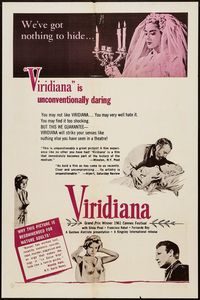
    Viridiana (1961)

    (Kanopy Streaming, October 2018) I’m not saying that there isn’t some potential in a movie taking on religion and rich people as satirical targets. But I’m saying that Viridiana isn’t it—not with its muddled message, punching down to the homeless as objects of scorn, fuzzy dramatic arc and few overriding commitment of cohesion. But then again—it’s from writer/director Luis Bunuel, meaning that consistency may not be the point. The plot, as loosely as it can be called as such, has to do with a noviciate visiting her wealthy uncle, avoiding his seduction, staying at the mansion following his death and the arrival of her half-cousin, trying to morally uplift some vagrants who then trash the mansion, avoiding another sexual assault and then settling into a ménage-a-trois with her half-cousin and a servant. Or something along these lines—I wasn’t exactly paying rapt attention to the film by then. There is some supposedly comic material here (usually mixing piety and vulgarity, such as when the homeless re-create The Last Supper) but it usually feels haughty and forced. I strongly suspect that the different social context matters: The Vatican designated the film as blasphemous, whereas there’s little here that modern audiences would find particularly shocking. (The film itself is still a bit off-putting, what with its multiple instances of sexual assault.) It doesn’t amount to much—Viridiana may have some potential, but it feels obvious and mean today, much of the satirical intention has been stripped away by the decades.

  • Le charme discret de la bourgeoisie [The Discreet Charm of the Bourgeoisie] (1972)

    Le charme discret de la bourgeoisie [The Discreet Charm of the Bourgeoisie] (1972)

    (In French, On TV, October 2018) I liked Le charme discret de la bourgeoisie quite a bit more than I expected, which is saying something given my usual reluctance toward surrealism and/or French cinema of the 1970s. Writer/director Luis Buñuel does have a few surprises up his sleeve, though, the best of those being the dry black humour of a film in which anything and everything can happen. Once you accept that Le charme discret de la bourgeoisie is pure surrealism (which doesn’t take all that long, even taking into account that 1970s French bourgeoisie was weird enough), the rest is simple joy as the film zigs and zags between dreams and absurdity. Violence abounds, but the film remains riotously funny even as the black comedy gets even darker. The flipside is that nothing means much, so it’s not really worth watching the film for characters or plotting as much as a series of sketches featuring more or less the same cast. Which isn’t to say that the film is meaningless comedy—while it’s strongest when it’s at its funniest, there’s enough of a graphic (at times unsubtle) illustration of hypocrisy to keep thematic engines running. Even for plot-centred viewers such as myself, meaningless isn’t the same thing as worthless, and Le charme discret de la bourgeoisie gives us enough narrative breadcrumbs to sweeten its own surrealist intent. I liked it more than I thought I would. In fact, I may even enjoy a repeated viewing in a few years.