Mark Hamill

  • Body Bags (1993)

    Body Bags (1993)

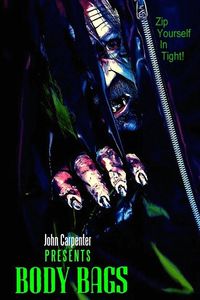
    (In French, On Cable TV, September 2020) Clearly a film by and for horror fans, Body Bags can best be described as another horror anthology movie (patched together from a failed proposal for an episodic TV series), with a moody framing device (John Carpenter playing a morgue worker messing around for the audience) setting the stage for three twenty-some-minute-long segments. The first is “The Gas Station,” featuring Alex Datcher as a student taking up a gas station attendant job in the middle of the night, and (rightfully) feeling scared when a killer is identified as prowling around. Directed by John Carpenter, this a rather straightforward action thriller segment is well-executed but familiar in its topic matter. The second segment, “Hair” (directed by Tobe Hooper), is somewhat more comedic, as a middle-aged Stacy Keach takes increasingly drastic steps to reverse his increasing baldness. It ends in creepy-funny material, although the abrupt end once the joke is explained seems unsatisfying—at least it takes the time to properly dissect the various reactions of its characters to encroaching baldness. The third segment, “Eye,” lands us in straighter horror territory as a baseball player (Mark Hamill with an unfortunate moustache) who lost an eye in a car accident is the recipient of a transplanted eye… who belonged to a serial killer. The eye predictably takes over with disastrous results. As an anthology film, Body Bags is not all that bad—but its most distinctive feature is its unapologetic appeal to horror audiences: There are tons of cameos from horror director here, and the tone is the kind of horror/comedy that reaches as far back as the early EC comics. It’s not world-changing entertainment, but it’s a chance to see a few familiar names having fun, and one of Carpenter’s last good films.

  • Village of the Damned (1995)

    Village of the Damned (1995)

    (On DVD, January 2020) If you’re a horror fan, the 1995 remake of Village of the Damned should be somewhere on your long list of things to see—if only to see how famed director John Carpenter would take on the task of modernizing the classic 1960 film. Predictably, the result is decent… while remaining quite a bit less than the original. Still, let’s recognize that Carpenter at least has the chops to make the film slightly more accessible than the sometimes-cold original, and that, from a distance of 25 years, the mid-1990s setting is fast becoming a period piece in its own right. The result can boast of an intriguing cast—Kirstie Alley is fine as a hard-driven scientist, and it’s fun to see both Christopher Reeves and Mark Hamill in roles away from the best-known characters. (As it happened, this was the last film that Reeves completed before the horse accident that left him paraplegic.) Carpenter fans will recognize this as middle-tier work from someone who had mastered horror directing at this point in his career—it’s suspenseful and atmospheric, but also slightly ridiculous and at times too gory (but not always). The rescue subplot at the very end is troublesome, considering that it messes with something that should not be messed with. Still, while it may not reach the heights of Carpenter’s best work, Village of the Damned is still a serviceable little chiller that can be watched easily—and it’s probably more interesting now than it was upon release.

  • Star Wars: Episode VI – Return of the Jedi (1983)

    Star Wars: Episode VI – Return of the Jedi (1983)

    (Fourth or Fifth Viewing, On Blu-ray, November 2018) I do have a soft spot for Return of the Jedi: I don’t hate the Ewoks as much as some pretend to do (heck, keep in mind that they’re probably going to eat those fallen Stormtroopers) and as a kid who was eight when the movie came out, cinema couldn’t get any better than the sequence in which the Millennium Falcon goes inside the Death Star to blow it up. Decades later, I still get a kick out of that sequence, especially given its place in the three-ring circus that is the last act of the film. Richard Marquand does a fine job directing a complicated film, and the result it still fun to watch. I’m not happy with some of the digital alterations made to the movie since its release—the celebration sequences set on planets that would be introduced in the prequels are the worst. Mark Hamill is a much stronger presence this time around (even though the short timeline between the two movies don’t support much of his growth), while Harrison Ford and Carrie Fisher are up to their standards. (Fisher never looked better than in this film, and I’m not talking about the Jabba-the-bikini sequence as much as her long hair extensions down in the Ewok village.) While revisiting the original Star Wars as a not-eight-years-old was a serious let-down, the two immediate sequels are still fine—as long as you learn to live with the various idiocies of the science-fantasy adventure tone requiring so many contrivances along the way.

  • Star Wars: Episode VIII— The Last Jedi (2017)

    Star Wars: Episode VIII— The Last Jedi (2017)

    (On Blu-ray, March 2018) So the newest mainline Star Wars movie is out and wow is it interesting. After criticisms that The Force Awakens was a carbon copy of A New Hope, here comes The Last Jedi, seemingly determined to outdo The Empire Strikes Back and undercut expectations at every turn. Never mind the mind-warping idiocy of the premise (space bombers requiring gravity? A space chase in which they need fuel to keep going the same speed? Why is this so dumb?) when the entire movie, from plot points to one-liners, seems determined to shake up the Star Wars legacy. Consider the repeated undercutting of the heroic male as represented by Poe. Consider the savaging of the idea that Rey’s parentage was important. Consider Luke as a reluctant mentor. Consider the silly humour of “general Hugs” or the milking sequence, at odds with the series so far. Consider the script, replete with dialogue along the lines of “I didn’t expect that,” “I assumed, wrongly,” “let the past die,” “It’s time for the Jedi … to end.”  Heck, simply consider the misdirection in which a steam iron is momentarily made to look like a new ship. Most of the plans hatched in this movie are near-complete failures. Dozens of plot arcs launched in The Force Awakens are cut shot here, usually unceremoniously. The ending is the bleakest in the series so far, even in acting as a counterpoint to The Empire Strikes Back. This is no mere accumulation of coincidences: Official interviews confirm that there was very little overarching plotting for the trilogy—writer/director Rian Johnson was able to go wherever he wanted with this film, with little regard to the intentions of the previous film. Considering that, it’s easy to understand why a number of Star Wars fans were infuriated at the result—it certainly doesn’t fulfill expectations, and arguably destroys quite a bit of the Star Wars mythos in the process. On the other hand … for jaded viewers who have been contemplating a yearly Star Wars franchise unable to take risks, this is a welcome shot in the arm. It’s worth reminding everyone that the trilogy isn’t complete—there may be retractions and further revelations to build upon the earthquake seen here. It’s all very interesting, which wasn’t necessarily something to be said about The Force Awakens (although it was one of the strengths of Rogue One). It helps that the film itself is reasonably made, although with significant issues. At nearly two hours and a half, it’s too long by at least fifteen minutes—the last act in particular feels like an afterthought after the climactic throne room confrontation. The idea of Canto Bight is far better than its execution, and while cutting off dramatic arcs in unexpected fashion is intriguing, it’s also frustrating—the case example here being the somewhat unceremonious end for Captain Phasma. The special effects work is fantastic, the Porgs aren’t as annoying as expected, and the actors aren’t bad either—among the newcomers, the ever-interesting Laura Dern makes a good impression in an unusual role, while Kelly Marie Tran brings a bit of welcome diversity (not simply in ethnicity, but also in class) to the usual cast. Mark Hamill makes the most out of his acting repertoire, while Adam Driver is a bit more than an angsty antagonist this time around. Still, the star here is the plot and its willingness to go against expectations. I’m not entirely happy with the results, but I’m far more interested in seeing where the next episode will take us than I was at the end of The Force Awakens. I’m still bothered by a lot of the world building, but, eh, it’s Star Wars after all. Plausibility doesn’t factor in.

  • Star Wars (1977)

    Star Wars (1977)

    (Seventh or eighth viewing, On Blu-ray, May 2017) Well, well, well… Star Wars. The original. A fixture of my childhood, to the point where I long thought of the movie as review-proof: what would I possibly say about a film I watched every time it played on TV when I was a boy? I last saw it in theatres when it was re-released in 1997, and before then in the mid-nineties in a campus theatre with a bunch of animation students enthusiastic about the 1993 Definitive collection laserdisc, and before that nearly every broadcast on Radio Canada… But as I sat down to celebrate the 40th anniversary “May the Fourth” to watch the latest 2011 Blu-ray release of the 1977 film, I realized that there is, actually, quite a bit to say about Star Wars from a critical perspective. I’m not seven anymore, and the flaws of the film are more glaring than I expected. The story is simplistic. George Lucas’s dialogue, other than some oft-quoted lines, is frankly terrible. Carrie Fisher, Mark Hamill and Harrison Ford have charm, but they were not gifted actors at the time (they got better, or more accurately grew more comfortable with their chosen screen persona). The universe is bare-bones and at time nonsensical. The special effects are all over the place, a flaw actually magnified by the hodgepodge of changes made to the film through the years, most notably in inserting now-dated CGI in the 1997 version of the film. The results clash, all the way to the overwhelming grain of 1977 film stock being blurred with 1997 digital makeup. The Blu-ray transfer of the film may be too good—much of the low-budget origins of the film clearly show, and harming the look of the film isn’t a good thing given that its substance is so lacking as well. Now, I still do like Star Wars—but I’ve become less and less of an uncritical fan over the years, and refreshing my memory of the first instalment does nothing to reverse the tendency. What may remain from Star Wars eventually is not much more than the launchpad of a much bigger and deeper shared universe. I’ll be watching the original trilogy in the next few months to officially log my reviews along the way (I saw them all last before I started keeping track of reviews), but I’m not going to be surprised if I end up re-evaluating the prequel trilogy based on my adjusted impressions of the three original films.