Marx Brothers

  • Horse Feathers (1932)

    (On DVD, November 2021) Alas, it is with a mournful tone that I announce having reached the end of the Marx Brothers filmography. Oh, I still have a few odds and ends to follow-up, and a few more standalone Groucho roles to see, but Horse Feathers marks the last of the Paramount Fives. It may also be the least of those Fives — taking place in the still very familiar environment of college football, it features Groucho as a college president, Zeppo as his football-playing son, Chico as a semi-underworld figure and Harpo doing whatever Harpo wants to do. The plot purports to have something to do with hiring pro football players to help a college team win, but no one ever watches Marx Brothers films for their plot: it’s all about the gags and jokes and simply seeing the Brothers do their own thing, whether it’s a string of non sequiturs, harp playing or pure vaudeville gags. It’s all quite funny, although not quite as funny as their other films of the period: there isn’t much in terms of sustained comic sequences or memorable sight gags: even the dialogue is amusing without being striking. There are a few musical numbers (most of them thankfully more comic than heartfelt, unlike their later MGM efforts) and some intriguing period detail — the presence of a “college widow” as a significant supporting character led me to a trip in the dusty hallways of outdated tropes. Still, Horse Feathers is not a dull movie: there’s nearly always something going on, and the Brothers’ way of hitting several comic registers in quick succession remains one of their more remarkable traits. If Horse Feathers is a goodbye film, then it’s not a disappointing one. It’s not their best… but not their worst either.
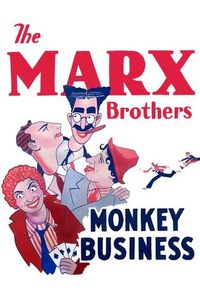
  • Monkey Business (1931)

    Monkey Business (1931)

    (On DVD, August 2021) I’m predisposed to like Marx Brothers films, especially their more anarchic Paramount period before they got hired and steamrolled by MGM. Monkey Business is their third film — their first shot in Hollywood rather than in New York City, their first original script rather than a collection of vaudeville routines, and their first without Margaret Dumond (sorely missed). Somewhat awkwardly sandwiched between Animal Crackers and Horse Feathers, it doesn’t quite have the memorable sequences from other Marx Bros films of the period. Oh, it’s funny enough — and it begins on a very recognizably 1930s setting, which is to say on an ocean liner crossing the Atlantic to the States. Subsequent bits of business (after the brothers are identified as stowaways by the ship’s crew) involve mobsters and saving a girl. Zeppo plays the romantic lead, Groucho talks smart, Chico talks fast and Harpo doesn’t talk. Some of the usual setpieces are there (Groucho insulting an older woman, Harpo harping, etc.) but again it’s hard to find highlights. The Maurice Chevalier imitation scene is distinctive and drags on too long (although it remains an intriguing glimpse at the stature of Chevalier back then.), which is a common failing of many other scenes. Oh, it’s fun enough and there’s enough for Marx fans to see. It’s also far more overly comic than the MGM films. But compared to its immediate predecessors and successors, Monkey Business feels a bit flat, undercooked and easy — although what’s underwhelming by Marx Brothers’ standards is still quite funny compared to other films of the time.

  • Room Service (1938)

    Room Service (1938)

    (On Cable TV, March 2021) In the Marx Brothers filmography, Room Service is perhaps more distinctive for being the one film not written by the Brothers themselves. As a theatrical play adaptation, it’s clearly different — more cohesive, less anarchic, but also less tailored to their own strengths. Still, you can see the Brothers doing what they can to bend the material to their preference — Harpo doesn’t speak, Groucho does and Chico hustles. Much of the action takes place in a hotel room where the protagonists are plotting to put on a show despite acute financial problems — there’s a white whale that can solve all of their problems, but hooking him won’t be easy, considering the interference of the hotel manager who wants them out of there right away. Ann Miller shows up in an early-career appearance, and it’s hard to believe that she’s only 15 here: having lied about her age by five years to get her RKO contract, she easily looks older but doesn’t have that many scenes to shine. The comedy is decent and sufficiently outside their screen persona to be interesting, but clearly not up to the Brothers’ usual standards. It’s much better when you grade it not against other Marx movies, but against other 1930s theatrical comedy adaptations: it’s funnier than most, certainly more absurd than others and faster-paced as well.

  • The Big Store (1941)

    The Big Store (1941)

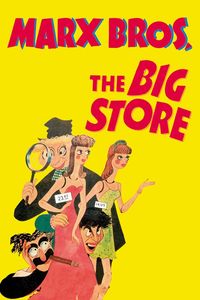
    (On Cable TV, November 2020) Nearly every Marx Brothers film is worth a few laughs, but there are still clearly superior Marx films and then the others. While The Big Store is not one of their worst, it doesn’t rank as a particularly good one. Made during their MGM years, it features three of the brothers wreaking havoc in and on a department store, as Groucho plays a detective asked to uncover a plot against the owners. Everyone plays their part, including Margaret Dumont as the rich older lady pursued by a gold-digging Groucho. As usual for Marx films of the period, the plot serves as a way to hang the sketches, and to provide a break from the comedy with easily skippable musical numbers that borrow a lot from operettas and feature the featureless Tony Martin and Virginia Grey.  (Virginia O’Brien, as usual, is more distinctive with a monotone take on a lullaby.) Harpo plays the harp, Chico does his wiseguy and Groucho plays with words. For fans, the two standout sequences of the film are a demonstration of increasingly wilder beds popping out of the walls, and a final chase through the entire store that finely upholds the Marx Brothers’s tradition of visually anarchic movie climaxes. As with all of their movies, it’s worth a look and possibly a box-set purchase. But it’s not one of their best, and the MGM structure clearly differentiates between the fun scenes and the dull ones in between.

  • Go West (1940)

    Go West (1940)

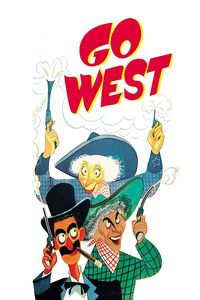
    (On Cable TV, August 2020) Good but not great, the Marx Brothers comedy Go West is typical of their MGM years. Structurally sound, it has the extraneous romance for supporting characters, it has musical numbers we don’t need, it has Harpo on the piano and the harp, and it takes a very specific environment (in this case the Wild West, or perhaps more accurately the western genre) as an excuse to line up thematic gags. As usual, the plot summary is irrelevant – The Marx Brothers go west! While well assembled by director Edward Buzzell, the film as a whole remains a sedate affair for a very, very long time: amusing but not hilarious. Having the brothers not being pure agents of chaos is a disappointment, as is an iffy sequence with a Native American character (the patter is progressive, but the portrayal is regressive). But then comes the climactic scene, in which the frantic brothers must dismantle their train in order to keep feeding the engine (a comic device used in prior and later films, but still quite funny here) – that scene is clearly the highlight of Go West. Unfortunately… I had just watched it a few days earlier as part of The Big Parade of Comedy anthology film. While funny, this is weak stuff compared to the better Marx Brothers movie – but if you’re intent on watching their whole filmography, then this one is in the lower tier, but still wrings out a few more bits of comedy.

    (On Cable TV, June 2021) You would think that unleashing the Marx Brothers on the Western genre would have been a sure-fire recipe for comedy, but the Brothers’ MGM years weren’t all equally good, and Go West is often blander than their other movies. Typical to the MGM formula imposed on the Brothers, their antics are interrupted by straight romantic-drama stuff and musical numbers — some of them fun, like “Ridin’ the Range,” but others bland and forgettable. The moments that we best remember from the Marx movies are fewer. The opening is a classic interplay between the brothers and the final twenty minutes are a great deal of fun, but what’s in the middle is dull and hardly deserving of the Marxes. There’s a sadly stereotypical sequence with native characters that feels more obnoxious than funny (although it does get a few pot-shots at white colonizers in between the more racist material), but otherwise the film doesn’t quite know what to do with its vaudevillians invading the western frontier. I actually had to watch the film twice to form a coherent impression of it, having fallen asleep in the middle section the first time. (And that’s after having forgotten that I had seen it last year.) A second viewing did not necessarily improve my opinion of it much. Go West was clearly made in the descending era of the Brothers’ filmography – you can still see the bits of genius that made them famous, but there’s not much left once you remove the spirited final train sequence.

  • At the Circus (1939)

    At the Circus (1939)

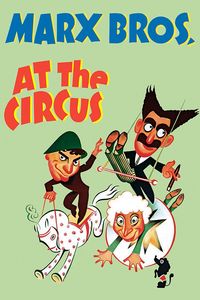
    (On Cable TV, January 2020) In the grand arc of the Marx Brothers’ career, their move from Paramount to other studios is often seen as a hinging point—the Paramount pictures were anarchic, reflective of their vaudeville career and are still acknowledged as comedy classics, whereas the longer they worked outside Paramount, the more they became disciplined, comfortable with the medium of film and… duller. (Exception made of their first two movies with MGM, A Night at the Opera and A Day at the Races, combining the best of both approaches.) At the Circus finds them four films removed from Paramount and clearly comfortable with the newer approach. Once again, we have the “at the” film title structure; we have Harpo harping (very well indeed), playing piano and miming his way through physical comedy; we have Chico fast-talking and jesting; we have Groucho singing “Lydia the Tattooed Lady,” quipping furiously and scheming to get money from an oblivious character played by Margaret Dumond; and we have a lead romantic couple singing their love while the Marxes wreak comedic havoc on their surroundings. It’s all the same as their other pictures… except that it’s not as funny. A high-flying finale does leave the film on a stronger note, but much of At the Circus plays like a thinner re-thread of the Marx Brothers’ best movies—still funny, sure, but not as much. Fans will like much of the material (I’m quite fond of Groucho turning to the camera at a risqué moment and wondering, “There must be some way of getting that money without getting in trouble with the Hays Office.”) although newcomers to the Marx Brothers would be better served by their other better movies.

  • That’s Entertainment, Part II (1976)

    That’s Entertainment, Part II (1976)

    (On Cable TV, March 2019) As amazing as the first That’s Entertainment movie musical compilation film can be, there’s a good argument to be made that That’s Entertainment, Part II is equally impressive, albeit in slightly different ways. Directed by dance legend Gene Kelly, it features Kelly and Fred Astaire in their second (and last) dance sequence together—which doubled as Astaire’s last dance number as well. Both of them get to present clips (Kelly even showing up in Paris), which are one bundle of joy after another. This follow-up is a more deliberate affair than the first, with a conscious intention to go beyond MGM musicals to encompass comedy skits (including the Marx Brothers’ famous stateroom sequence) and tributes to non-musical stars and a retrospective about Spencer Tracy and Katharine Hepburn. Still, the foundations of the film are the musical clips, and the MGM catalogue is so deep that the result is still well worth a look even when it’s missing the most classic numbers already featured in the first film. That’s Entertainment, Part II can work both for neophytes and jaded fans of the musical genre: By introducing the highlights for newcomers, and by reminding connoisseurs of what they’ve seen: There’s a mixture of discovery and appreciation throughout. Being somewhere between the two extremes at the moment, I had fun identifying films I had already seen and performers I already knew, all the while taking notes of movies that I had to see next. One warning: The title song “That’s Entertainment” attains earworm status at some point during the course of the film. It’s a very small price to pay (if it’s even one) for a great retrospective.

  • A Day at the Races (1937)

    A Day at the Races (1937)

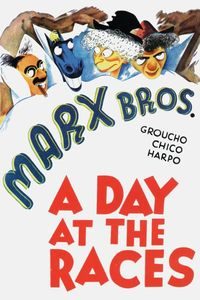
    (On Cable TV, January 2018) Marx Brothers vehicle A Day at the Races, second in their MGM line-up, does feel a lot like the previous A Night at the Opera—individual set pieces for the Brothers, matronly role for Margaret Dumont, romantic subplot for the non-comedians Maureen O’Sullivan and Allan Jones, large-scale conclusion in a very public setting … it’s a formula, but it works even when it’s not as effective. Once again, I’m far more partial to Groucho’s absurdist repartee than Harpo’s silent act, but the result is decently funny, with a few highlights along the way: The musical numbers are actually pretty good (including pulling a harp out of a destroyed piano), even if the blackface sequence is hard to enjoy now despite the good rhythm of the song. Most of the comedy bits drag on a touch too long (or definitely too long for the “ice cream” sequence) but the charm of the Brothers usually make up for it. A Day at the Races isn’t quite as good as some of the previous Marx films, but it’s still watchable enough today.

  • A Night at the Opera (1935)

    A Night at the Opera (1935)

    (On Cable TV, December 2017) I’ve been meaning to go back to the Marx Brothers comedies, decades after seeing and loving Duck Soup. Fortunately, these eighty-year-old movies are still holiday fixtures, so I’m back with the Marxes starting with A Night at the Opera, the first of their MGM movies after leaving Paramount and being led to a more audience-friendly format. Sadly, the connective material that MGM imposed remains the weakest part of the film—who cares about a romance between two dull secondary characters, other than it provides the backdrop against which the brothers run wild? Plots are necessary, but it’s the individual comic sketches that make A Night at the Opera so memorable. Whether we’re talking about Groucho’s verbal pyrotechnics, the famous stateroom scene, the anarchic finale set among a malfunctioning theatre stage … or even the surprisingly engaging bit of piano-playing, this is a film of scenes and sequences. It doesn’t all work (I’ve never been much of a Harpo fan) and often overstays its welcome, but much of A Night at the Opera is still very funny today. 

  • Duck Soup (1933)

    Duck Soup (1933)

    (On VHS, September 2000) In humor, there’s a tendency to assume that everything relevant was invented recently, but this Marx Brothers film shows that most comedy tactics were used well before our birth. Duck Soup isn’t a film to see for a strong plot (there isn’t one beyond stringing together a few vignettes), original characters (the Marx brothers basically play their specialties; Groucho with his verbal deftness, Guido with his pantomime and Chico somewhere in between) or cinematic qualities (though there are a few surprisingly modern sequences). But is it funny? Definitely. Enough to track down the film and see it as a group. You’ll be quoting from it for days after.

    (Second Viewing, On Cable TV, January 2021) I was a bit worried about watching Duck Soup again—I first saw it twenty years ago, before I got interested in classic Hollywood or most other Marx Brothers movies, and I didn’t want another, much better-informed look to bring down my opinion of the film. I shouldn’t have been worried: despite being far more familiar with Groucho, Harpo, Chico and Zeppo than I was back then, Duck Soup remains one of their finest achievements.   Groucho defies convention at every opportunity as Rufus T. Firefly, dropping quips without a care in the world and indulging in still-amazing wordplay. The world of the Marx Brothers seems even more fantastic in Duck Soup than in other films, as they go for nationwide satire depicting how the nations of Freedonia and Sylvania are brought to the brink of war. Political satire and a wild war sequence combine in the last of the Brothers’ Paramount films—perhaps the slickest expression of their anarchic brand of comedy before MGM put them under contract and inside a more rigorous formula. While I think that some Marx Brothers had better individual showcases in other films (Harpo, in particular, seems ill served by this episode), Duck Soup is perhaps better at seeing them work with each other—the terrific “mirror” scene being the anthology-worthy illustration of that. Plenty of comic set-pieces pepper the film, but it’s the somewhat more mature tone—with a big helping of disregard for patriotic values—that makes Duck Soup just a bit more endearing to contemporary audiences. I loved it in 2000; I still love it in 2021.