Natalie Wood

  • Marjorie Morningstar (1958)

    Marjorie Morningstar (1958)

    (On Cable TV, October 2021) Merely calling Majorie Morningstar not one of Gene Kelly’s finest efforts is probably looking at the film from the wrong angle. As a Kelly musical, it’s definitely underwhelming—the song-and-dance numbers are few and short; he’s badly matched with a heroine (Natalie Wood) twenty years younger than he is; he’s asked to play a character of Jewish ethnicity (a stretch for Irish/German stock); and (thankfully?) he doesn’t get the girl. But that’s an awfully reductive way of looking at the film, which is an adaptation of Herman Wouk’s massive coming-of-age novel, dealing with issues of tradition and modernity clashing as our protagonist grows up and tries to find herself a suitable husband. Majorie Morningstar is noteworthy (says Wikipedia) for being unusually forthright at the time about showing Jewish traditions and rituals and explicitly having Jewish character. But that does mean that the film is, at heart, a messy romantic drama more focused on the protagonist finding herself than presenting a romance—quite a change from the usual musical comedy formula that Kelly evokes by his presence. It does make for interesting viewing—the look at NYC’s 1950s Jewish community is often interesting, and even includes a side-trip to the Catskills resorts. Wood looks great in one of her first post-adolescent roles, and some of Kelly’s dramatic material can be surprising for fans of the actor. (He also looks pretty good with stubble.)  But at more than two hours and an intentionally subtle conclusion, Majorie Morningstar does feel like a let-down of a film: something that approaches, even courts being a Technicolor musical comedy for marketing purposes, but really should have been executed in a lower-key, more dramatic form featuring lesser-known actors.
  • Gypsy (1962)

    Gypsy (1962)

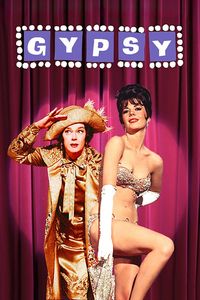
    (On Cable TV, April 2021) It took me far too long to realize that Gypsy was based on a true story, but no matter — even if you don’t know anything about burlesque dancer Gypsy Rose Lee and her impossibly micromanaging mother, the film still works quite well as its own thing. Few movies do the passing-of-the-torch thing as well as this one, either narratively, structurally or in a historical context. While Gyspy’s first moments are almost entirely dedicated to the formidable presence of “the ultimate stage mother” played by Rosalind Russell, almost forgetting the children and especially the eldest one, the film gradually shifts focus as it goes on, giving more and more place to the eldest daughter, as Natalie Wood takes centre stage and needs to put her mother in the background for her own good. Taking a step back, the film itself can be seen as a generational passing of the torch between Russell and Wood — both of them not dissimilar as actresses. (Legend has it that the two did not get along very well on set.) Wood looks really good here even if, to remain a family film, Gypsy considerably sugarcoats burlesque to the point of innocuousness. There’s plenty of good dialogue, strong character evolution and enough colourful background details to make it interesting. The first hour is a bit long — and much of it can be justified by seeing the film as a transition between two characters that could have been rushed had the first hour been snappier. Adapted from a Broadway musical that was itself adapted from Gypsy Rose Lee’s autobiography, Gypsy remains a fascinating character portrait more than a true musical… and it’s still effective even in a far more permissible twenty-first century.

  • The Star (1952)

    The Star (1952)

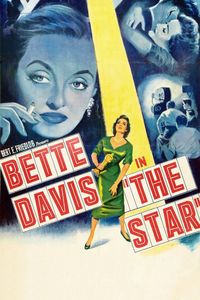
    (On Cable TV, February 2021) The more I explore Hollywood history, the more I’m struck by the meta-textual aspect of good casting, where factors outside the confines of the fiction end up contributing to its effectiveness. For instance, you can watch The Star and appreciate, at face value, its story about a washed-up Hollywood star struggling to relaunch her career. You can watch the lead actress and the younger actress playing her daughter and think, “Hey, they’re pretty good!”  But once you’re aware of the vast tapestry of Hollywood history and learn to recognize Bette Davis and Natalie Wood, having them in the lead role gives an added dimension to the entire film — taking advantage of those two actresses’ careers spanning decades of history before and after The Star. It gets wilder once you read the film’s production history and learn that the lead character was based on Joan Crawford — and that Davis, who famously loathed Crawford, was only too eager to play a version of “her rival” rather than a character too much like her. (Davis was rewarded for her honest portrayal in an unglamorous role by an Academy Award nomination.)  As for The Star, it’s actually quite good — if you like Hollywood inner baseball, it’s a credible portrayal of an aging star who comes to grips with fame having passed her by, and it’s not quite as lacerating nor as satirical as similar treatments of the topic have been in other circumstances. But really, it’s the casting that makes the film special.

  • Natalie Wood: What Remains Behind (2020)

    Natalie Wood: What Remains Behind (2020)

    (On Cable TV, May 2020) Considering the richness of Natalie Wood’s life (the films, the forty-year-long career, the child star, the beauty, the men she dated, the family, the clashes with the studios, the awards) and the tragic circumstances of her death in 1981, any documentary about her has an embarrassment of material to showcase. Documentarian Laurent Bouzereau chooses a middle path in Natalie Wood: What Remains Behind, trying to strike a balance between the film that her daughter Natasha Gregson Wagner (the film’s defining voice) wanted to see as a celebration of her mother’s life, and the more sensitive discussion of her death, which is what most viewers are interested in. After the rapid-fire overview of her career, the film moves to a climax of sorts when Gregson Wagner interviews her stepfather, Robert Wagner, about what happened on the boat the night Wood died. While Wagner’s responses are emotional, they’re also incomplete and don’t reveal anything new. While clearly designed to exonerate Wagner of any wrongdoing, the film ends up being this semi-hagiographic, semi-regurgitated look at Wood that packages her life and one version of her death into content fit to feed into the streaming maw — but does not bring any new light on the topic. So, Wood fans, keep your expectations in check and take the documentary for what it is—a reminder of a vivacious screen presence gone too soon, a celebration of her less-visible facet as a mother, and a public statement by her family. Considering that of the four people that were on the boat that night, two are dead and the two others are Christopher Walken and Robert Wagner, maybe we’ll eventually get a more satisfactory answer. But then again, maybe not. One thing’s for sure—if you’re looking for a more even-handed approach to Natalie Wood’s life and death, read a book.

  • Bob & Carol & Ted & Alice (1969)

    Bob & Carol & Ted & Alice (1969)

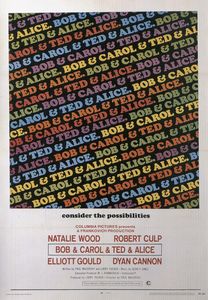
    (On Cable TV, March 2020) Mainstream Hollywood’s take on the sexual revolution of the 1960s gets one of its definitive examples in Bob & Carol & Ted & Alice. Writer-director Paul Mazursky takes on the radical openness of the time with his protagonists seeking enlightenment (or maybe just a sense of cool) through affairs and proposed swinging. But nothing quite goes as planned, which definitely keeps the film more interesting than a simple time capsule. A typical problem with 1960s films is that they often feel like watching your parents trying to goof off—we know it’s not going to hold and, in the meantime, it’s just embarrassing. Bob & Carol & Ted & Alice, in its breathless embrace of free love and infidelity, occasionally runs into this problem. But keep watching because Mazursky eventually arrives at a conclusion that anticipates the post-hedonistic letdown of the 1970s. Or maybe the film is more about messy feelings than the attraction of free sex, and that works just as well. In addition to Mazursky’s welcome ambivalence about the whole thing, the film does benefit from a solid cast—with specific mentions to the ever-beautiful Natalie Wood and a pleasantly goofy Elliott Gould. While permeated by the smell of the 1960s, Bob & Carol & Ted & Alice has aged better than the average drama of the time: it doesn’t go for easy answers, moral characters or irony. It’s still definitely a period piece, but not an unbearable one.

  • Sex and the Single Girl (1964)

    Sex and the Single Girl (1964)

    (On Cable TV, January 2020) The sex comedy subgenre of the early-to-mid-1960s has not aged well at all, and yet it remains curiously irresistible. I could watch several of those films one after the other—the only thing stopping me is that I would run out of them too quickly. So it is that Sex and the Single Girl has both a prime-era Tony Curtis and a spectacular stockings-clad Natalie Wood battling it out romantically against the dual backgrounds of psychiatry and Manhattan magazine publishing. (I strongly suspect that this was one of the main sources of inspiration for 2003’s pastiche Down with Love.) Having Henry Fonda and a gorgeous Lauren Bacall in supporting roles really doesn’t hurt either, even if their roles are underwritten. While the film itself does miss several comic opportunities and could have been more sharply written, there’s a lot of fun to be had simply plunging into the film’s atmosphere, rediscovering relics from another time (gags from coin-operated devices?) and enjoying the naughty-but-not-vulgar style of that era’s guiltless sex comedies. Pure wholesome fun is the special glue holding these films together despite their specific weaknesses. Wood’s Audrey-Hepburnesque qualities are in full display here, and Curtis is at his most Curtisesque all the way to a reference to Some Like it Hot. While the film could have been written more carefully, there’s a deliberate approach to its idiot-plot structure, with misunderstandings and misdirection between characters growing bigger and wilder every minute, climaxing with a consciously self-aware highway climax that’s a pack-and-a-half of logistics to juggle. By the time the characters are all chomping down on pretzels, it’s all non-stop joy that ends remarkably well. I could certainly go for another film much like Sex and the Single Girl right now. A shame they’re not making them like this any more, even with the disappointing writing.

  • Splendor in the Grass (1961)

    Splendor in the Grass (1961)

    (On Cable TV, August 2019) I’m not a big fan of small-town dramas, but there are two or three things that make Splendor in the Grass worth a look. The first is the most obvious: the casting. With Natalie Wood and Warren Beatty in the lead, there’s additional interest that other movies with lesser-known actors may not have. The other is more subtle, but with its premise turning around the dilemmas experienced by two circa-1928 teenagers dealing with romance, sex, and future prospects, you can feel the film trying to say something about the changing perception of teenagers as of 1961. Splendor in the Grass, directly written for the big screen, is nonetheless messy in ways that originally scripted movies usually aren’t: At times, with its time skips and changes of situation, it feels like an adaptation of a novel being overly slavish to the source material. There are a few melodramatic junctions that stretch the bounds of a believable drama, but so it goes. Director Eliza Kazan was trying for something more than comforting formula here, and the result manages to transcend specific time or place. But even if you’re not having any fun seeing the story go where it goes, at least there’s Wood and Beatty delivering early great performances.

  • Brainstorm (1983)

    Brainstorm (1983)

    (Third Viewing, On Cable TV, July 2019) I recall seeing Brainstorm at least twice during my childhood and teenage years, leaving a lasting impression each time. (But apparently not enough in terms of narrative, because even though I remembered many of the film’s visual high points—ah, those optical tapes! —, much of the finer details and subplots were like brand new this time around). 1983 was a remarkable year for technology-oriented thrillers, and even if Brainstorm earned its way on that year’s roster by uncontrollable means (most of the film was shot in 1981, but production issues following star Natalie Wood’s death delayed its completion and release by two years), it certainly earns a place alongside Wargames, Videodrome, Blue Thunder and even Superman III in musing about the trouble that technology was about to get us into. An analog Virtual Reality thriller, Brainstorm offers a deeply convincing portrait of how revolutionary technology is developed in the lab, only to escape its creators’ control once the technology is perverted by others (either in the vulgar or the ideological sense). Christopher Walken headlines the film as a scientist who develops a way to record and play back subjective experiences, with Natalie Wood as his estranged wife and Louise Fletcher in a great performance as a driven scientist. The retro-technological feel of the film is wonderful, what with its bulky early-eighties laboratory and industrial environments—it’s pure charm for techno-geeks such as myself. But the way Brainstorm develops its ideas is what holds attention, examining in turn all the possibilities offered by the new technology and how it could be used. It ends with a third act that focuses on an extended remote hacking episode, our protagonist moving through physical space in order to stay in virtual space. (The ending reduces everything cosmic to an isolated pay phone, which is the final touch to crown an intensely clever script.)  Director Douglas Trumbull clearly shows his understanding and mastery of special effects, with sequences that still play extremely well today, and a willingness to play with the codes of cinema in order to make story points … most notably by switching between aspect ratios to show people affected by sensory recreation. I liked Brainstorm quite a bit when I was younger, but I think I like I even more today. It’s a great science-fiction film, perhaps a bit forgotten today but still very much fascinating to watch.

  • The Great Race (1965)

    The Great Race (1965)

    (On Cable TV, September 2018) I sometimes do other things while watching movies, but as The Great Race went on, I had to put those other things away and restart the film. There is an astonishing density of gags to its first few minutes (from the title sequence, even) that require undivided attention. While the first act of the film does set up expectations that the second half fails to meet, it does make The Great Race far more interesting than expected. Clearly made with a generous budget, this is a comedy that relies a lot on practical gags, built on a comic foundation that harkens back to silent-movie stereotypes. Making no excuses for its white-versus-black characters, the film features Tony Curtis as an impossibly virtuous hero, facing the comically dastardly antagonist played with gusto by Jack Lemmon in one of his most madcap comic performance. Meanwhile, Natalie Wood has never looked better as the romantic interest (seeing her parade in thigh-high black stockings unarguably works in the film’s favour) and both Peter Falk and Keenan Wynn are able seconds. The film’s visual gags are strong, and so is writer/director Blake Edwards’s willingness to go all-out of his comic set pieces: The legendary pie fight is amusing, but I prefer the Saloon brawl for its sense of mayhem. There is a compelling energy to the film’s first hour, as pleasantly stereotyped characters are introduced, numerous visual gags impress and the film’s sense of fun is firmly established. Alas, that rhythm lags a bit in the last hour, with an extended parody of The Prisoner of Zenda that falls flat more than it succeeds (although it does contain that pie fight sequence). Still, it’s a fun film and the practical nature of the vehicular gags makes for a change of pace from other comedies. I liked it quite a bit more than I expected.