Nicole Kidman

  • Australia (2008)

    Australia (2008)

    (On TV, July 2015) I probably could have written the following review without seeing Australia, so consistent is director Baz Luhrmann when he gets to work: Fantastic visual style, great performances by the lead actors, a bit of an underwhelming script and a sense of excess that overflows from every frame.  As it turns out, that’s an accurate assessment: This take on World-War-Two northern Australia is every bit as lush and excessive as we could expect it from the creator of Moulin Rouge!  Nicole Kidman is radiant as a widow taking on her deceased husband’s ranch, running against cattle barons trying to take it from her, but meeting a charming cattle driver played by the always-photogenic Hugh Jackman.  Thematically, Australia is more concerned about aboriginal exploitation, spending a lot of time fretting over a young boy’s problems as he’s taken away from the ranch.  Still, this is all an excuse for razzle-dazzle epic, perhaps none more over-the-top than the cliff-side stampede.  To its credit, Australia is about show and spectacle, and there’s definitely a place for that kind of stuff.  The landscape is impressive, and shot in consequence.  Less fortunately, this tendency toward excess can lead to unchecked lengths and meandering storytelling – and yet, for a movie so grandiosely titled, Australia doesn’t always feel as epic as it should be.  It’s not as innovative as it could have been either, as Luhrmann giving a lot of energy trying to re-create familiar sequences.  Still, it’s decently entertaining –often on the sole basis of its wide-screen ambition.  I suppose that it could have been worse –at least we get almost exactly what we expected from the film.

  • Paddington (2014)

    Paddington (2014)

    (In French, Video on Demand, June 2015) Even without being overly familiar with the children-book source material, I can report that Paddington works well as a film: It’s an absolutely charming surprise.  Whimsical, sweet, good-natured and visually inventive, it manages to create a contemporary version of a walking-talking teddy bear without coming across as overly sweet or manipulative.  It’s a tricky balance, but the film pulls it off.  The special effects are good enough that at no time do viewers have any reason to question the existence of Paddington.  Ben Whishaw brings a lot to our ursine protagonist through his voice performance, while Sally Hawkins and Hugh Bonneville are instantly likable as the heads of the family that take in Paddington.  Nicole Kidman also makes an impression in a fairly rare role as an antagonist, although her evil character sometimes feel out-of-place in an otherwise good-natured film.  Writer/director Paul King should get most of the credit for the success of the film, not only for a charming screenplay, but also for visual flights of fancy that establish its unique atmosphere–the flybys through the cutaway Brown family home are a highlight, but several other sequences are executed in a remarkably original fashion.  Funny, heartwarming, instantly-accessible and a pure delight, Paddington should please anyone within sight of the screen it’s playing on.

  • Before I Go to Sleep (2014)

    Before I Go to Sleep (2014)

    (Video on Demand, March 2015) I have a bit of a fondness for films in which exotic afflictions are used for thrilling effect.  (See; Faces in the Crowd; MementoBefore I Go to Sleep starts by describing the plight of a woman who loses her memory every night, only remembering events from long-ago.  Every morning, she reads notes to orient herself; every morning, her husband reassures her; every morning, she discovers who she was.  But, of course, some clues accumulate suggesting that what she is told to remember isn’t what really happened to her… and the thrills begin.  Who is her husband?  Does she have a son?  Is the doctor she’s seeing without her husband’s knowledge there to help or hurt her?  So many questions to be answered during a delirious third act!  Nicole Kidman isn’t bad as the protagonist and Mark Strong is his usual menacing self, but it’s Colin Firth who turns in the most remarkable performance with a somewhat unusual turn for him.  Rowan Joffé’s direction has a few stylish moments and if the story is wild enough to compensate for odd turns of logic, the film does suffer from a bit of a middle-third lull and some late-movie clichés.  Still, given that Before I Go to Sleep had a fairly low profile in North America, it’s most likely going to be a pleasant surprise for fans of the two lead actors, and offer a reasonably competent late-night thriller for audiences with low expectations.

  • Stoker (2013)

    Stoker (2013)

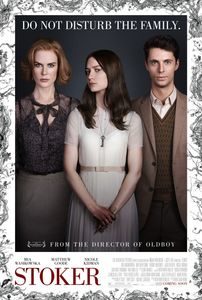
    (On Cable TV, May 2014) Oh, what a fiendishly troubled family relationship is set up in Stoker‘s unapologetic gothic madness. Big foreboding house, dead father, crazy mother, troubled daughter and deranged uncle: it’s all there, along with generous helpings of tentative incest and confirmed murder. It takes a special kind of audience to play along, but director Park Chan-wook’s stylish direction means that everything look good even as the script makes no effort to be anything but a deep genre homage. The film surely takes its own time setting up all of its elements: Stoker is moody and contemplative at the best of time. It doesn’t help that the entire film exists in its own reality out of time, the characters living in personal orbits that have more to do with Hitchcockian homage than anything else. Mia Wasikowska is remarkable as the introspective teenage heroine, easily stealing the spotlight away from Nicole Kidman’s by-the-number deranged mother, but it’s Matthew Goode who gets the acclaim with his Anthony-Perkinsesque role as the visiting Uncle Charles, as his handsome features barely disguise a completely demented mind. The best moments of the film are in the heroine’s reactions to his psychopathy, as they take us farther from classical gothic thrillers and into something quite a bit more twisted. And then there’s the sumptuous direction, which imbues a great deal of class to a script that could have been handled as schlock in less-experienced hands. Where Stoker isn’t as successful is in doing anything with the elements at its disposition. Much of the third-act revelations are obvious, whereas what actually happens during the conclusion feels a bit flat despite the increasing amount of blood being spilled. Stoker makes more sense on a shot-per-shot basis than a sustained film, but the direction is so striking at times that it’s hard to be all that disappointed in the result.

  • Just Go With It (2011)

    Just Go With It (2011)

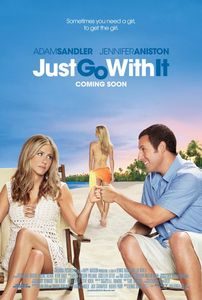
    (Video on Demand, May 2013) I’m not a big fan of Adam Sandler, but he can be effective when used in the right context (ie; not left free to indulge his man-child persona) and Just Go With It comes closer than most attempts at producing a non-irritating Sandler comedy.  It helps that the film uses some fairly convoluted plot mechanics to keep him from taking center-stage: the script involves a decent amount of romantic deceptions, mismatched identities, fortuitous meetings and tangled lies.  Set against the pleasant backdrop of a Hawaiian resort, well, it could be worse.  Sandler is restrained in a role that asks for more maturity from him than usual, while Jennifer Aniston gets a more interesting role than usual as his assistant-turned-fake-wife.  Nicole Kidman gamely tries to keep up, but this kind of comedy really isn’t her thing, and it shows.  Still, the plot circumvolutions are enough to keep our attention and while the end result doesn’t aspire, let alone attain, greatness, it’s good enough to fill up a lazy afternoon.  As the title says, just go with it.

  • Trespass (2011)

    Trespass (2011)

    (Video-on-Demand, December 2011) Once upon a time, maybe in the mid-nineties, a thriller directed by Joel Schumacher and featuring both Nicolas Cage and Nicole Kidman would have been a sure-fire box-office draw.  But this is late 2011 and the most noteworthy thing about Trespass is how a very limited theatrical run was followed barely two weeks later by a wide DVD release.  So does the film best compare to theatrical thrillers or direct-to-video efforts?  From a visual perspective, it’s clear that this is an A-list effort: Schumacher’s direction is effective, the cinematography is striking and even as the film focuses on house-bound action from dusk till dawn, the filmmakers are able to get a lot of visual energy from limited locations.  Much of Trespass, in fact, feels like a theatre production as a well-off family is threatened by a small gang of home invaders.  But the criminals aren’t united, and everyone has secrets to hide: by the film’s twentieth-minute mark, they’re already shouting at each other in trying to figure out what’s happening.  Nearly hidden behind over-sized glasses, Cage gets a typical “Cage flip-out moment” early on by trying to negotiate with people who aren’t expecting negotiations.  The intensity of the psychological drama can’t be sustained over 90- minutes: by the third act, the action diffuses itself back to B-grade movie levels by going out of the house and a few repeated plot beats while we’re waiting for the various elements previously set up to be used in rapid succession.  Once the shouting is over, it’s a bit easier to see the generic nature of the plot and the plot cheats used to constrain it.  Still, Trespass is a clear notch above much of what’s meant to go quickly from theatres to video –more of a comment on the changing video landscape in the age of instant home video consumption than a particular reflection on the film itself.  If nothing else, it’s an average thriller made by above-average filmmakers and stars.

  • Moulin Rouge! (2001)

    Moulin Rouge! (2001)

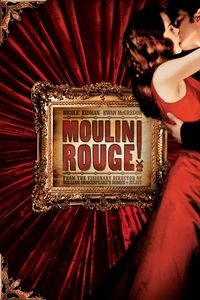
    (In theaters, September 2001) As someone who sees nearly a hundred films per year, it’s often difficult to justify seeing so many when so many of them are just crap. Then comes the odd one-in-a-hundred moment, the one that is so good, so original, so perfect that it fully justifies the rest of the dreck in theaters. That moment is the highlight of Moulin Rouge!, the introduction of the nightclub and of the Satine character, a raucous musical number featuring and blending “Diamonds are a Girl’s Best Friend”, Madonna “Material Girl”, Nirvana’s “Nevermind”, the latest “Lady Marmalade” remix and a brand-new Fatboy Slim track. You have to see it and hear it to believe it. But don’t be surprised to find yourself stuck with a silly grin during the first half of Moulin Rouge!, even occasionally shaking at how good it is. A triumphant revival of the musical with an initial hyperkinetic approach reminiscent of Fight Club, this is one unique film, a jewel in the rough for everyone who loves movies and pop songs. Gleefully using twenty-five years of pop music like a toolbox to tell his story, writer/director Baz Lurhmann does things with the raw material that will leave you breathless at his audacity. Postmodernism at its best. Top-notch editing, a wonderful screenplay and excellent musical talent will leave you gasping for more. Granted, the second half of the film is more dramatic, less impressive than the first half, but that first half is likely to be the best thing you’ll see in 2001. Even the dependence on raw sentimentalism works to some degree. Don’t miss Moulin Rouge!

    (Second viewing, On DVD, August 2002) Wonderful stuff any way you choose to see it. Boffo set designs, exceptional music, enjoyable acting and some dynamite movie moments. It doesn’t stop, and you’ll wish it never did. The DVD is stuffed with an embarrassing amount of extras, commentaries, on-set documentaries and oodles of other fun stuff, such as co-writer Craig Pearce discussing an early draft of the script which contained a character called “Baron von Groovy”. (I want to see that film!). Warning, though: While the audio commentaries are great, the film perceptibly loses a lot of its impact stripped of the music, which makes the completely-muted commentary track a very curious choice from the DVD makers (as opposed to a track where the audio plays at a greatly reduced volume throughout.) I still think it’s a fantastic film.

    (Third Viewing, On Blu-ray, November 2021) I’ll admit it – in choosing what movies to rewatch, I will give precedence to decent films with good set-pieces, but shy away from amazing movies – what if they’re not as good as I remembered them? It took me a while to get back to Moulin Rouge: Nothing could possibly match my over-the-top reaction to viewing the film’s first half-hour for the first time, which pretty much ignited my fascination with movie musicals. The music! The colours! The pacing! I was not expecting a second look to come close to that, especially after watching a few hundred musicals in the interval. Well, improbably enough, a rewatch does come close to recapturing the magic of the original viewing: Twenty years later, Baz Luhrmann’s Moulin Rouge is as vibrant, joyful and exhilarating as it was meant to be. The fizzy blender mix of 1990s pop songs remixed against a backdrop of 1900s Paris is still remarkably effective, and carries quite an audio-visual punch. It’s good enough to make even a cynic like myself embrace the film’s refreshingly uncool credo of “Truth, Beauty, Freedom and Love.”  It’s all high-gloss romanticism, and it’s worth indulging into the film’s unabashed mawkishness. The music is terrific, even though I remembered a few moments wrongly after multiple reruns of the soundtrack:  Fatboy Slim’s “Because we Can-Can” is a mere snippet in the film, and my memory completely failed me in remembering that the anthemic “Lady Marmelade” cover barely makes up a few seconds in a much more expansive number. (Conversely, the “Lady Marmelade” music video is well worth rewatching a few times, but it doesn’t include a single snippet of the film.)  Fortunately, the music numbers make the film: “Zidler’s Rap Medley” is frantic, while “The Pitch” is hilarious and “El Tango de Roxanne” heartbreaking. Ewan MacGregor and Nicole Kidman have taken a few hits over the years for their vocal performance here, but they are honestly giving it everything they’ve got in addition to their acting, and I prefer this authenticity to autotune or being dubbed by others. I may not have loved the result as much as I did in theatres twenty years ago, but Moulin Rouge hasn’t aged all that much, nor lost most of its effectiveness – if anything, it exceeded my pessimistic expectations on a re-watch: it’s still one of my top musicals of all time (OF ALL TIME!) and I may revisit it more frequently knowing that it doesn’t dull too much on a re-watch.