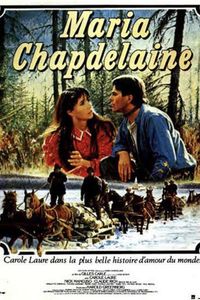
Maria Chapdelaine (1983)
(On TV, November 2020) As I grow older, I suppose that it’s inevitable that I would come back to claim ownership of my own culture. My French-Canadian family tree is made of farmers and lumberjacks dating all the way to the 1600s, and the older I get the more I’m delighted to accept that lineage as my own cultural history, equally folkloric and interesting as other ethnic lines. In parallel, I’m also rediscovering depictions of this heritage, made easier by Québec’s longtime insistence on highlighting its rural roots. This brings us to Maria Chapdelaine, a minor French-Canadian classic with a storied ancestry of its own—the original novel written by Louis Hémon, a newly arrived French Immigrant who died before the novel became a major success in Europe. The 1983 version of Maria Chapdelaine is the third adaptation of the film, but the first that was made in Québec by French-Canadian filmmakers for a local audience—previous versions being made by and for Europeans. The nice thing about this atmospheric period piece is that it has aged quite well—it credibly portrays frontier life in the early 1900s, with plenty of period details, rural joual and wilderness shots. Carole Laure plays the beautiful Maria, with a supporting cast that includes half a dozen French-Canadian actors who would become household names later on—including future politician Pierre Curzi. For French-Canadian viewers, there’s added comedy in how writer-director Gilles Carle would later return to a similar frontier-village territory with the far more ribald La Postière. But as for Maria Chapdelaine itself, it feels like a shot of pure laine tropes: you’ve got the hardy colonizers, the three suitors each representing facets of the French-Canadian character, a deep respect for winter, quasi-caricatural expressions and historical recreation… it’s the Québec often being sold (erroneously) as “the true Québec” from a certain traditionalist perspective and it’s interesting to watch. The romantic suspense of having three suitors for the heroine becomes its own kind of suspense veering into political commentary. In other words, I found quite a lot to contemplate in Maria Chapdelaine… but I acknowledge that you practically have to be among the characters’ notional descendants to get as much out of it.
![La chute de l’empire américain [The Fall of the American Empire] (2018)](https://www.christian-sauve.com/wp-content/uploads//la-chute-de-lempire-americain-2018.jpg)