Planet of the Apes series

  • Battle for the Planet of the Apes (1973)

    Battle for the Planet of the Apes (1973)

    (On Blu-ray, September 2020) I expected to dislike the original Planet of the Apes series the more I went into the later much-derided instalments, but on the contrary, I find myself unexpectedly impressed by how much the series was able to put on the table even then—the inspiration for the 2010s remakes is clearly seen in the last few films of the original series. But even I struggle to find anything more to say about the last film of the original series. The fifth instalment Battle for the Planet of the Apes certainly feels like an epilogue looking for something to say—it repeats points of previous episodes, looks as if it was filmed with enthusiastic LARPers on a weekend getaway and tortures itself by staying close to the previous films despite an obvious time skip. It’s worth a look for the material it laid out for the later remake series, but it can be a slog to get through thanks to the slow pacing, rough dialogue and meaningless plotting. There are a few extended battle scenes later on that highlight where the meagre budget has been spent, and it’s hard to stay mad at a film that ends the series with an ambiguous message of interspecies harmony. Still, it’s a whimper of a conclusion rather than a bang: the earlier instalments had much more to say.
  • Conquest of the Planet of the Apes (1972)

    Conquest of the Planet of the Apes (1972)

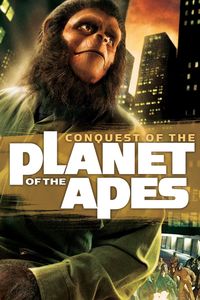
    (On Blu-ray, September 2020) I hadn’t really explored the later instalments of the original Planet of the Apes series, but now that I am, I realize how little the rather good 2010s remake series actually invented. In Conquest of the Planet of the Apes, the story takes a time skip into the near-future (from 1972’s perspective) and tells us about how apes replaced cats and dogs as pets, learned to talk and eventually rebelled thanks to the leadership of the baby ape born of its time-travelling parents. Conceptually, the Big Idea is intriguing, and some of the smaller ideas work as well. On-screen, however, the film is hampered by a low budget, dialogue-level silliness, and a lack of expertise in deploying science-fictional devices. (A compliant common to most of the later movies of the series.) While the film does build to a haunting climax, it seldom makes a lot of sense getting there—the idea of future-ape being the catalyst barely makes sense, considering the sudden intelligence of the apes kept as pets and servants—and that’s not even getting into the unimaginable logistics of getting so many apes as pets in a decade or two. But as with many SF movies of the early 1970s, the point is more about the allegory than the nuts and bolts of the plot: there are a lot of parallels here between the apes and the civil rights movement and Conquest of the Planet of the Apes doesn’t even try to be subtle about it. It does add a layer of additional respectability to a film that wouldn’t be so admirable on purely technical grounds. Of course, the recent remake series has redone all of this except much better and with a far better tonal control. The original series may still be worth a look, though, if only to show the kernel of the idea being worked out.

  • Escape from the Planet of the Apes (1971)

    Escape from the Planet of the Apes (1971)

    (On Blu-ray, September 2020) I’ve never been a big fan of the original Planet of the Apes series, and Escape from the Planet of the Apes is the series’ last gasp of interest before sinking lower and lower into nonsense. There are still some undeniable strengths to this third instalment, starting with how the screenwriters found a way to keep the story going even after the all-destroying climax of the previous film. Now, apes get back to circa-1971 California through more time-travel shenanigans and we can see a reverted image of the first film in how they are welcomed, feared and destroyed by human society. The potential for social commentary here is rich, especially given the era Civil-Rights in which the film was produced, and it’s to the film’s credit that some effort is invested in making the ape protagonists likable, and to try to show how the world reacts to them. Unfortunately, the script seems to have been written with an impossible deadline and a compendium of dumb movie clichés because the first half-hour is so dumb that it becomes exasperating. The film flies from one implausible situation to another not because it’s trying to be funny, but because it’s deliberately avoiding logical plot progression out of a misguided intention to save some revelations for Big Scenes—it doesn’t help that the scientists in this film are among the more incompetent ones ever assembled for a first-contact situation. As a result, Escape from the Planet of the Apes exhausts all goodwill even before it gets where it wanted to go through that slap-dash first act. It leaves a bad impression that can’t be entirely corrected by later improvements in the film’s overall quality. The unrefined dialogue can’t do justice to the ideas that the film wants to explore, and the action doesn’t fly particularly high either. The actors are fine, but the limits of the film’s budget clearly show throughout—although it’s fun to see the 1970s brought to life so unpretentiously. Still, the beginning hurts, and so does the overly pessimistic ending (although this was now the New Hollywood grim-dark era, and it’s not as if the series do far didn’t already feature two of the bleakest endings in American cinema at that point). I’m glad I didn’t stop watching when the script’s stupidity was unbearable because Escape from the Planet of the Apes does improve significantly after a while. But it brings my appreciation to a muddled ambivalence rather than anything overly positive.

  • War for the Planet of the Apes (2017)

    War for the Planet of the Apes (2017)

    (On Cable TV, April 2018) Nobody expected the 2011 Rise of the Planet of the Apes reboot to be worth anything after the increasingly campy tone of the first series or the dumb 2001 remake. So it’s a surprise to conclude, after watching War for the Planet of the Apes, that the new trilogy has managed to exceed all expectations to deliver one of the finest, most sustained film series of the decade so far. After nailing a surprisingly realistic tone for the first film in the series, the two others managed to head in the same direction. It helps a lot that the series has been a high-water mark for CGI character creation: Entirely digital “Caesar” is a memorable character with numerous emotional moments and the film is nearly flawless in how it portrays him on-screen. The trilogy tells how humans cede the planet to apes and this third instalment describes the final battle of the changeover, with enough perfidious humans to make us feel better about the succession. (If there’s a theme to this decade’s finest Science-Fiction, it’s that from robots to apes, humanity is ready to accept that we may be supplanted by something more human than itself.)  Writer/director Matt Reeves leads the film with a sure hand, adding depth and sentiment to what could have been a noisy spectacle. War for the Planet of the Apes wraps up the trilogy in a way that almost makes us feel not asking for one more for fear of tainting the impact of the three films so far. Who could have expected that only a few years ago?

  • Beneath the Planet of the Apes (1970)

    Beneath the Planet of the Apes (1970)

    (On Cable TV, January 2018) I actually have faint and mild traumatized memories of seeing the end of Beneath the Planet of the Apes as a kid, with its nightmarish conclusion. A more contemporary viewing isn’t making me any friendlier toward the film, although for different reasons: I now think that the end of the film, with its horrific facial revelation and atomic conclusion, is the best thing about a remarkably redundant sequel. Not that I’ve been a fan of the original film or the subsequent series—While the 2011–2017 second remake trilogy is fantastic, the first series and 2001 singleton are dull beyond belief. Beneath the Planet of the Apes is not particularly interesting, revisiting the same material and not offering much until the end. Even Charlton Heston is sidelined for most of the film. The cosmic coincidence of having a second set of astronauts land in more or less the same place is too big to swallow, and the grimness of the ending, underscored by a fairly definitive narration, isn’t one to make one’s inner kid happy. Too bad the rest of the series couldn’t stay as dead as it should have been after the ending of this one.

  • Planet of the Apes (1968)

    Planet of the Apes (1968)

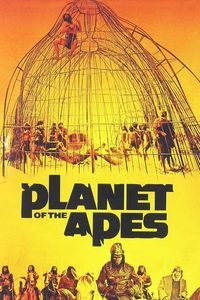
    (Second viewing, On Cable TV, October 2017) The original Planet of the Apes is often used as a punchline these days (if it’s not a reference to the classic twist ending, then it’s about The Simpson’s “Doctor Zaius” musical, the increasingly bad sequels or generally anything to do with a “man in ape suits” standard for bad SF movies) and it does deserve a lot of cackling. Much of the plot mechanics are silly, the overall premise makes zero sense (not to mention anything about the sequels), the thematic messages are heavy-handed and Charlton Heston does chew heroic amounts of scenery in his performance. Still, watching the film today does have a few unexpected things going for it. It’s clearly a big-budget production for its time, something that can be seen in a rather lavish opening sequence. Heston’s character is also surprisingly cranky for a heroic protagonist, and the script does have a few odd zingers here and there. Still, even the most forgiving viewer has to acknowledge that the film has aged poorly. The goofy script (by Twilight Zone legend Rod Serling) is ham-fisted, the production values show their age and much of the film feels dull given how often it goes over familiar terrain. In fact, one thing I did not expect from watching the original film is how much better it makes the 2001 remake look—especially given how I did not particularly like the remake. And this is not even mentioning the far superior 2011–2017 reboot trilogy.