Ray Harryhausen

  • Mighty Joe Young (1949)

    Mighty Joe Young (1949)

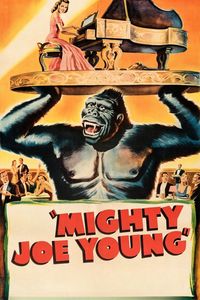
    (On Cable TV, January 2021) You’d have to be willfully ignorant of film history not to see the obvious parallels between 1933’s King Kong and 1949’s Mighty Joe Young—in both cases, a giant ape is brought back from exotic lands to so-called civilization (i.e.: America, this time Los Angeles rather than New York) until there’s some inevitable mayhem—and a young woman saves the day. The resemblance was not accidental—much of the same filmmaking team was behind both movies, and there’s a clear intention in the later film to one-up the special effects of the first. In this respect, you can consider Mighty Joe Young to be a remastered version of the previous film, with just enough differences to be both familiar and interesting. What the filmmakers could scarcely have suspected back in 1949 is that the wunderkind to whom they entrusted the stop-motion special effects, Ray Harryhausen, would go on to become one of the titans of movie special effects. His skill is already apparent here—the special effects are still convincing, charming and filled with character, even to modern jaded eyes. The sequences are more ambitious than in King Kong, the integration with the live action more daring, and the details of the characters being animated as sufficient to give them a personality—something that would become a Harryhausen trademark. Some other aspects of the spectacular production still impress—nearly everything set inside the nightclub is very impressive from a filmmaking perspective. The film is also far more kids-friendly than King Kong—funnier, but more specifically graced with a happy ending that wouldn’t have fit in the earlier film. In other words, Might Joe Young may be closely affiliated with its illustrious predecessor, but it holds up admirably well as its own production. Rewarded with a Best Visual Effects Academy Award, it’s still a treat to watch.
  • It Came from Beneath the Sea (1955)

    It Came from Beneath the Sea (1955)

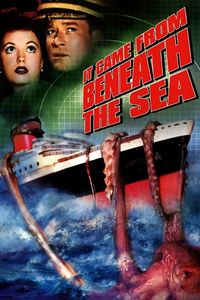
    (On Cable TV, December 2020) Many low-budget creature features were made in the 1950s and not many of them are worth watching today as anything more than examples of the Cold War obsessions of the time. It Came from Beneath the Sea would, at first glance, seem to belong to that category: a low-budget monster film taking what’s become a bit of a cliché (radioactivity creates a monstrous life-form!) and running with it until the spectacular climax. But there are at least two things that make it worth a look. First, a quasi-documentary approach in the first half of the film that gives it a nice 1950s techno-thriller feel: it’s not entirely silly, and the film’s cooperation with the military ensures at least a patina of realism on the result. The second reason becomes more obvious once the tentacle monster reaches San Francisco in time for the climax: Ray Harryhausen’s spectacular stop-motion work, doing its best with an “octopus” limited to six arms due to a limited budget. Taken together, those two advantages take an already adequate film to something worth watching if you’re looking in the corpus of the 1950s creature features.

  • Ray Harryhausen: Special Effects Titan (2011)

    Ray Harryhausen: Special Effects Titan (2011)

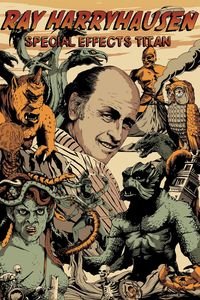
    (On Cable TV, November 2020) Usually, I prefer written biographies than the bite-sized filmed ones, but there’s something so innately cinematic about Ray Harryhausen’s stop-motion animation that it would be impossible to do justice to his work without showing it on-screen. Clearly an authorized biography completed by friends of his, Special Effects Titan digs deep in interviews, archival footage and new-for-this-documentary material to pay homage to his work, from his early inspirations to the CGI legacy he has left. Most (if not all) of his films are mentioned, commented and shown. Heavy hitters of spectacle-driven cinema such as Spielberg, Jackson, del Toro, Cameron and Lasseter show up to pay tribute, and the film clearly highlights the friendship between Harryhausen and writer Ray Bradbury. The stop-motion work is described and commented upon, with frequent praise being that his stop-motion puppets had acting character of their own. At 95 minutes, Special Effects Titan is a quick, clean summary of Harryhausen’s life and work, well worth a look for anyone even slightly interested by his legacy.

  • Mysterious Island (1961)

    Mysterious Island (1961)

    (On Cable TV, August 2020) I first read Jules Verne’s L’Ile Mysterieuse as a kid and was thrilled at the result. It was, I think, the first real robinsonade that I encountered, and I kept marvelling at the way our desperate characters could manage to recreate civilization while stuck on an island in the middle of the Pacific. It was also the first novel that drove the point home of an imagined universe, as it eventually featured Captain Nemo of another Jules Verne novel. I much older and jaded now, but I was still disappointed at the 1961 adaptation of Mysterious Island. If I hadn’t read the novel, I probably would have been satisfied with the big-screen result. But having such vivid memories of the original worked against the movie – where were the details of their survival against all odds? What are giant stop-motion creatures doing in that story? Why is there a woman in the cast of characters? The answer to all of these questions, obviously, as found in Hollywood’s need to make movies thrilling, exciting and have at least one female role. In doing so, it transformed Mysterious Island from a novel of survival to a Ray Harryhausen special effects spectacle, simplifying as much of the plot as they could in order to squeeze in more special effects sequences. I’m complaining on behalf of my younger self, but I can understand the impulse – and I note that nearly every single Classic Hollywoodian Vernes novel adaptation has committed the same sins, sometimes ending with gold (20,000 Leagues Under the Seas) and sometimes with dreck (From the Earth to the Moon) and sometimes with something in-between (Journey to the Center of the Earth). Mysterious Island is somewhere in the middle – the addition of Harrysausen’s stop-motion special effects is almost always something wonderful to watch, and it does compensate for many of the shortcuts taken in order to fit a leisurely detail-packed novel into a film’s running time. I still think that the third act could have been improved, and the character of Nemo given a better send-off. But it’s been seventy years since the film’s release and it’s not healthy to obsess over the choices two generations removed. As mentioned, this ranks somewhere near the theoretical middle of Verne adaptations – generally faithful at first, then increasingly Hollywoodized. Audiences went to see it, and that’s what mattered then.

  • Jason and the Argonauts (1963)

    Jason and the Argonauts (1963)

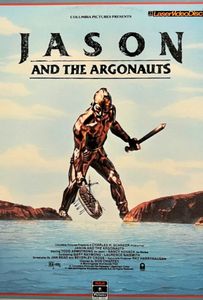
    (On Cable TV, August 2020) It took a remarkably long time for Jason and the Argonauts to deliver what I was expecting from it. Renowned for its Ray Harryhausen stop-motion animation, I was expecting a fantasy adventure with wall-to-wall special effects, or at least a continuous string of them. I was not prepared for a first half-hour of tedious Greek mythological babble, almost entirely absent any fantastic element. It starts building midway through, first with disappointing special effects (that bronze statue… ugh), but then with increasing confidence. It culminates in a captivating skeleton battle sequence that is easily worth the bother of watching the film. I probably overdosed on Greek mythology a while back and couldn’t appreciate much of Jason and the Argonauts, but the film gets better and better as it goes on, and has the good sense of culminating on a classic special effects sequence that’s still worth a look today.

  • The 7th Voyage of Sinbad (1958)

    The 7th Voyage of Sinbad (1958)

    (On Cable TV, June 2020) Fantasy films weren’t as plentiful in the 1950s as they are today, so the all-out thrills of The 7th Voyage of Sinbad made a mark on an entire generation, and for good reason. As a fantasy spectacle, it’s still potent today. The special effects alone are worth a look, considering that they’re from master step-motion animator Ray Harryhausen and there are a lot of them. His creatures are still remarkably effective today, carrying both menace and personality. It’s a good fit for a film that’s still filled with charm and perhaps even more so today, given the dated nature of it all—arch dialogue, overdone musical dues and rough-hewn optical effects can either feel old-fashioned or old-school, depending on your perspective. The adventure with an eastern twist is not particularly complex in matters of narrative, but that helps it stay perfectly accessible today. Considering the amount of work that went into illustrating Sinbad’s fantastic voyages, it’s not a surprise if the film clocks shorter than expected at 90 minutes or so. It’s remarkably obvious why The 7th Voyage of Sinbad is still considered a milestone of fantasy filmmaking’s history.

  • 20 Million Miles to Earth (1957)

    20 Million Miles to Earth (1957)

    (On Cable TV, June 2020) There’s a way of seeing 20 Million Miles to Earth as nothing more than a standard 1950s creature feature, with enough stop-motion animation and landmark-destroying creature rampage to be emblematic of the era. Indeed, the script isn’t worth praising—it’s a mishmash of lousy science in which a mission to Venus brings bag the egg of a creature that grows up to attack much of Rome. But the fun of the film lies elsewhere—specifically with the stop-animation from Ray Harryhausen (who co-wrote the story) to portray the monster. Never mind that it takes quite a bit of time to get to the good parts of the film when the monster shows up: when it shows up, the film sharply increases in interest. (The Coliseum-set climax is not bad at all.) Harryhausen’s typically great animation helps this film stand apart from the pack, and ensures that it’s still at least slightly enjoyable to watch today. More than simply representative of its era, 20 Million Miles to Earth can be great fun to watch in the right indulgent frame of mind.

  • First Men in the Moon (1964)

    First Men in the Moon (1964)

    (On Cable TV, June 2020) Much like the 1960 version of The Time Machine, this 1964 adaptation of H.G. Wells’ 1901 novel First Men in the Moon has at least two layers of historical archaeology for twenty-first century viewers—the “modern” 1960s framing device, and the 1899 story of how three English people made it to the moon using the gravity-nullifying substance Cavorite. It all makes for a surprisingly enjoyable romp, well in the hybrid tradition of Hollywood movies and Wells’ original novel. Featuring a bit of steampunk before steampunk was even a thing, First Men in the Moon can also depend on the beautiful Martha Hyer as a member of the expedition, and some great step-motion animation from Ray Harryhausen. Where the novel falters after a good opening half is when the lunar exploration gets silly and less interesting as aliens pop up. The ending, amusingly enough, does have a cute reference to Wells’ The War of the Worlds. The comedy of the film can be misplaced or inconsistent—it dies down during the second half, which adds to that section’s problems. Still, this is not a bad film—not up to its potential, perhaps, but already better than one would expect.

  • Earth vs. the Flying Saucers (1956)

    Earth vs. the Flying Saucers (1956)

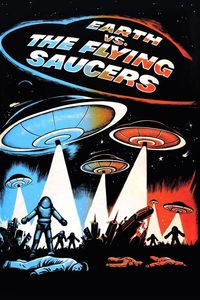
    (On Cable TV, June 2020) Despite its silly-sounding title, Earth vs. the Flying Saucers comes across as a techno-thriller of the 1950s. It does splendidly exemplify the flying saucer paranoia of the 1950s—and as a result still keeps some charm even if you think that UFOlogy is a bunch of hooey. The plot and characters aren’t developed or executed as effectively as they should, especially given a promising start. But plot and characters aren’t the right reason to see Earth vs. the Flying Saucers—that would be the crude, yet effective special effects from the legendary Ray Harryhausen, with its prototypical flying saucers surprisingly well integrated into the scenes. The ending is an all-out special effects spectacle taking aim at Washington, DC monuments, culminating with the iconic capitol scene. You can see echoes of this film in many, many successors—consider watching this as a double-bill with Mars Attacks! Quite enjoyable in its own way, Earth vs. the Flying Saucers is best approached as an earnest and endearing time capsule of fears and wonders.