Richard Jenkins

  • The Hollars (2016)

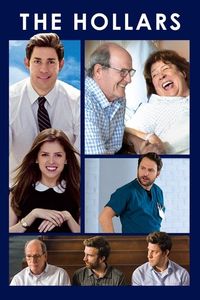
    The Hollars (2016)

    (In French, On TV, September 2021) While writer-director-actor John Krasinski earned rave reviews as director of A Quiet Place, he already had two feature-length movies in his filmography before his horror breakout. The Hollars is the second of them, and it falls squarely in that favourite playground of low-budget independent cinema: the dysfunctional family dramedy, coupled with a “city boy comes back to town” plot to tie it all together. A cherubic beardless Krasinski anchors the picture as the prodigal son coming back to his childhood home after his mom gets ill — only to discover a bankrupt father, bitter brother, clinging ex-girlfriend and the realization of the fears holding him back from marrying his pregnant girlfriend. This is thoroughly familiar stuff, only slightly elevated by decent execution and a rather good cast. While such familiar names as Anne Kendrick, Sharlto Copley, Charlie Day, and Richard Jenkins add to the film, it’s Margo Martindale who earns the most attention in a tough part as a sick matriarch. The rest of the film is not bad, but it is familiar enough to be forgettable, and there are enough half-sketched subplots to make anyone wonder if the film ended up stuck between comedy and drama, instead aiming for a half-satisfying compromise. Watchable but not memorable, The Hollars is an honourable result for Krasinski, but a pale precursor to his next films.

  • Kajillionaire (2020)

    Kajillionaire (2020)

    (On Cable TV, June 2021) I suppose that if you’re interested in quirky character-driven drama, Kajillionaire should be enough to make you happy. It’s not for everyone, though: Focusing on a family of small-time grifters multiplying elaborate schemes in search of two or three-figure payouts, it’s a film about serial schemers and liars, hardly the kind of person you’d like to meet (you’d be lucky to escape without your wallet — hopefully they don’t get your house keys). They are not normal people, and that’s especially apparent when it comes to the film’s lead, a twentysomething woman pretty far along the autism spectrum. Their miserable life does have a certain routine to it, but everything suddenly spins out of control when they befriend a young woman who seems curiously amenable to their lifestyle. For our protagonist, it’s a chance to grow up… but it’s not going to be easy. Anchored by Richard Jenkins and Debra Winger as the parents, the film is perhaps best served by its younger leads. While Gina Rodriguez looks great in an improbable series of close-fitting tops, it’s Evan Rachel Woods who impresses as the impassive, emotionless “Old Dolio” (the explanation eventually comes up) who has to get away from her exploitative, sociopathic parents. The narrative is self-consciously quirky to a fault, leading viewers a predefined plot that feels moved along by contrivances rather than organic developments. While the conclusion satisfies, it’s largely because we won’t have to spend one more single minute with these people. Writer/director Miranda July is clearly after something specific and deliberate here, but it’s not going to be for everyone.

  • Shall We Dance (2004)

    Shall We Dance (2004)

    (On TV, November 2020) I haven’t seen the Japanese film on which Shall We Dance is based, but the American remake is, in a word, charming. It’s about a married man who starts attending dance classes in an effort to escape his increasingly boring life. The wife soon suspects something, and ends up hiring a private detective who’s amused to find out that the truth is not about adultery. There are additional shenanigans thanks to the other dancers, and a competition that consumes much of the third act, but the film is really about dancing in a way that has grown increasingly rare since the end of the golden era of musical comedies. (Fittingly, there’s a shout-out to The Band Wagon.) Richard Gere is quite likable in the lead, helped along with supporting performances from a motley crew of Susan Sarandon, a superb Jennifer Lopez, Bobby Cannavale and Richard Jenkins, with an unusually good turn from Nick Cannon in a supporting role and a very enjoyable performance from Stanley Tucci. I liked the unusual romantic angle of the film, with the main character interested but not exactly pursuing another romantic interest at the dance studio, providing inspiration for the other woman but ultimately returning even more strongly to his wife. The direction is unobtrusive most of the time, although it does let the actors show off some dance movies (including a surprisingly buff Tucci), and ends with a very nicely stylized epilogue. Shall We Dance is not supposed to be particularly deep or meaningful, but it’s pleasant enough to be watchable without effort, and pleasantly harkens back to an earlier tradition of dance movies.

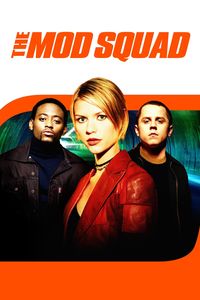
  • The Mod Squad (1999)

    The Mod Squad (1999)

    (On TV, September 2020) The biggest occupational hazard for TV shows move adaptations it getting over the inane high-premises often built into serial TV. In The Mod Squad’s case, the problem is magnified by its origin in a TV show thirty years earlier, down to the dated “Mod” in the title. (If you thought, “What, we some kinda… Suicide Squad?” was bad, wait until you hear its 17-year precedent “So you kids are, what? Some kind of mod squad or something?”) Here, Claire Danes, Giovanni Ribisi and Omar Epps do their best to convince them that they’re delinquent hoodlums while working undercover for the police. While the best-case scenario for The Mod Squad would have been a middle-of-the-road crime action thriller (or a 21 Jump Street-style parody), this reboot struggles under the dated nature of its inspiration, and can barely be bothered to deliver the essentials of the film it’s supposed to be. With twenty years’ hindsight, it’s also easy to see that the film is far too deliberate in its appeal to 1999 young adults (I was part of that cohort, so I can say that the film’s soundtrack feels like a nostalgic throwback to that time’s dance music) and simply feels like a fifty-year-old producer’s attempt to imagine what young people would like. There are some interesting names in the cast (notably Dennis Farina and Richard Jenkins as adult supervision), but The Mod Squad itself is too gimmicky, too badly handled, too unintentionally funny to be effective.

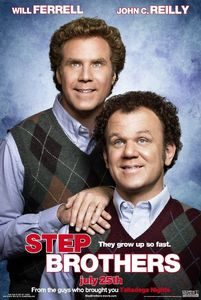
  • Step Brothers (2008)

    Step Brothers (2008)

    (Crackle streaming, February 2015)  I’ve been checking off a list of “unseen must-see movies” lately, and some of my least-favourite ones are those films belonging to the filmography of popular comic actors that I don’t find particularly funny… in this case: Will Ferrell.  (Also see; Adam Sandler)  Stupidity is celebrated here as two thirtysomething men with the EQ of unpleasant eight-year-olds are forced to live together when their parents remarry.  From afar, Step Brothers looks like the dumbest thing to have been filmed, and the actual film often feels like it, what with Ferrell and John C. Reilly doing their best impression of socially-retarded man-children.  I can’t deny that some of the sight gags can be amusing, but given my distaste for Ferrell’s typical overgrown-toddler shtick, Step Brothers was often an endurance exercise –especially given how often it relies on the kind of humiliation-comedy gags that I find unbearable.  Mary Steenburgen and Richard Jenkins are particularly enjoyable, but their characters suffer the brunt of most of the film’s jokes.  A surprising amount of Step Brothers is mean-spirited on top of everything else, so it’s no surprise if my final reaction to the film really isn’t all on the positive side. 

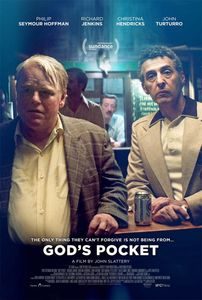
  • God’s Pocket (2014)

    God’s Pocket (2014)

    (Video on Demand, January 2015) Even almost a year after his death, Philip Seymour Hoffman’s presence is still deeply felt, and each posthumous film seems to remind everyone of what an interesting screen presence he could have.  In God’s Pocket, he’s about as far from glamour as he could be, playing a down-on-his-luck blue-collar worker you gets entangled in a growing pit of lack luck and even worse circumstances.  It’s far from being a cheerful story, and Hoffman’s hanging-dog charm fits perfectly with the poor-neighborhood setting.  Unfortunately, he’s stuck in a script that doesn’t quite know how to balance the sad drama with the black comedy – at times, God’s Pocket goes from naturalistic social study to jet-black absurdist comedy without graceful transition, or even unity in its presentation.  The very dark ending doesn’t help anything.  Still, John Slattery’s direction isn’t too bad, and Richard Jenkins gets some attention as a journalist who’s ultimately too smart for his own good.  In the end, we just want to get away from the place as quickly as we can.

  • Killing Them Softly (2012)

    Killing Them Softly (2012)

    (On Cable TV, February 2014) While Killing Them Softly has the admirable ambition of using a crime story to tackle much-bigger social and economic themes, it looks as if, along the way, it has forgotten to entertain viewers on a minute-to-minute basis. Adapted from a seventies crime novel but updated to be set in the middle of fall 2008’s presidential/economic crisis, it’s a film that attempts to make parallels between low-level mob desperation and wider social problems. As such, it’s got a lot more ambition than most other crime thrillers out there. It all culminates into a tough but compelling final scene, in which America is unmasked as a business far more than a community, and in which getting paid is the ultimate arbitrator of fairness. Stylistically, Killing Them Softly has a few strong moments, perhaps the most being a slow-motion bullet execution. Alas; it’s so kinetically entertaining as to be atonal with the rest of the film, which takes forever to makes simple points and delights into long extended conversations in-between bursts of violence. Still, Brad Pitt is pretty good as a mob enforcer trying to keep his hands clean (it’s another reminder that he can act, and is willing to do so in low-budgeted features once in a while), while James Gandolfini has a one-scene role as a hit-man made ineffective by his own indulgences. Richard Jenkins also has an intriguing role as a corporate-minded mob middle-man in-between men of violence. Otherwise, though, Killing Them Softly‘s tepid rhythm kills most of its interest: Despite writer/director Andrew Dominik’s skills and lofty intent, the film feels too dull to benefit from its qualities.

  • The Cabin in the Woods (2012)

    The Cabin in the Woods (2012)

    (On-demand video, October 2012)  Horror fans won’t have to think twice about whether to see this film: The Cabin in the Woods is as essential a horror film as any in the past few years.  A gleeful deconstruction of the good-old “cabin in the woods” horror scenario, it’s a commentary as much as it’s a comedy.  It takes the good old tropes and plays with them until they fall apart.  I have some evidence that the film won’t play very well to an audience that is unfamiliar with horror films, making it even more specially targeted (for better or for worse) to a specific public.  Coming from geek-favorite co-writer Joss Whedon and co-writer/director Drew Goddard, The Cabin in the Woods is a blast-and-a-half for those in the know.  Is it perfect?  Of course not: one danger with parodying tropes is forgetting a few, and it sure seems as if one “upstairs sabotage” plot thread has been left dangling. (My theory involves the audience getting bored.)  Still, what the film does manage to deliver is enough to mandate a viewing.  It helps that The Cabin in the Woods is competently-made: Goddard knows how to deliver the laughs, and the actors do passable jobs in the roles they’re given.  Kristen Connolly, Fran Kranz and Richard Jenkins stand out, by virtue of their places in the plot as much as anything else.  There’s plenty of freeze-frame fun, and the film does a fine job at playing with the demands of the various genres it has taken on.  For a while, The Cabin in the Woods is going to be the horror movie to watch with friends and that’s great: the horror genre was taking itself a bit seriously lately what with the icky torture-porn trend, and this is a welcome corrective.  One final note about spoilers: it’s perfectly possible to spoil yourself rotten about the film, and still enjoy it immensely… so don’t panic if you think you already know too much.

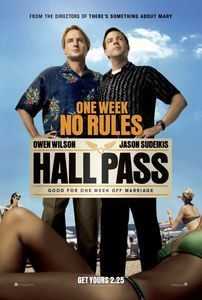
  • Hall Pass (2011)

    Hall Pass (2011)

    (On-demand Video, April 2012) I’m never too sure whether I should be annoyed or relieved when mainstream Hollywood comedies end up neutering their daring premises with innocuous plot developments.  Audiences don’t like to be unnerved when they’re supposed to be laughing, and I suppose that I’m no exception.  Nonetheless, there’s something maddening in seeing a film about married couples agreeing to mutual indiscretion racing to a conclusion when nothing really happened.  (Actually, it may be best to ignore the fact that the one woman who did something, albeit briefly, ends up punished by a car crash that ends up not much more than a plot point for her husband’s emotional growth.  But such is the way of Hollywood, and this includes the emotionally-retarded male protagonists who are supposed to earn our sympathy. The gender politics here aren’t particularly even-handed here, which is keeping in mind the target audience of the film.)  Still, Hall Pass has a number of laughs in reserve, especially when the protagonists can’t even begin to imagine how to take advantage of the freedom they’ve bargained for themselves.  Owen Wilson and Jason Sudeikis (who, in-between this film, Horrible Bosses and A Good Old Fashioned Orgy, is carving himself a bit of a niche as a sex-obsessed protagonist) are both as charming as they can be in characters who are barely emotionally adults, although it’s Richard Jenkins who gets the biggest laughs in short appearances as an even older and less mature professional bachelor. The problem is that by ultimately playing it safe, Hall Pass doesn’t do anything that warrants any lasting attention.  Despite a few out-of-place graphic gags, it’s a disposable comedy destined to the bargain bin.