Robert Mitchum

  • Undercurrent (1946)

    Undercurrent (1946)

    (On Cable TV, June 2020) Wait, wait! There’s a film in which Vincente Minelli directs both Katharine Hepburn and Robert Mitchum? Why did no one tell me? Well, it’s probably because they’ve seen it, considering how all three are playing outside their wheelhouse in Undercurrent. A domestic thriller the likes of which were popular at the end of WW2, it features a demure spinster who marries a mysterious rich man but ends up having a closer affinity with his brother. There’s a bit of gothic romance to the story as hints of mental instability creep in and the action moves to murder: it doesn’t escalate to noir, but there’s still a creepy drama underscoring the entire film. The threat may come from inside the house, but Undercurrent’s biggest twist is that Hepburn plays a meek character, Mitchum plays a sensitive guy (for barely three scenes), Robert Taylor plays the creepy villain, and Minnelli tries his hand at suspense, all of which is completely at odds with their strengths. One of Hepburn’s last role as a debutante (she was 39!), the film isn’t particularly good nor terrible: it’s interesting for the eyebrow-raising use of familiar names in unfamiliar roles, but if you’re looking for a good domestic thriller of the era, you might as well have another look at Gaslight.

    (Second Viewing, On Cable TV, July 2021) The only thing better than a film that brings familiar names together is a film that uses those familiar names against type. Of course, saying that about Undercurrent is misleading, as it takes place early in the career of two of its three marquee names. So here we have MGM musical director Vince Minelli going for a quasi-gothic thriller, steely Katharine Hepburn settling for a soft and weak character, and noir icon Robert Mitchum playing a refined and good-hearted character. (Plus, leading man Robert Taylor going for moustache-twirling psychopathy.)  It’s quite a ride if you’re coming to it with different expectations, and it’s probably that which distinguishes my second better-informed viewing for the first – in between the two, I developed my own appreciation for those three names, and Undercurrent clearly plays against them. Otherwise, well, there’s not much more to say: from a detached narrative perspective, the film does go hard for gothic mysteries, as the new wife of a mysterious man gets to gradually unveil the secrets surrounding his brother. The film is designed to be overly melodramatic, and feels long at something like 115 minutes. It’s not a bad watch but not a particularly fine example of a form perfected by Rebecca or Gaslight – but it’s worth a look if you’re too comfortable in what to expect from any of the marquee names.

  • Crossfire (1947)

    Crossfire (1947)

    (On Cable TV, April 2019) 1947 was an interesting year when it comes to social-issues drama films at the Academy Awards. Two films in nomination for the Best Picture Oscar were squarely about antisemitism—a bold statement at the time. One of them, the serious and finely controlled major studio picture Gentleman’s Agreement, won the award. But it’s the other, Crossfire, that clearly exceeded expectations. A production of a major studio (RKO) but clearly intended as a B-movie in the disreputable crime thriller genre (now identified as a film noir), the picture went beyond its strict murder-and-investigation formula by tying it to a sensitive social issue—the victim having been the victim of an antisemitic hate crime. (Tellingly enough, the film is based on a novel where the victim was homosexual rather than Jewish.)  It is, in many ways, more overly hard-hitting than Gentleman’s Agreement—the price to pay for discrimination being death rather than social ostracism. Its execution may be less refined, but it’s well in the norms for a film noir—a darkly-lit tale of murder and the investigation to find not only the killer, but his motive. Crossfire is merely one in a long line of crime dramas being used to illustrate deeper issues, but it has the distinction of being the first to punch through the Academy’s prejudice against genre films to earn a handful of nominations. It’s still quite watchable today even if you don’t care about the historical context: Robert Mitchum stars as a police detective, making the film just a bit better every time he’s on-screen. Director Edward Dmytryk keeps things moving through a tight 86-minute running time, delivering a very satisfying film that exceeds noir motifs to deliver a stark and still relevant discussion of hate-fuelled murder. You may watch Gentleman’s Agreement and find that it has aged poorly in its well-mannered depiction of prejudice, but Crossfire will still grab you by the throat.

  • The Sundowners (1960)

    The Sundowners (1960)

    (On Cable TV, February 2019) There is a weightiness to The Sundowners that makes it both respectable and a burden to watch. The story of a nomadic family trying to make ends meet in outback Australia, it’s a character study (adapted from a novel) of a man unwilling to settle down, something that his wife finds increasingly untenable. Robert Mitchum stars in a very manly role, with Deborah Kerr as his long-suffering wife—despite the mostly happy marriage banter between the two, much of the film’s central conflict is about whether or not they’ll be able to reach an accommodation, and the ending is far less definite than many would have wanted. But the real reason to watch the film may have less to do with plotting and more with the impressive colour cinematography—unusually enough for 1960, much of the film was shot on location in deep Australia, featuring plenty of koalas, kangaroos, sheep and sheep-shearing. Peter Ustinov makes an impression as a refined older man somehow found in the outback. It’s a solid drama that was eventually nominated for five Academy Awards (including Best Picture), but don’t expect much in terms of resolution.

  • The Longest Day (1962)

    The Longest Day (1962)

    (On Blu Ray, September 2018) I often complain about excessively long movies, but even at nearly three hours, I found The Longest Day riveting throughout. A meticulously detailed overview of the Allied landing in Normandy during World War II, this film takes a maximalist approach to the event: It features dozens of speaking roles in three languages, as it tries to explain what happened from the American, British, French and German perspective. Character development gets short thrift, but that doesn’t matter as much as you’d think if you consider the event as world-sweeping history featuring four nations. An all-star ensemble cast helps propel the story forward with some sympathy, as the personas of John Wayne, Richard Burton, Robert Mitchum, Sean Connery (in a very funny pre-Bond role), Sal Mineo and may others guide us through the war. The black-and-white cinematography is gorgeous, and hits anthology levels with a sweeping minutes-long uninterrupted shot of urban warfare. (There’s also a great camera movement early in the film that shows the beach landing and many of the 23,000 soldiers used during filming.) While Saving Private Ryan has eclipsed The Longest Day as the definitive portrayal of D-Day, this 1962 production remains important as a historical document in itself: Many cast and crew had been in Normandy twenty years later, to the point where some actors were portraying people close to them when it happened. (Richard Todd was offered his own role and ended up taking that of his then-superior officer, and ends up speaking “to himself” during the movie.) Visually, the movie remains spectacular even fifty-five years later, and it gets better the more early-1960s stars you can spot. (This also works for historical figures—Omar Bradley is instantly recognizable in a one-shot role.) It’s an exceptional tribute to the events of June 6, 1944, a thrilling adventure story and its relatively bloodless nature doesn’t undercut its portrayal of war as being hell where anyone can die at any time. It’s quite a rewarding film, and it’s even better when you can understand more than one of the three spoken languages.

  • The Night of the Hunter (1955)

    The Night of the Hunter (1955)

    (On Cable TV, December 2017) When watching older movies, it’s natural to assume certain parameters. Aside from the occasional noir movie, themselves neutered by the restrictions of the Hays Code, most films from the fifties are presumed to be fairly soft—neutered in themes, gentle in approach, straightforward in presentation. The Night of the Hunter has endured because it is most definitely not those things. Anchored by a strong menacing performance from Robert Mitchum (in a role that clearly anticipates his turn in Cape Fear), the film soon disposes of its central female character, then turns its attention to mortal child endangerment. What’s more, director Charles Laughton applies nightmarish expressionist style to its hard-core thriller plot for a surreal experience that has as much to do with sheer style as substance. A popular and critical dud upon release, The Night of the Hunter has grown in stature since then for obvious reasons: it’s a film ahead of its time, precise in its impact and still quite impressive to take in.

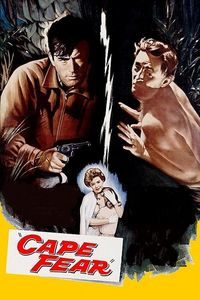
  • Cape Fear (1962)

    Cape Fear (1962)

    (On TV, September 2017) I caught this film mostly as a prelude to watching the 1991 remake, but I’m actually impressed at how well this Kennedy-era thriller has held up. Even (slightly) pulling its punches regarding violence and sexual assault, Cape Fear does manage to be gripping and nightmarish. Much of this effectiveness has to be credited to Robert Mitchum: Gregory Peck is fine as the stalwart hero of the story, but it’s Mitchum’s incredibly dangerous ex-convict character that makes the movie work so well even fifty-five years later. The houseboat assault sequence alone, a lengthy one-shot that begins with an egg being smashed on the film’s female lead, is still off-putting even today. It certainly helps that Cape Fear has a strong Hitchcock influence (he storyboarded it; J. Lee Thompson stepped in after Hitchcock quit the project but kept most of the style intact), and remains distinctive despite imitators and a lasting influence. I was favourably impressed by the film, and actually prefer it to its slick 1991 remake in many ways.