Robin Williams

  • The Final Cut (2004)

    The Final Cut (2004)

    (On TV, September 2020) While Robin Williams’ filmography isn’t solely characterized by comedy, his foray into very serious science fiction The Final Cut still stands out as being unusual. Here, Williams plays the role of a “cutter” in an alternate universe (or future) in which memories can be recorded on implants—his specialty is editing memories of the recently deceased to play at funerals as hagiographies. But his latest case turns out to be far more dangerous than he expected—and leads him to unexpected discoveries. Writer-director Omar Naim has a few good ideas rattling around in The Final Cut, and being able to use Williams as a straight dramatic actor is a rare privilege. So, it’s a shame that the film, in the end, doesn’t amount to much—the bits about the protagonist rediscovering his childhood don’t really lead anywhere, and the bits about cleaning up a dead person’s memories to make him appear more sympathetic are not given a satisfying send-off. The narrative contrivances are vexing and so are the piled-up clichés. In between, we get a fairly standard science fiction thriller in which all the made-up rules are made to be broken one by one, except executed with a fairly resolute lack of visual flair. For a film whose cinematographic approach cried for a noir-ish visual sheen, The Final Cut is depressingly pedestrian. Its first half is definitely better than its second, as Naim seems to eventually lose grasp of a much-better plot and impose a hasty conclusion. A rewrite or two would have done this film a world of good. In its current state, though, this is half of an interesting film—it’s barely worth a look for another surprisingly dark role from Williams and a good idea that goes nowhere.

  • Shakes the Clown (1991)

    Shakes the Clown (1991)

    (On Cable TV, August 2020) Perhaps the best thing anyone has even said about Shakes the Clown is how Martin Scorsese defended the film, saying that it’s “the Citizen Kane of Alcoholic Clown Movies.” That should give you an idea of the themes, plot and very specific atmosphere that writer-director-star Bobcat Goldthwait was going for in this intentional cult movie. Clearly aiming to dismantle any kind of romantic illusions about the lifestyle of a professional clown while at the same time creating a bizarre portrayal of secret entertainer sub-societies, Shakes the Clown fully indulges in its own reality. The comedy here is more conceptual than gag-based, especially as the film builds its universe in which performers spend their entire lives in clown outfits and makeup, where there are vicious rivalries between types of street entertainers, and where a murder naturally leads to a clown going undercover in another gang to find the truth. A surprising cast anchors the picture, from one of Adam Sandler’s earliest turns to Robin Williams (as “Marty Fromage”) in a very funny role as a mime instructor. Shakes the Clown’s most reliable asset is that it never tries to be all things to everyone: it plays in a very specific vein of humour and lets its public self-select out. As a result, it’s a bit obscure these days, and often brought up for laughs than any sincere admiration. But it goes to the end of its specific preoccupations, and it’s almost admirable for that. This being said, it’s still not for everyone.

  • Fathers’ Day (1997)

    Fathers’ Day (1997)

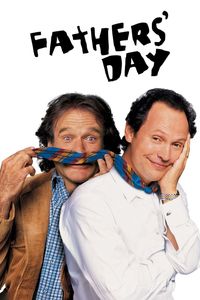
    (In French, On Cable TV, July 2020) Some movies are about as forgettable as their titles, and so it is that Fathers’ Day is about as generic as its titular holiday. The premise does have a bit of interest to it, as a woman separately manipulates two ex-suitors into believing that they have a hitherto unknown son… and that he needs to be found. It wouldn’t be nearly as funny if the two men didn’t meet and share notes at some point, which does happen once the action gets underway. Of course, such material needs strong comic actors, and so perhaps the one thing that most people will remember from the film is that it’s Billy Crystal facing down Robin Williams as two very different father figures. The generic Hollywood comedy star vehicle approach means that the script leaves many opportunities for Crystal and Williams to mug at the camera and do what they do best. Williams is his usual hyperactive polymorphous persona as a dramatic drama teacher, while Crystal gets to punch an unusually large number of people in the face in a lawyer’s role. The picaresque adventure takes them on the road across California to find out what happened to their son, taking us from scenes shot in Los Angeles, San Francisco and Reno (at least one of those cities doubling for Sacramento) along the way. Much of the film is very generic once you get past the lead actors, although seeing late-1990s Julia Louis-Dreyfus is fun, and the atmosphere (specifically the overwhelming music) is starting to date the film as a period piece. I didn’t hate Fathers’ Day as much as some other reviewers did, but neither did I find it all that compelling.

  • Nine Months (1995)

    Nine Months (1995)

    (On TV, March 2020) Writer-director Chris Columbus’ assignment on Nine Months was simple: turn in a slightly hysterical portrayal of a commitment-phobe young man in the process of becoming a father. Whether he succeeded is debatable. There are certainly good arguments in favour: Hugh Grant is in full befuddled floppy-raised butterfly-blinking mode here, almost sending up his own early-career persona. If you care about cutie redheads, there’s a young and soft Julianne Moore, plus Joan Cusack as an unexpected bonus. A strong supporting cast includes Tom Arnold, Jeff Goldblum and Robin Williams doing an Eastern-European shtick. Nine Months is luminously shot in beautiful San Francisco, and has a few amusing comic moments. Alas, it’s not all good, and what’s not good arguably overwhelms the rest. Columbus has significant problems striking an even tone between the universality of its premise and the wild comic extremes of some sequences. Much of the character drama that should emerge organically instead seems contrived through characters who make dumb choices because the script requires it to prolong the tension. Even for comic effects, the protagonist seems remarkably clueless. Suspension of disbelief snaps a few times, whether it’s from perplexing character actions, or even simple physics. (No, you can’t be suddenly hit in the face by a swing you’re casually pushing.) Nine Months tries hard, and probably too hard: it tries to take two directions at once and ends up confused about what it was trying to do.

  • Toys (1992)

    Toys (1992)

    (In French, On Cable TV, September 2019) Some movies are like surprise bags filled with things both cool and dull, and Toys fits squarely in this category. It’s visually sumptuous, filled with interesting actors and directed with a unique vision. Alas, it’s also juvenile when it shouldn’t, thematically wobbly and often not as witty as it thinks it is. Set in a world not quite like ours, it features a rich toymaker bequeathing his company to his military brother rather than his eccentric son. As we may expect, toy production soon takes a back seat to war machines, with the just-as-expected son fighting back. On paper, it’s not much and one of the worse aspects of the film is how it eventually becomes tiresome once the visuals become familiar. But that would be dismissing far too easily the power of those visuals, especially in the first act: For the art direction of the film (written and directed by Barry Levinson) is deliciously off-beat, inserting strange and whimsical visuals in contexts where we wouldn’t expect them. A lot of it harkens back to Magritte paintings, including an over-the-top spoof of MTV videos. The dynamo at the centre of it all is Robin Williams, in a curiously subdued performance. The supporting cast includes Joan Cusack, Robin Wright, L. L. Cool J as a hilariously overprepared military man and Jamie Foxx in his first (small) role … and Debi Mazar in a short but striking role as a libidinous nurse. Unfortunately, the result is less than its components: While the film isn’t exactly aimed at kids, it does feature a simplistic plot and an anti-war moral sense that eventually turns against itself when the heroes go to war against their opponents. There are several cute fillips in the plot, but it still comes across as a witty setting let down by a less-than-witty script. I’ll grant that the film was unusually prescient in some aspects: its discussion of swarms of “toy” war machines controlled by teenagers eerily prefigures the military drone era. But the disappointment with the rest of the script is real—it never transforms its fascinating weirdness into more than a merely satisfying narrative experience, and that’s a wasted opportunity. Still, let’s admire the audacity of the visuals, most of them achieved without CGI: I bet that a remake would look very, very different today.

  • The Survivors (1983)

    The Survivors (1983)

    (In French, On Cable TV, August 2019) You would think that a Robin Williams/Walter Matthau pairing would be comedy heaven, but the truth as proven by The Survivors (for this is the only such pairing) is that it just ends up being a mess. The roots of the problem go back to a meandering script with poor tonal control and what seems like few ideas about where it’s going. Williams doesn’t get a chance to work in his best comic range, although Matthau does a bit better in a role suited to his persona—some of the film’s best and funniest sequences are those in which his characters use his experience and hidden skills to try to control the excesses of his younger co-star. Still, there are plenty of missteps along the way, including a wholly unsatisfying redemption arc for the film’s villain that undercuts most of the (thin) emotional involvement of the audience in the film. There’s some material here about survivalists and a jaundiced perception of New York City that still plays well, but it’s really not enough. The lunacy of the script seems scattershot (sometimes featuring an employee-firing parrot, sometimes mired in urban grittiness). Now little known outside being a part of its two co-stars’ filmography, The Survivors isn’t a particularly shining example of early-1980s comedy.

  • Good Morning, Vietnam (1987)

    Good Morning, Vietnam (1987)

    (In French, On TV, August 2019) The latter half of the 1980s was an interesting time for American Vietnam movies. If you accept that most of the 1970s were wasted denying that there was even a war, that the early 1980s were a time for anger (as per Rambo and Chuck Norris’ Missing in Action), then the late 1980s were a grab-bag of depression (Full Metal Jacket) and acceptance (Platoon, Casualties of War), then Good Morning, Vietnam looks a lot like bargaining: “Sure, we’ll set a movie in Vietnam and acknowledge our losses, but we’ll turn it in a wacky radio jock comedy!” OK, so that’s being a bit unfair—while Good Morning, Vietnam is among the quintessential Robin Williams movies solely for the characteristic riffs he performs early on (you can feel the script stop and the improv begin), it also sets the stage for a more sober look at the conflict in the film’s last third, as our observer protagonist finally feels involved in the events. The result is still a provocative blend of comedy to ease viewers into a somewhat even-handed depiction of the war, deftly using Williams’ natural gift to make a film that would have been impossible with another actor. While the focus is often on the comedy, director Barry Levinson doesn’t skimp on the portrayal of the war itself—there’s a twenty-second tracking shot of helicopters at the end of the “It’s a Wonderful World” sequence that would fit in any other Vietnam movie, comedy or not. There is a formulaic nature to Good Morning, Vietnam, sure, but it’s more than offset by a successful execution. The result is still a gripping, funny, very enjoyable film even decades later.

  • Dead Again (1991)

    Dead Again (1991)

    (In French, On Cable TV, April 2019) I’m not going to be such a milquetoast as to state that Dead Again is all that weird a movie—but it’s weird and unusual enough to be interesting even thirty years later, and that’s not too bad. While Kenneth Branagh has a Shakespearian motif as a director, his filmography is varied enough to include this neo-noir romantic thriller that delves into classic Hollywood, past-life regression, hypnosis and full-bore romance. It’s quite a lot, but this joyously off-beat mixture of reincarnation, crime mystery, decade-long grudges and romantic thrills is executed stylishly enough to keep our interest. It is somewhat enjoyable is you take it the right way, which is to say dismissing the film’s plotting as a big ball of nonsense in service of a romantic atmosphere. Branagh is not bad in front of the camera, and Emma Thompson is quite cute in her dual roles. Robin Williams also turns up in a small but predictably surprising turn. The twists and turns are enjoyable to watch, and some of the historical material is quite immersive—especially if you know about 1940s Los Angeles. Branagh’s filmography is expansive enough to include an MCU film, a Tom Clancy-inspired techno-thriller, a Disney live-action adaptation and two Agatha Christie murder mysteries, so I’m not sure we can credibly claim that Dead Again is too weird for him. But it still stands out as an oddity against other movies in general, so on that basis alone it’s worth a quick look.

  • The World According to Garp (1982)

    The World According to Garp (1982)

    (On Cable TV, March 2019) I recall reading The World According to Garp in high school and being bemused at the novel’s obvious artificiality, going from one attempt to shock to another. Even today, it would probably be seen as a checkmark exercise in hitting as many hot-button issues as possible, from violent feminism to adultery to transgender characters to sexual assault to many other issues. The film adaptation, for all its faults (most of them self-inflicted) is relatively faithful to the book, although the actors do an incredible job in humanizing what, on paper, often feels like an exercise in authorial fiat. Should we give a bullhorn to John Updike? Many smarter people than me haven’t come to a conclusion. So it is, though, that the film adaptation is a blend of extreme characters, out-there hijinks (many of them sex-related), a writer obsession about being a writer, and so on. A young Robin Williams is in fine form with a character that’s not entirely aligned with his later screen persona. Glenn Close is good as his mother, but John Lithgow is even better as a transsexual friend—and the film, fortunately enough, has aged far better than expected in this regard, largely because it treats its character with respect and affection, making up for an otherwise lack of sophistication. I’ll admit that The World According to Garp remains interesting on a basic what-the-heck-is-going-to-happen-next level, but there is an extreme contrivance to much of the plotting that make it hard to take seriously upon reflection. It was a weird book and it remains a weird film, so at least it has that going for it.

  • The Adventures of Baron Munchausen (1988)

    The Adventures of Baron Munchausen (1988)

    (On Cable TV, November 2018) On the one hand, Terry Gilliam’s The Adventures of Baron Munchausen is an imaginative, clever, exuberant fantasy film. On the other, it’s the kind of film that appears severely limited today by circa-1988 technology: it swings for the fences, but doesn’t have what it takes to pass muster today. It’s also a story of the one-thing-after-another variety, meaning that the picaresque structure may not feel as if it’s tied up together. Still, it’s good fun to see John Neville justifiably hams it up as Munchausen, along with such notables as Sarah Polley, Jonathan Pryce, Uma Thurman and Robin Williams in grander-than-life roles. The fantasy between reality and fantasy here is thin, and I’m not too sure that it makes the most out of this quality. Still, as part of Gilliam’s “Trilogy of Imagination” after Time Bandits (which I didn’t like all that much) and Brazil (which is an all-time classic), The Adventures of Baron Munchausen ranks as a solid, um, average. I like what it’s trying to do, I appreciate that it was almost impossible to accomplish back then, but I’m not all that enthusiastic about the results.

  • The Birdcage (1996)

    The Birdcage (1996)

    (In French, On Cable TV, November 2018) Social trends shift over two decades, but if some aspects of The Birdcage are now slightly dated, the film itself remains quite a lot of fun to watch. There is, mind you, quite a pedigree to this American comedy—it’s an updated Americanization of 1978’s French farce La Cage aux Folles, which was itself a movie adaptation of a 1973 play of the same name. (And I’m not getting into the sequels to the French film nor the American musical.) In other words, the roots of The Birdcage go back to before I was born. But no matter the year, the premise is the same: A half-flamboyantly gay couple has to hide who they are as their son comes to visit with his fiancée and her ultraconservative parents. The key word here is “flamboyantly”—while issues between gay couples and social conservatives continue to be a rich source of conflict, the portrayal of the gay couple in all versions of the story does include a very camp gay character with a vested drag queen identity. The Birdcage bathes its gay characters in a warm sympathetic portrayal, which helps it a lot in being just as amusing today—the portrayal of the social conservative characters haven’t aged so well, but then again some caricatures are necessary. Now, of course, gay couples can now marry even in the United States and social conservatives are slightly more approving of them—and The Birdcage is often mentioned as one of the movies that helped move things along. Still, even though some of the details have changed, much of the movie does remain a lot of fun to watch: Robin Williams plays, if you’ll pardon the expression, the straight man to Nathan Lane’s far more exuberant character, with Hank Azaria making quite an impression as a supporting character and Gene Hackman playing ultraconservative like few others. The shrill screaming, snappy snarking and outlandish outfits clearly benefit from the drag club atmosphere, but the moral message underneath it all couldn’t be more wholesome, and the film’s portrayal of all of its characters is immensely likable. Breezy and fun, The Birdcage remains surprisingly good even more than twenty years later.

  • Popeye (1980)

    Popeye (1980)

    (Popcornflix streaming, September 2018) I grew up on Popeye cartoons (in French, mind you), but somehow hadn’t seen the live-action adaptation until now. I can’t say I missed much, because for all of director Robert Altman’s skill in recreating a cartoon-inspired seashore village, much of Popeye simply falls flat with simplistic character motivations, too-long musical numbers and an overall impression of … dullness. It’s not all bad: Robin Williams is good as Popeye, but Shelley Duvall is terrific as Olive Oyl and Paul L. Smith is remarkable as Bluto. The sets are splendid (almost too good, in fact—we don’t really want to spend any more time there) and there is some occasional good staging for the physical comedy. But otherwise, Popeye remains surprisingly boring: The film feel self-satisfied, prone to excessive sentimentalism and unwilling to make its narrative advance. Williams’ constant mumbling of malapropisms as Popeye in in-character, but that doesn’t mean it’s any less annoying. In some ways, Popeye also seems made for those who already know Popeye—I’m among those, but we’re literally a dying breed and I wonder what audiences new to the character would make of the film. I certainly had to pause and think a bit about those Saturday morning cartoons to be reminded of why the film followed a certain path, who those annoying people were and why it was so stylized. Overall, I’m disappointed at the result.

  • Dead Poets Society (1989)

    Dead Poets Society (1989)

    (Second viewing, On DVD, November 2017) I must have seen Dead Poets Society on TV back in the nineties, and revisiting it today makes for a complex mixture of remembrance, rediscovery and mild mourning that Robin Williams is gone. There is a small but definite dramatic subgenre out there that could be called “inspirational teacher” movies (and once you lump mentors, coaches and grumpy old guys teaching young men a lesson in there, it becomes a rather large subgenre) and Dead Poets Society seems to be its flagship title. A throwback at the boarding academies of the late fifties, this is a film that glorifies English classes to an admirable degree. Poetry has seldom been so cool (well, maybe in 8 Mile) and the link between English literature and taking ownership of one’s life is unusual enough to be interesting. It helps that, having been conceived as a period piece from the start, Dead Poets Society hasn’t aged much in nearly thirty years. The only thing that makes the movie wistful is Robin Williams—at times, it seems as if half of the film’s appeal is “wouldn’t it have been cool to have Robin Williams as your teacher?” and the circumstances of Williams’ death since then do make the film even more poignant. (Alas, I suspect that it also gives his character a free pass on a few disputable choices … as the film says, “free-thinking at seventeen”?)  The atmosphere of the boarding school comes with a heavy dose of nostalgia that isn’t as unpleasant as you’d think. It all amounts to a decent film, even a powerful one for those who find that it has resonance over their own experiences. 

  • Awakenings (1990)

    Awakenings (1990)

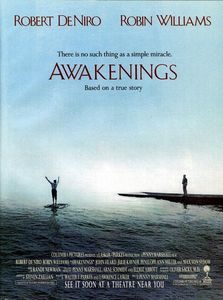
    (On Cable TV, May 2017) I’m not sure what I was expecting from Awakenings—seeing Robin Williams as a doctor, maybe something along the lines of Patch Adams? What I did get was more than expected. The first half of Awakenings is good without being particularly striking: Here are patients immobilized by a rare disease; here’s an unconventional doctor trying a new radical therapy to improve their condition and break them out of their catatonia. When, against all odds, it works, it’s the film’s big triumphant moment: People are free to live again, experience the world and blossom against all odds. The film’s real kicker, however, happens when the therapy stops being effective, and the newly awakened patients are dragged back in catatonia. It does give to Awakenings an efficient dose of wistfulness, and a stronger “experience life before it’s taken away from you” message. Robin Williams is good and not overbearing in a more serious role than usual, while Robert de Niro turns in a respectable performance as a patient who comes out of catatonia before facing the prospect of sinking back into it. Awakenings may be best approached with low expectations—it’s not a great movie, but it’s noteworthy and far from being as sappy as it could have been. It’s not comfortable and works better because of it.

  • Aladdin (1992)

    Aladdin (1992)

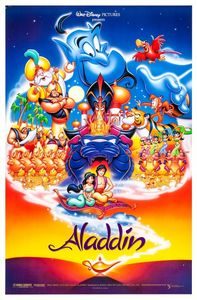
    (On DVD, April 2017) This is not quite a “first viewing” review. I have, after all, seen quite a lot of Aladdin by sheer virtue of being a dad. But living with a preschooler-in-chief means that most kids’ movies have to be seen in bits and pieces, always in French and in-between fetching, cleaning or food-prepping. Over time, I have grown accustomed to the ever-growing DVD library of kid’s movies that I’ve seen but never really watched. Well, it’s time to remedy that. (My daughter was scandalized that I would want to watch one of her movies in the original English while she was busy playing—note to self; for The Little Mermaid or The Lion King, wait until after bedtime.) Now that I’ve had the chance to watch the movie from beginning to end, let’s acknowledge a few things: It’s a tight take on the Aladdin story, filled with enough humour, action, suspense, romance and adventure to entertain everyone. The animation is pretty good, with an impressive early integration of CGI and 2D animation at a time when such a thing was only becoming possible for top-notch studios such as Disney. The film is worth viewing in the original English if only for Robin Williams’ remarkable tour-de-force vocal performance at the genie. Not only does the film come alive when he’s on-screen, but his rapid patter is typically Williamsesque to a point that gets lost even in the most well-meaning translation. I’ve long suspected that Jasmine is one of my favourite princesses, and this film confirms why—you can clearly see in her nature the template for the feisty female characters that would form the core of the Princess archetype during the Disney Resurgence period that continues even today. At roughly 90 minutes, it’s a film that doesn’t have a lot of dull moments. (Although I would redo the introduction: Not only does it come across as a bit racist, it inelegantly contextualizing the film as being “from somewhere else”, contrarily to the approach taken by more recent film such as Frozen or Moana that takes us inside the other culture from the first few moments.) Small nice moments abound, such as the two-faceted nature of the villain animal sidekick (another performance worth savouring in English, by Gilbert Gottfried), or the surprisingly deep bond of friendship between Aladdin and the genie. Musically, I like Aladdin’s introduction songs (both of them), and the effective “Friend Like Me”. All in all, Aladdin remains quite satisfying for the kids, pleasantly funny for the adults who can catch the anachronistic references, and a family film in the best sense of the expression.