Roger Deakins

  • 1917 (2019)

    1917 (2019)

    (On Cable TV, December 2020) World War I has long been neglected by Hollywood – WW2 gets all of the attention, and the technical improvements in digital cinema weren’t necessarily used to update the portrait of the Great War as much as they’ve been used to rethink other conflicts. But that’s all over with the arrival of 1917, which not only serves a big wide-scope view of the war that encompasses its multiple facets, but does it with an insane gamble: following two messengers through a pair of very, very, very long continuous shots giving viewers the immediacy of them being involved in the conflict without cuts away from the action. It’s a bravura performance from writer-director Sam Mendes and cinematographer Roger Deakins, and it works surprisingly well, what with the digital wizardry blending everything together as time passes unnaturally fast and yet we find our characters going from one episodic adventure to the other. The feeling left by this sweeping view of a large-scale conflict is gripping, and yet very personal for our two viewpoint characters. There’s something fascinating in seeing how modern filmmaking technology can enhance the immersive experience even further, and thanks to everyone involved in 1917, World War I has never felt so real, immediate and relevant.

  • The Goldfinch (2019)

    The Goldfinch (2019)

    (On Cable TV, May 2020) The truth about filmmaking is that so many people are involved and so many things can go wrong that it’s almost a miracle when something good comes out of the process: Good movies are the exception, not the default. This is true no matter your budget, your actors or your source material. While you can try to stack the deck with seasoned professionals, the result is still often a game of luck. (And now you know why Hollywood loves the sequels.) So it is that with The Goldfinch, producers certainly did get the best of everything—an award-winning novel, a seasoned screenwriter, a handful of great actors, Roger Deakins doing cinematography, enough budget to do justice to the story’s globe-spanning narrative, and all of the other production niceties afforded to a prestige drama. (I’m sure the catering must have been really nice.) This thing is taking us to the Oscars, they must have thought. And yet, and yet—nobody knows anything and, in the end, The Goldfinch is a messy, unwieldy adaptation of a novel that probably should have been best handled as a TV series (if at all) than as an unfocused, herky-jerky two-hours-and-a-half train wreck. The weird result blends genre thrills and pretentious narrative conceits in an attempt at becoming a so-called serious drama. In this regard, it reminded me a lot of Extremely Loud & Incredibly Close—along with sharing terrorism plot points and Jeffrey Wright—although I suspect that The Goldfinch is far too ludicrous to age as gracefully. If you’re looking for solace while you’re stuck in the film’s interminable length and ludicrous plot points, you can at least point at the actors, some of them used against type (Luke Wilson), others in more familiar characters (Wright) but none of them are any more comfortable with the results, as they are prisoners of a script that jerks characters around like puppets. While The Goldfinch is not strictly bad (it looks far too good for that), it’s just not very pleasant to watch most of the time. Even the structure tries for a collage and ends up with what feels like undisciplined flashbacks. But worse of all is the feeling that The Goldfinch had Best-Picture-of-the-Year ambitions and then, through hubris or complacency, completely wasted everything it had at its disposal.

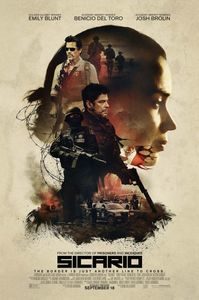
  • Sicario (2015)

    Sicario (2015)

    (Video on Demand, January 2016) As far as hard unflinching thrillers go, Sicario is a cut above the average. Featuring a merciless look at the increasingly uncivilized war between governments and drug dealers on both sides of the US-Mexico border, this film takes viewers into darkness and doesn’t allow for much light at the end. Our gateway character is a competent police officer drawn into a murky universe in which answers aren’t forthcoming and may be harmful to the soul. Director Denis Villeneuve once again manages a spectacular-looking film: with the help of legendary cinematographer Roger Deakins, Sicario revels in the bleak gorgeousness of the desert and its menacing twilight. The “bridge sequence” is a terrific thrill ride, while the almost-cryptic lines of dialogue do much to suggest an entire universe beyond the words. Emily Blunt is good in the lead role, but Benicio Del Toro and Josh Brolin end up stealing the show at times. Heavy in macho rhetoric against which crashes our protagonist, Sicario has the heft of a big thriller, the likes of which aren’t seen too often in today’s studio environment. Still, it’s not quite a perfect film: The morbid reality of its vision can weigh heavily at times, but the script appears half-polished in the way it switches protagonists during its third act, doesn’t quite maximize its own strengths and occasionally seems unfinished. I wanted to like it a bit more than I did by the end. Still, Sicario stand tall as one of the big thrillers of 2015, and should be good enough to make adult-minded viewers happy with their evening choice.