Russell Brand

  • Four Kids and It (2020)

    Four Kids and It (2020)

    (On Cable TV, December 2020) A kids’ fantasy film so lightweight that it flies away as soon as it’s over, Four Kids and It looks and feels like a TV movie that somehow stumbled upon a promising cast. The story is about what happens when four kids in a newly blended family discover a mysterious beach creature with the power of making wishes real. Complications accumulate as they explore the limits of that power, and when a local aristocrat has designs on the creature. There are some interesting names in the cast: Michael Caine voicing the creature, Paula Patton and Matthew Goode as the parents of the blended family, and (sigh) Russell Brand as the villain. The special effects are generally acceptable, and the film has enough budget to indulge in its script’s flights of fancy. But there are too many problems to discount: Patton and Goode are saddled with unlikable characters that they can’t fix, while the kids are even more obnoxious than the parents. Brand seems to be playing in a film aimed at an older and more irony-appreciating audience, and the film doesn’t have enough plot to cover it 110 minutes. In the end, Four Kids and It feels like slot-filling TV: it exists because it’s cheap and fulfills some basic programming imperative, but could have been replaced by just about anything even remotely similar.

  • Rock of Ages (2012)

    Rock of Ages (2012)

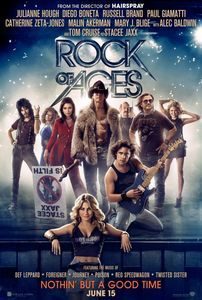
    (On-demand video, November 2012) I’m a forgiving fan of movie musicals and as such I’m pretty happy with Rock of Ages, which grabs eighties-rock songs and re-shapes them into a straightforward musical about finding love and success in 1987 Hollywood.  Julianne Hough and Diego Boneta do well as the dull young couple anchoring the story, but the rest of the cast shines.  Alec Baldwin is hilarious as an aging rock-will-never-die club owner, Paul Giamatti is perfect as a slimy impresario and Catherine Zeta-Jones is amusing as a socialite with a revealing past.  Still, they’re not the best of what Rock of Ages has to offer: Russell Brand steals his scenes with lines that sound tailor-made for his personae but even he takes a step back whenever Tom Cruise chews the scenery as rock god Stacee Jaxx.  Cruise-as-Jaxx transposes and perverts his movie-star status into a related realm, and if Cruise seems more accomplished than unleashed as a self-destructing icon, it’s still a great performance in a pivotal role.  Music-wise, Rock of Ages will have you humming “I Wanna Rock”, “Wanted Dead or Alive” and “Don’t Stop Believin’” (among others) for days, even though the movie’s soundtrack may not compare to the original versions of the songs.  I’m told that the movie’s plot is considerably happier and simpler than the original musical, (although it keeps the vexing two-act structure leading to a mid-movie lull) but director Adam Shankman’s adaptation is also able to weave song medleys around characters doing their own things separately –at best, it’s an exhilarating example of the creative freedom offered by well-produced cinema.  While Rock of Ages may be a fluffy fantasy loosely connected to the anthem-rock era, it’s bouncy and fun and just as entertaining as it wants to be.  But I did say that I’m a forgiving fan of movie musicals.

  • Forgetting Sarah Marshall (2008)

    Forgetting Sarah Marshall (2008)

    (On Cable TV, April 2012) If you believe in the idea of Hollywood as one big giant conversation during which the same group of people build upon each others’ ideas in order to make genres “evolve” (acknowledging that evolution isn’t always progress), then Forgetting Sarah Marshall now seems like an essential piece of 2000s American comedy.  It’s from well-known comedy producer Judd Apatow; it features early feature-film appearances by a number of performers who would earn further notoriety in other films; and it fits in the revival of the raunchy R-rated romantic-comedy-for-boys sub-genre that stretches from The 40-Year-Old Virgin to counter-exemplar Bridesmaids (so far).  In short, Forgetting Sarah Marshall has become an essential piece of the conversation about the comedy genre over the past ten years, and I had to see it after missing out on its inauspicious release four years ago.  Fortunately, it lives up to the hype: It’s biggest enduring legacy is bound to be writer/actor Jason Segel’s break-out performance as a relatively more charming man-boy character than the Will Ferrell type.  Forgetting Sarah Marshall also remains noteworthy for bringing Russell Brand to the movies; something that would lead directly to Bring Him to the Greek.  Otherwise, there are good performances here by Mila Kunis, Kristen Bell and Jonah Hill, all of whom would go on to star in other high-profile comedies.  The film itself is decently funny, if sometimes over-long and almost repetitive at times.  The ending clearly shows the way to 2011’s The Muppets, as a further piece of evidence of Forgetting Sarah Marshall‘s crucial link in the Hollywood comedy conversation.  You don’t have to see it for what it set in motion: the film is successful enough by itself.  But it’s far more interesting as part of a genre than as a film completely disconnected from its context.

  • Arthur (2011)

    Arthur (2011)

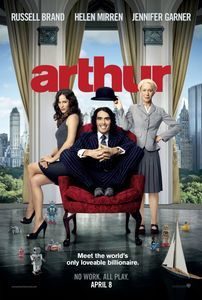
    (On cable TV, January 2012) Safely devoid of surprises, this romantic comedy about a slacker billionaire having to grow up is a vehicle for Russell Brand’s comic personae more than anything else.  It’s a risky bet, as the spoiled man-child shtick can quickly grow wearisome and then irritating.  Nonetheless, this Arthur remake manages to walk along that line and remain on the side of viewers’ affections: Never mind that Jennifer Garner is more interesting here as the romantic antagonist than in many of her previous movies: It’s Brand and Helen Mirren as her nanny that steal the show, with occasional assist from Luis Guzman and a gruff Nick Nolte.  The plot beats are intensely predictable, which makes the small details of the story seem more important.  The dialogues are surprisingly good, with a good understanding of conversation-as-argument and a bigger vocabulary than most romantic comedies.  Still, if those strengths do save Arthur from being nothing more than a typically average remake of a much-better film, they don’t do much more to strengthen the film.  At best, we end up with a watchable but inconsequential film that will gradually sink in memory even as the 1981 original will endure.

  • Get Him to the Greek (2010)

    Get Him to the Greek (2010)

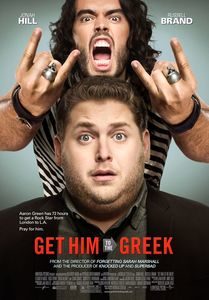
    (On DVD, September 2010) This movie pushes a lot of my anti-humour buttons: I’m still sceptical about a good chunk of the latest British comics, and Russell Brand’s fame seems as unexplainable to me as that of Steve Coogan or Sacha Baron Cohen.  (To say nothing of Jonah Hill, who feels like a less-funny Seth Rogen… and I don’t think of Rogen as particularly funny.)  Raunchy comedies aren’t my favourite sub-genre either, and I’m getting too old to play the spot-the-pop-references game in which Get Him to the Greek often indulges.  Those biases exposed, I still had quite a good time watching the film, in part because of its go-for-broke willingness to throw just about everything at the screen and hope some of it will be amusing to viewers.  Much of the celebrity cameos were wasted on me, except for Paul Krugman’s deliciously unexpected appearance.  Who would have thought?  Brand’s grander-than-life portrait of a rock star living to the maximum is enough to make us pine for the decline of mass-marketed music, while Sean Combs turns in a equally-enjoyable performance as an overblown music executive.  The film’s R-rated language and themes creates an atmosphere in which nearly anything can happen (including some things that you hope wouldn’t) and that kind of dreamlike no-limits feeling is something that’s relatively rare in today’s PG-rated comic landscape. Get Him to the Greek is undisciplined and scattered, but there isn’t as much grossing-out as you may expect… and even some overdone sweetness by the end.  Too bad that the more responsible plot elements end up looking so dull and worn-out compared to the film’s excesses: a script polish may have been able to smooth out some of those edges.  What’s there, however, is at least funnier than most other comedies on the shelf.  It may even surprise those of you who don’t expect much.