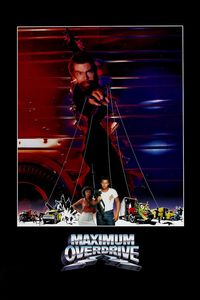
(In French, On Cable TV, October 2021) Oh, this is just stupid. Look: I’ve read shelves full of Stephen King books. I’ve seen nearly all of the movies adapted from his work and can run his filmography forward and backwards. I’ve been aware of movies for decades and semi-religiously reviewing since 1997. And yet until today, despite recording the film on my DVR and having it sit there for six months, I was unaware that King’s short story “Trucks,” which led to Maximum Overdrive, also led to the latter Trucks. This is really weird and can only be explained by selective memory, an amazing set of oversights and the fact that Trucks is nearly forgotten today. There’s a good reason for that. Made for television (hence flying under the radar of moviegoers in a pre-streaming era), Trucks makes a series of artistic choices that, in nearly all cases, lead to a superior film than Maximum Overdrive… and yet fail to hold our interest like the first film did. The answer to that mystery is counterintuitive. Even the kindest, most objective observers will note that King spent much of the 1980s in a haze of fame and cocaine (having been in such a state that he doesn’t even remember writing some novels). At the height of his first bubble of fame, he was offered the directing job for Maximum Overdrive and, in coke-fuelled insanity, proceeded to make an utterly ridiculous film that never stopped to question whether what it was doing was sane or logical. The result is a film that’s both terrible and hypnotically fascinating. No one thinks that Maximum Overdrive is a great movie, but they remember its insanity and love it for its excesses. So when director Chris Thomson took on Trucks and set out to make a more serious adaptation of a skimpy short story, a lot of competent people made very competent decisions. They gave a serious spin to the production to make it an outright horror film rather than a comedy. They hired better actors who could deliver the serious lines. They followed seasoned screenwriters’ advice and got relatable characters. They relocated the action to the American southwest to make it visually distinctive. And they utterly forgot one point: sentient evil trucks are a fundamentally stupid idea. It doesn’t work. It’s inane and crazy. So, in making a more respectable horror film out of “Trucks,” they completely exposed the futility of ever trying to turn the story into something halfway respectable. Worse: in not being able to fully realize their vision (thanks to limited budget, lack of imagination, and lack of daring), they ended up with a thoroughly mediocre product that leaves no lasting impression. Oh, there are other problems with the film: the characters are from stock, the directing is pedestrian and the insertion of gory sequence makes no sense (the Tonka truck killing someone? It’s like trying to put some Maximum Overdrive in a film that’s not built for that speed. Oh, and the axe murder has me asking if the masked figure was a truck in disguise.) So that’s what you get: Trucks is a marginally better film that’s somehow not as good as its demented predecessor. That makes just about as much sense as me not knowing about the film’s existence.