Stephen King

  • The Eyes of the Dragon, Stephen King

    The Eyes of the Dragon, Stephen King

    Signet, 1995 reprint of 1987 original, 380 pages, C$7.99 mmpb, ISBN 0-451-16658-2

    When it was first published in 1987, Stephen King’s The Eyes of the Dragon seemed like a significant departure for the author.  Occasional exceptions aside (such as the first novel in the Dark Tower cycle, or The Talisman), audiences had been conditioned, through the first fifteen years of King’s career, to expect adult horror fiction, not a fantasy fairy tale seemingly aimed at younger readers.  Now, of course, King’s brand is associated with a variety of dark fantasy subgenres; The Dark Tower did much to expand his perceived repertoire, and it’s no accident if that series is closely related to The Eyes of the Dragon, all the way to a common antagonist.

    And yet, nearly 25 years after its first publication, the distinctiveness of The Eyes of the Dragon remains, and so does its interest.  From the first sentence (“Once, in a kingdom called Delain, there was a King with two sons”…), we understand that this is going to be a different kind of reading experience: The story is told as a fairy tale, by a narrator whose presence couldn’t be more obviously felt.  Taking place a long time ago in a country far away, this is a story of a weak king, an evil magician, and two princes.  Tired of waiting for his chance at power, the mage eventually frames the good prince for his father’s death, sets up the weaker prince on the throne and set about to take from the kingdom of everything of value.  Fortunately, a cunning plan is in the works…

    But plotting isn’t the main feature of this novel, which is best appreciated as a storytelling exercise.  Reportedly adapted from stories King told his children, The Eyes of the Dragon sometimes feels like a self-imposed dare: different subject matter, different tone, and different rhythm.  The narration becomes its own reason to read the book, as King spends the first half of the book providing us with the backstory, the characters and the motivations.  The narrator is omniscient, but only to a point: He frequently addresses the readers to tell them that he has described everything as it happened, but the audience should make its mind as to what it means.  Meanwhile, the story is told with its own special charm, and the novel quickly gains the trust of its readers from the start.  It is, in other words, a lot of fun to read.

    It’s also misleading to keep referring to this as “a fairy-tale for kids”: While the setting, vocabulary and sentence structure may seem destined to a younger audience, King doesn’t limit himself to simple sentiments or emotions in the telling of the story.  The words are simple but the thoughts aren’t, and The Eyes of the Dragon may work better as a fable for grown-ups, creating a sentiment of nostalgia for bedside storytelling while managing to address adult concerns.  There’s more depth to the book than expected, and a lot of sympathy for the fully-sketched characters.

    Where The Eyes of the Dragon doesn’t work so well is in its pacing: Ironically, the novel gets a great deal less absorbing once the plot moves forward.  Rather than focus on the protagonists and the palace intrigue, it dissipates by changing focus and following minor characters.  Those characters aren’t so minor in that they are reportedly meant to portray King’s children in the story, but they do send the novel in another, less interesting direction just as it should move toward its conclusion.

    Still, the overall impact of the book is strong, and it cements the notion that Stephen King is not just a gifted writer, but one who has continued to try new things along the way.  King scholars will better understand the relationship between The Eyes of the Dragon and the rest of the King universe (most particularly his fantasy work) but you don’t need to be a King aficionado to appreciate this book and what it attempts to do.

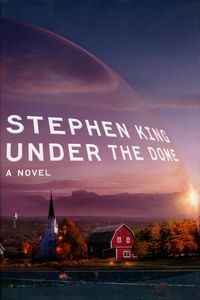
  • Under the Dome, Stephen King

    Under the Dome, Stephen King

    Scribner, 2009, 1074 pages, C$39.99 hc, ISBN 978-1-4391-4850-1

    Frankly, there’s just one thing you need to know about Stephen King’s Under the Dome:  It’s big.  It’s really, really big.  Count the pages and recall the two other King novels of similar heft: The Stand and It.   The page count shows that Under the Dome is King’s third-longest novel, and it certainly feels epic.

    The premise is simple: When a small Maine town is cut off from the world by an invisible but impassable barrier, its residents struggle to understand what’s going on and survive the experience.  But such a plot summary glosses over the totality of King’s presentation of the event.  He’s got two thousand viewpoints to play with, and if the action wisely focuses on half a dozen main protagonists, at times it feels as if the omniscient narration gives us a glimpse of every single citizen of Chester’s Mill.  The first chapter alone takes a kaleidoscopic view of what happens when the dome falls, with crashing vehicles, cut-off body parts, interrupted streams, accidents of fate locking some people in or out and other assorted phenomenon.  The omniscient narration can be chatty, but it also goes quiet when it’s time to focus on the main characters.

    Because there’s a lot more to Under the Dome than a town physically cut off from the rest of the world: Chester’s Mill has its share of bad apples, and they control the place.  When media attention brought on the city following the fall of the dome threatens to expose secrets that the guilty would rather keep hidden, the dome itself becomes less dangerous than the people inside … Psychotic murderers, crystal-meth entrepreneurs, power-crazy policemen and panicked citizen all show their true colours during the days that follow the fall of the dome.

    But it’s the details through which King tells his story that make Under the Dome such an impressive and frustrating book.  On one hand, there is enough time and space here for elaborate plotting, reversals of fortune, copious inner monologues and ample character growth.  When King activates his omniscient narration, it’s like floating above a small town and having direct access to two thousand minds in all their diversity.  On the other hand, that amount of verbiage slows the action down and frequently makes readers wish for the next plot point.  King pulls a bit too obviously on familiar plot threads about religion, serial killers, corrupt authority and civil unrest to avoid a feeling of familiarity throughout much of Under the Dome.

    There is, however, quite a bit of allegory going on under the surface of the text.  It doesn’t take much of an imagination to see the parallels between an isolated and paranoid Chester’s Mill and Bush-administration America.  The division of power between a ruthless sheriff and incompetent politicians has real-world parallels, and much of the popular hysteria cuts a bit too close to headlines of the last decade to be entirely accidental.

    Where Under the Dome doesn’t do so well is in its ultimate justification for the Dome.  It moves the novel from the Horror to the Science Fiction genre.  This is not by itself a bad thing, but it will make a number of more rigorous readers cringe given the thinness of the premise and the somewhat arbitrary way the novel is resolved.

    Still, that ending is preceded by an apocalyptic sequence that leaves few people standing, so it all evens out.  While Under the Dome can occasionally be exasperating, annoying and underwhelming, it’s also a novel that disappoints because it attempts so much: Even if he misses a few targets along the way, King still manages to hit plenty of them.  The result may not have the quasi-mythical heft of The Stand or the tight focus of “The Mist”, but it’s the kind of wide-screen horror/thriller that has become a bit too rare lately.  King being King, it’s also a book written with clean prose, compelling characters and a thicket of plot developments.  It is, in short, a perfect book for those who want to sink into a lengthy reading experience and blink their eyes back to reality a long time later.

    In its own four-pounds fashion, it’s also a powerful advertisement for ebook readers.

  • From a Buick 8, Stephen King

    From a Buick 8, Stephen King

    Pocket, 2003 reprint of 2002 original, 487 pages, C$11.99 mmpb, ISBN 0-7434-1768-2

    At this stage of his career, Stephen King can take risks that a younger writer wouldn’t dare.  Risks like a novel that consciously withholds complete satisfaction from the reader, wrapping everything in a preachy blanket of “there are strange things we’re not meant to understand”.  No, I’m not talking about The Colorado Kid, but From a Buick 8, an uncanny novel that does things in ways few genre readers would expect.

    Which is just as well, because a very superficial look at the novel immediately summons memories of another King novel: his Christine is the first example that comes to mind whenever talking about “evil car horror novels” for instance.  But the similarities end there: In From a Buick 8, things are far more complicated than just a car haunted by evil spirits.

    After all, it’s not even a car.  When Pennsylvania State Troopers are called to a gas station to pick up an abandoned vehicle, they quickly find out that the object that looks like a Buick Roadmaster really isn’t: Not only do the details don’t match (extra decoration elements, oversized wheel, etc.) but the car won’t even move by itself.  Never mind how it got there, or where its driver has gone: Soon enough, the Troopers discover that the materials used to build the car are quite unlike anything they know, and that the car self-repairs when damaged.

    But wait: it gets worse.  Periodically, the car starts bending reality.  Temperatures next to it drop by several degrees and the inside of the car lights up with eerie electrical light.  Soon after those events, things either disappear or appear next to the car.  One trooper goes missing.  Repulsive plants and animals pop up next to the car.  Faced with such phenomenon, the troopers safely shutter the car in a shed.  Years pass.

    Don’t expect a tidy chronological third-person telling of the tale.  From a Buick 8, also much like The Colorado Kid, is a novel in which a younger protagonist is told things by older, wiser people who have seen it all happen.  In this case, a young teenager, whose recently-killed father knew the secrets of the Buick, prods and asks his father’s colleagues about the car he discovers hanging around the barracks.  Their tale goes from 1979 to the early years of the new century, in bits and pieces given how they don’t want to acknowledge all at once the piece of pure strangeness in the back shed.  The narration is one filled with regional expressions, jaded details, blue-collar vocabulary and homespun turns of phrase.  The teenager wants to know everything as soon as possible, and have it make sense, whereas the older folks know that it’s impossible: The car has been in their lives for decades, and it’s unexplainable as far as they know.

    In many ways, it’s a novel about storytelling and how it’s neater than messy reality.  The Buick becomes an irrational part of the characters’ lives, to be locked somewhere in a shed and occasionally confronted as it takes out another piece away from their orderly reality, or spits out something that has no right to exist.  It’s not a scary novel as much as it’s a quietly terrifying one as the characters come to terms with something that will never be explained.  In that regard as well, it’s a precursor to the dirty trick that King would spring on readers with The Colorado Kid, presenting them with a tantalizing mystery that the author refuses to solve.

    Yet From a Buick 8 is somewhat friendlier to genre readers than The Colorado Kid in that it does feature a decent amount of chills and thrills even before the conclusion, and that it does offer enough of an explanation and a conclusion to mollify most readers.  The central mystery itself remains, but most of the smaller details are tied together in a final vision, and the epilogue offers a surprisingly reassuring way out of the strangeness.

    It amounts to a strange and uncanny novel that works in ways that horror novels usually don’t.  It’s a pleasure to read thanks to the narration and the accumulation of details about the life of state troopers, but it does eventually leads somewhere with its steady freak show of small-scale terror.  The framing device works in large part because the conclusion jumps out of the frame and starts messing with the people telling the story.  Writers will recognize the risks taken by King here, but readers should feel blessed to be in the hands of such a good storyteller.  From a Buick 8 is not your average horror novel, and it’s all the better for it.

  • The Mist (2007)

    The Mist (2007)

    (On DVD, December 2009) Stephen King’s “The Mist” having been a favourite story of mine ever since reading it in Skeleton Crew, I was apprehensive about seeing a big-screen adaptation.  Despite the track record of screenwriter/director Frank Darabont, what would become of the story?  As the film gets going, a number of things don’t quite seem to work: The dialogue seems forced, the intensity of the drama seems to jump prematurely, seemingly driven by anticipating the next plot beat rather than evolving organically.  But at the mist engulfs the characters and the monsters slowly appear, The Mist settles down and the bigger problems fade away.  Smaller problems remain: characters make stupid decisions (why, gee, golly yes: insects are attracted to light during night-time), keep making stupid decisions (when you hear “something” in a murderously monstrous environment, the time has come to run) and then make some more stupid decisions.  I also had mixed feelings about the film’s human antagonist, which goes so far into pious-evil territory that she becomes exasperating more than threatening: there’s a difference between hating a character and wanting other characters to hit her on the head with a shovel.  But the film gradually redeems itself with better and better material as it goes along, culminating in a pitch-dark ending that manages to one-up the novella’s original conclusion.  It all amounts to a fairly decent horror film, filled with disgust and terror and bleakness, not to mention tentacled monsters jousting for disgust with dangerous humans.  As an adaptation, it respects the original despite a few early issues.  While those flaws are a bit too annoying to make The Mist anything more than a modest success, the overall result is a respectable entry in the Stephen King adaptation canon.  The DVD has a charming audio commentary by Darabont as well as a featurette on artist Drew Struzan that eventually becomes quite pretentious, but skimps short on the special effects documentaries.

  • Bag of Bones, Stephen King

    Bag of Bones, Stephen King

    Pocket, 1999 mass-market reprint of 1998 original, 732 pages, C$10.99 mmpb, ISBN 978-0-671-02423-9

    Halfway through Bag of Bones, I realized that I had come to take Stephen King for granted.  It’s easy to do so: With a decades-long body of work that makes even so-called prolific authors look like slackers, King has been a fixture of the American publishing scene for decades, and while he’s had both high and low points, his work delivers a dependable reading experience.  Studying my reading history, I see that I tend to read King in big batches every five years or so, running up his back-catalogue until I’m (relatively) caught up once again.

    Now it’s time for another batch, because clearly I had forgotten how much fun a King novel could be.

    Not that Bag of Bones is fun in itself: After all, it begins with the death of our narrator’s wife.  Things don’t necessarily get any better after that: For four years, our scribbling protagonist is physically unable to write even one line of fiction.  It’s only when he returns to their summer home and finds out that she may have been up to a secret project that something changes in him.  This being a King story, our grieving narrator soon finds himself stuck between vengeful ghosts, benevolent spirits, an obsessed billionaire and a cute single mother.

    As a reflection of King’s pet themes, Bag of Bones starts out respectably: Our narrator’s status as a well-selling writer of romantic thrillers allows him to talk about the publishing industry with insider’s knowledge, and King manages to make something as esoteric as writer’s block seems accessible to everyone.  Later on, a few twists end up being referred to as plot devices by an all-too-aware narrator.  What’s less familiar is the theme not just of matrimony, but of domestic intimacy that emerges from Bag of Bones’ description of a widower being reminded of what he shared with his deceased wife.  For some reason, that’s an aspect of life that few writers attempt, let alone pull off convincingly.

    But Bag of Bones was, for me, another opportunity to be immersed all over again in King’s prose style.  He doesn’t have much of a reputation as a stylist because his writing seems so clear, but the way he manages the technical aspects of his prose are still nothing short of amazing: Inner monologue, action, explanations and flashbacks proceed seamlessly, and the voice of the narrator holds it all together.  The only passages that seem atypical are a pair of lengthy dream sequences that eventually prove far more important to the plot than they seem at first.  Still, King’s prose has rarely been as pitch-perfect as it is here, and he is able to highlight various emotional tones from joy to dread to despair.

    Structure-wise, there are a number of sharp turns in the story, some of whom feel gratuitous at first, but all eventually coalesce by the end of the book.  While Bag of Bones is a ghost story, it multiplies the parties involved (both real and occult) to an extent where the usual plot templates don’t readily apply.  The portrayal of small Maine communities has always been one of King’s strengths, and he once again excels at that here.  Add to that the more literary ambitions of a story in which half the battle is a widower getting over his grief and there’s a good chance that non-genre readers pulled away from King’s more bloodthirsty reputation will find much to like in this more nuanced story.  (It’s no accident if the title alone has literal, metaphorical and thematic interpretations.)

    Bag of Bones may not have the conceptual punch of some of King’s other novels, but it all adds up to a big book that’s worth the time to read.  It’s well-crafted, strongly characterized, entirely within King’s pet themes and yet a step beyond into powerful reality-based fiction.  It’s a deft blend of genre horror and character-driven fiction.  It’s also a reminder, even ten years after publication, that I happily still have a lot of King left to read: I ended up drawing a list of his titles that I haven’t read yet, and ended up with enough material for the next two years.  By then, he will have probably published three or four new books.  But that’s OK: The only danger in that much of a good thing is that we come to expect it without a proper amount of gratitude.

  • On Writing: A Memoir of the Craft, Stephen King

    Pocket, 2000, 297 pages, C$10.99 mmpb, ISBN 0-7434-5596-7

    If you are a Stephen King fan, there is only one thing you need to know about this book: It’s essential reading. Go get it. Now. Shoo. Come back whenever you’ve read it. I’ll wait. It won’t take a long time, trust me.

    For everyone else, it’s important to place On Writing in the proper context of Stephen King’s life and times. In King’s nearly thirty-year-long career (Carrie was published in 1974, though King wouldn’t become a mega-selling author until after the de Palma and Kubrick adaptations of, respectively, Carrie and The Shining in the late seventies.) King has never been shy about either talking about himself or the craft of writing. (For proof, see, oh, the “Constant Reader” forewords, interviews and non-fiction pieces in places like Writer’s Digest.)

    But until now, though he had published non-fiction before (his book-length exploration of horror fiction, Danse Macabre, is a must-read for every serious student of the form), King had never tackled a sustained autobiography, nor a lengthier piece on the act of writing.

    Well, no more. On Writing is on shelves, and it’s definitely worth reading. Part confessional autobiography, part inspirational advice, part reflection on the techniques of writing, On Writing is of most interest to existing fans of King’s work, but should reach a much larger public by sheer virtue of honesty. The big surprise, in light of the massive length of some of King’s novel, is how On Writing comes out as an easy, short and snappy book, just long enough to leave us wanting more.

    The first section is a collection of thirty-eight memories, anecdotes and vignettes of his life, from the infant Stephen King to the seasoned best-selling writer. Though I’m no literary scholar, the level of honesty exhibited here by King is commendable. From an unremarkable childhood in a single-parent family to his first forays in writing, King gives us a glimpse in the formative experiences of the writer he has become. Future King specialists will read this in awe; the rest of us won’t be any less fascinated. King occasionally shocks (On his addiction problems: “I wrote The Tommyknockers, often working until midnight with my heart running at a hundred and thirty beats a minute and cotton swabs stuck up my nose to stem the coke-induced bleeding.” [P.90]) but follows up with some good advice (in this case, that the myth of the gloriously addicted writer is a false and dangerous one; “Hemingway and Fitzgerald drank because that’s what alkies are wired to do.” [P.92]) King also describes the fascinating process by which several of his best-known books were written. He doesn’t even remember writing entire novels, but what he does remember is sobering.

    He follows this confessional with writing advice that occasionally takes up more of an inspirational quality than a strictly didactic one. It also helps that this is a book about writing from someone who knows how to write and loves doing it. A random selection of King’s fiction shows an uncommon fascination with writers and the writing process (One title: Misery), and this fascination is entirely organic to his own writing process. It would be hard to imagine his best-selling colleagues (say, Tom Clancy or Danielle Steele) being able and willing to write a similar book. (Audaciously enough, King also takes the time to criticize some of his colleagues)

    The book closes on more autobiographical material, this time a lengthy description of his 1999 accident (in which he was hit by a drunk driver) and his rehabilitation. Seasoned horror readers might find themselves cringing with sympathy as King spares no details in recounting how difficult the experience was. At this stage in the book, it comes as no surprise if starting to write again has been a key element in his recovery.

    At this stage of his career, it’s widely acknowledged that King is well on his way to become the representative popular writer of the late twentieth century. On Writing shows the qualities that will make him a Dickens for our time in years to come. His dedication to craft and his knowledge of what he is doing are unequalled in the best-selling arena. There are undoubtedly better writers out there, but few have been able to marry popular success with literary quality like he has been able to do. We are lucky that he’s been so willing to set down his advice and his memories in such a book.

  • Storm of the Century, Stephen King

    Pocket, 1999, 376 pages, C$22.00 tpb, ISBN 0-671-03264-X

    EXT. ROCKLAND, ONTARIO: MIDDLE-CLASS SUBURBAN NEIGHBOURHOOD—NIGHT

    A lone Saturn car makes it through the streets of Rockland. It is snowing heavily, and only the excellent driving skills of THE REVIEWER, plus the front-wheel drive of the Saturn, manage to overcome the blizzard. The town is blacked-out: Only the headlights of the car illuminate the streets.

    The Saturn finally turns in a driveway and stops besides a modest home. The REVIEWER gets out of the car and enters the house. Behind him, his footsteps in the snow are erased by the howling wind.

    INT. HOUSE, HOME OFFICE

    The REVIEWER tries to open the light, but the power is obviously out. Ever-prepared, he opens a drawer and takes out candles and dry food.

    He settles down in his favourite reading chair. Looking on his coffee table, he notices that the next book on his reading stack is Stephen King’s screenplay for the TV movie Storm of the Century, published in book form by a publisher eager to make a few extra dollars.

    The REVIEWER takes the book, looks at the white blackness outside and smiles. How appropriate. He sits down and starts to read.

    There is a battery-operated alarm clock besides him. Five minutes pass.

    REVIEWER (VO)

    Wow, King surely loves to spoil things in his introduction. Should have been an afterword. I’m worried about his comparison with Needful Things, because so far the plot of both stories seem identical. Let’s read on.

    Five minutes pass.

    REVIEWER (VO)

    No small surprise that King loves the script format. It’s as descriptive as his usual writing style, and he can’t help but comment on the action.

    Twenty minutes pass.

    REVIEWER (VO)

    Nothing much has happened so far, but I’m intrigued. Who’s that Limoges fellow who kills and then asks for something? What’s that something? If it wouldn’t be for that question, the rest of the setup would be unbearably slow.

    Another twenty minutes pass.

    REVIEWER (VO)

    You know, King, it might be time to start the action. Halfway through, and half the dialogue’s so far is Limoges saying “Gimme whatta want and I’ll go away.”

    Five minutes later.

    REVIEWER (VO)

    Ah! More people die!

    Ten minutes later.

    REVIEWER (VO)

    Okay, stop the body count, I think I get the point.

    Five minutes…

    REVIEWER (VO)

    No, but really!

    Ten minutes.

    REVIEWER (VO)

    So that is what he wants. Is that it?

    Thirty seconds.

    REVIEWER (VO)

    Apparently so. I can see where this is going.

    Ten minutes. The reviewer snaps the book shut.

    REVIEWER (VO)

    Pretty much of a downer. Doesn’t deliver much, but that’s okay since we weren’t expecting much. Not one of his best, obviously.

    The REVIEWER gets up, shaking his head. At least he’ll be able to read something more interesting right away. He glances at his reading table and sees that all the books are more copies of Storm of the Century

    He gets up, shocked. He runs to his library and looks at the shelves. More copies of Storm of the Century. In all formats: paperback, hardcover, audiobook, videocassette, DVD…

    STEPHEN KING (VO)

    Give me the review that I want, and I’ll go away.

    The REVIEWER hyperventilates and screams.

    REVIEWER

    NOOO!!!

    Outside, the storm continues, unabated.

  • Desperation and The Regulators, Stephen King & Richard Bachman

    Signet, 1997, ???? pages, C$??.?? mmpb, ISBN Various

    Desperation, Stephen King: Signet, 1997, 547 pages, C$9.99 mmpb, ISBN 0-451-18846-2
    The Regulators, Richard Bachman Signet, 1997, 489 pages, C$9.99 mmpb, ISBN 0-451-19101-3

    Any way you look at it, Stephen King is an interesting author. Springing to national fame after two unusually successful movies adapted from his novels (Brian DePalma’s CARRIE and Stanley Kubrick’s THE SHINING), he has reigned over the bestseller lists for more than two decades. While lesser authors might have comfortably rested on their laurels, releasing formula novels every year or so, King is a genuine writer who’s not afraid to take risks. These risks don’t stop at what he write, but also extends at how they’re published. To promote Insomnia in 1994, he travelled through the United States on a motorcycle to do signing in independent bookstores. He agreed to publish The Green Mile in six small instalments, like the serial novels of yore. In 1996, he simultaneously released two novels: One under his name, and the other one as his pseudonymous alter-ego, Richard Bachman (also known as the author of Thinner and The Running Man, among others)

    The experiment doesn’t stop at the simple simultaneous release of two books. Where it gets really interesting is that both novel share their cast of character, the name of the villain and even some common lines. Up to a certain point, one can argue that the events of both novel sport a common history.

    Nevada, 1858: In the middle of nowhere, a small town has sprung up around a mine. The soil isn’t exactly stable, so the company hires Chinese personnel willing to work for almost nothing under horrific conditions. One day, while more than forty men are working underground, the mine caves in. Accident or totally intentional event? In any case, the mine is re-discovered more than a century later, as a blasting uncovers the mine shaft.

    Here, the stories part ways.

    In Stephen King’s Desperation, the action stays in the small mining town of Desperation, Nevada. During the first hundred pages of the novel, various visitors are brought together in the town’s jail by a crazy policeman. Few remain alive in the town, and who knows if the policeman has anything to do with this? For that matter, even the few surviving citizen of Desperation seem ready to swear that the policeman isn’t his usual self…

    In Richard Bachman’s The Regulators, the action stays in Wentworth, Ohio. More particularly, in the suburban picture- perfect Poplar Street. It’s a superb summer afternoon until a paperboy is killed by a shotgun blast fired from a futuristic red van. Before long, half the street’s residents are dead and the other half are waiting for the next devastating attack. It doesn’t help that Poplar Street isn’t in Wentworth any more…

    You can read one or both novels in any order; neither is sequel or sideshow. There are, however, interesting bonuses to be gained from doing what this reviewer did and reading both concurrently, fifty or a hundred pages at a time in both: backstories are fleshed out in one novel but not in another, subtle personality changes take more significance, background details seem more pertinent. The fate of characters isn’t identical, of course. Some survive to both, die in one or die twice.

    As interesting as the concept is, however, one almost wishes that the interplay between both works could have been deeper, even maybe up to an absurdly almost-postmodern point (one character could “know” something learned by the other book’s character, and similar tricks). In any case, the experiment raises interesting questions, and readers should be thankful that King has experimented with this.

    Besides literary curiosity, however, it’s a relief to find out that King has written some of his most “characteristic” novels in years with Desperation and The Regulators.

    Desperation, with its desertic, almost post-apocalyptic locale and its ultimate combat between the forces of good versus an incarnation of evil, is not without bringing back memories of King’s The Stand (though being nowhere near that novel’s power). King’s seemingly-effortless management of a multi-character cast also recalls some of his most successful older novels. On the other hand, it has more than a few lengths, also like King’s previous work. In any case, it’s a change (improvement?) from King’s last three novels, which took a far more intimate psychological approach.

    The Regulators is closer to Bachman’s previous five novels in that there are few lengths and more violent action than King usually puts in his novels. Shorter than Desperation and more classically exciting, The Regulators also marks a radical departure from King’s last few novels, which were becoming more and more sedate. Not exactly the ultimate tale of suburbia terror (the villain simply doesn’t let itself to this goal), The Regulator is nevertheless fast-paced action with a supernatural premise. Bachman’s narration is honed to quasi-perfection; the result is great.

    Both novel also mark a return to two of King’s favourite themes; children (saviours in both, but more ominously so in The Regulators) and writers (heroes in both, but more ominously so in Desperation).

    One flaw shared by both novels is that the opening chapters (creepy in Desperation and action-packed in The Regulator) promise more than is ultimately delivered. While this is not a new problem in horror -where menace is almost always more effective than execution- it seems more disappointing here perhaps because of the interplay between both novel. In The Regulators, it’s a bit difficult to express outright rage at the antagonist, while in Desperation it doesn’t seem quite so threatening in latter stages than in its policeman incarnation.

    In the end, however, Stephen King is having fun and the result is a return to old familiar places. (The second drive-by shooting in The Regulators is almost as merry to read as the degeneration of the villain in Desperation) Either novel is good by itself. Taken together, however, they become special. Maybe not as great as could have been expected, but still worthy enough of the King mark of quality.

    It remains to be seen what else Stephen King plans for us…

  • The Talisman, Stephen King & Peter Straub

    Berkley, 1984, 768 pages, C$8.75 mmpb, ISBN 0-425-10533-4

    People often ask me why I read so much Science-Fiction. Frankly, that’s a very good question that I haven’t got around answering yet. Oh, sure, there are the usual excuses: I grew up with it, I watched Star Trek for as long as I remember, I’ve always been interested in space, science and stuff, etc… Nevertheless, the best answer may still be that, frankly, what else would I want to read?

    Other genres are boring or limited in numbers: Techno-Thrillers are fun but few, romance isn’t my cup of tea, mysteries are (usually) mind-fluff, general literature meaningless AND boring, horror usually cliched and fantasy-

    I don’t usually read much Fantasy, and The Talisman reminds me why.

    Begin by ignoring the names on the cover. Sure, Stephen King and Peter Straub are two terrific horror writers, but that doesn’t necessarily mean that The Talisman is horror.

    It smells like fantasy, looks like fantasy and reads like fantasy. To wit:

    A young boy, wise beyond his years, discovers that he can access a parallel world. His mother’s analogue in this world is a queen, and he must cross America to retrieve a talisman that will heal both versions of his mother. Opposing him are a powerful dark prince and his real-world analogue, a lawyer.

    If that’s not the essential Fantasy Plot, what is?

    Surely, there are enough dark critters and evil persons to transform this in a dark fantasy, but it’s still the usual plot taking place.

    Like most novels by King -even though I suspect Straub might have written most of the book- this book is pleasantly readable… if such a word can be applied to dark fantasy. Characters are well-presented, the adventures of the hero are told reasonably well.

    There are a few deviations from the standard plot, mostly dealing with the dual-universe nature of the story, but the thrust of the novel remains the same as countless fantasy trilogies before it. And I can’t help but be ambivalent about a novel that is explicitly aware of hard-SF, yet grossly contradicts its own rules. Oh, and the finale is interminable.

    I’ve heard people say this is the best book they’re ever read. On the other hand, some people have called this the worst Stephen King book, ever. As usual, the truth lies somewhere between these two extremes. In short: Average.