Stephen Merchant

  • Fighting with My Family (2019)

    Fighting with My Family (2019)

    (On Cable TV, November 2019) Looking back at the past few decades, it’s interesting to see how wrestling has gone from vaguely disreputable status to something approaching family-friendly entertainment, and Fighting with My Family only underscores this evolution. Loosely adapted from a true story first presented as a 2012 documentary of the same name, it features a young woman (played by Florence Pugh) who, from unenthusiastic participation in low-budget wrestling leagues, goes to being drafted to compete in the World Wrestling Entertainment’s woman division and becomes a celebrity of the sport. Considering that the WWE played an integral part in the film (which features an extended cameo-as-himself from co-producer Dwayne Johnson, arguably the most successful wrestler-to-actor so far), Fighting with my Family doesn’t try to expose anything about the WWE except its rigorous physical requirements. The film is presented as inspiring family-friendly entertainment, with the most surprising name in its crew being Stephen Merchant as writer-director. (He also shows up briefly in a small role.)  A few familiar names appear in the cast, perhaps most notably Vince Vaughn as an imposing coach. Narratively, Fighting with my Family is familiar material, with wrestling taking the place of many other kinds of endeavour in being the backdrop to the heroine’s progression. The violence of the sport is downplayed as it moves closer to the WWE, with “career failure” being shown as brass-tack injuries in low-rent matches. A flurry of family (and family-friendly) values are constantly promoted, perhaps for fear than anyone would think Fighting with my Family is a grungy film. As someone whose understanding and interest in wrestling is tepid at best, I had perhaps more fun reading about the film and its deviations from reality than I had simply watching it. But it’s accessible even to non-fans of the sport.

  • Tooth Fairy (2010)

    Tooth Fairy (2010)

    (On TV, May 2019) Nearly every modern action star has one in their filmography—a kid’s movie, meant to humanize their four-quadrant image, give them something to watch with their own kids, and provide them with an alternate side-line if ever they get too old for the action stuff. Their quality is … variable. Tooth Fairy is Dwayne Johnson’s kid’s movie, and it’s not one of the better examples of the form. It’s about nothing less than a disillusioned hockey enforcer (so renowned for dental harm that he’s nicknamed the Tooth Fairy) discovering that there is such a thing as tooth fairies … and that he’s been summoned in their ranks. Never mind the trite believe-in-your-dreams stuff—that’s on par for the form. What’s more annoying is the film’s choppy rhythm, occasionally dubious morality, multiplying subplots, syrupy execution and weird chronology. The hockey details are also often ludicrously wrong, but that’s to be expected from a Hollywood movie. Few things manage to distinguish Tooth Fairy from the morass of similar films, but there are a few: some of the worldbuilding details of the fantasy tooth fairies are fun, and the repartee between Johnson and Stephen Merchant has its moments. One thing that doesn’t count as much is Johnson’s charm, and that’s due to the same reason why I suspect he wouldn’t make the same movie today—his character here is portrayed as far more abrasive than his current screen persona: even as part of the film’s “here’s how he acted before knowing better” act, making the hero an arrogant dream-sapping hockey enforcer celebrated for the physical damage he inflicts on others is a curious choice, not to mention the sequence in the middle of the movie where he cheats his way to personal satisfaction. I don’t quite think that today’s mister-positivity Johnson would go back to that kind of character. And maybe that’s for the best. In the meantime, there’s Tooth Fairy to remind you of early-Rock movies.

  • Table 19 (2017)

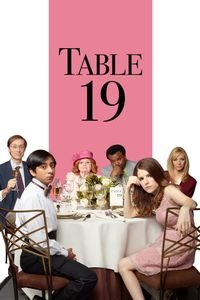
    Table 19 (2017)

    (On Cable TV, December 2017) It’s bad form for a reviewer to suggest that a film doesn’t live up to a wholly imagined alternative, but watching the first half of Table 19, I was struck at how the film seemed to work as a single-setting story. As various strangers gather around Table 19 of a lavish wedding’s reception, they gradually come to reveal their secrets and figure out the link between them. They all have backstories, quirks, aspirations and unfinished business—could all of this be resolved around a single table? For a while, Table 19 almost gets it as a stylistic exercise, as characters join or leave the table and their backstories are exposed. Then the film seems to lose interest in a potentially intriguing premise, and the action dissolves in far more conventional scenery-hopping. The second half of the film is far more conventional than the first, and even the combined charm and comedy of actors such as Anna Kendrick, Craig Robinson, Lisa Kudrow, June Squibb, Stephen Merchant and Wyatt Russell can’t quite rescue the film from dull mediocrity. Table 19 sadly leaves table 19 behind, going elsewhere in order to deliver a rather happy conclusion. It doesn’t help that some of the characters are too irritating to live—Merchant’s character, in particular, is annoying beyond belief and sabotages much of the film’s otherwise intriguing first half. Reviewers shouldn’t tell filmmakers how to make their movies, but this being said—I’s like to see a version of Table 19 in which the camera remains within a ten-meter radius of the titular table. Make it like a theatre piece, and the film may keep some of the intensity that it promised in its first half.