Teri Hatcher

  • The Big Picture (1989)

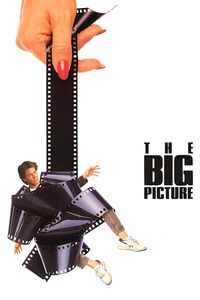
    The Big Picture (1989)

    (On Cable TV, September 2020) The premise of The Big Picture will be intensely familiar to anyone who’s ever seen a Hollywood satire: Smart Midwestern student filmmaker earns the attention of Hollywood producers, is gradually coopted by the studio system until he’s no longer himself, loses it all and fights to get to do it his way. That plot outline could be written on a napkin, but it’s not the point of the film. The point of it is the visual humour that writer-director Christopher Guest injects in his narrative, as our protagonist (a very likable Kevin Bacon) can’t help but supplement what’s happening to him with imagined spots heavily inspired by Hollywood classic movies. Tons of small visual jokes pepper the story, challenging viewers to pay attention. The cast can be surprising at times, especially when it comes to smaller roles: Teri Hatcher looks amazing as an opportunistic actress, John Cleese (sans moustache) plays an American bartender, Elliott Gould has a few moments as an imaginary prosecutor, Jennifer Jason Leigh is a wacky artistic type, Martin Short gets to play the stereotype of a talent agent, and Fran Drescher shows up as a trophy wife. Clearly produced as a satire of Hollywood for Hollywood people rather than the general public, The Big Picture is noteworthy in Guest’s filmography for not being a mockumentary, but rather a full narrative film, with plenty of imaginary asides. It’s quite a bit of fun, and probably ranks as one of those Hollywood satires that not enough people have seen. It’s well worth a look, and not solely as a filler for Guest completionists.
  • Tango & Cash (1989)

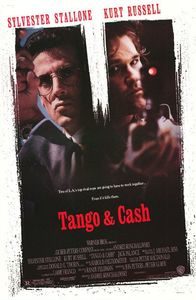
    Tango & Cash (1989)

    (In French, on TV, June 2017) Sometimes, we’ve grown so accustomed to the parody that we’ve forgotten what the original looked like. If your idea of 80s cop action drama dates from Last Action Hero, then go back to Tango & Cash for a look at what the pure ridiculous source material could look like. To be fair, it’s not as if Tango & Cash takes itself seriously—there’s already a bit of self-parody built in the film, and the results, as seen from nearly thirty years later, are often nothing short of ridiculous. There’s Sylvester Stallone, fooling no one by wearing glasses that don’t seem to serve any purpose. But then there’s Kurt Russell, chomping scenery as another loose-gun policeman. It takes place in Los Angeles, of course. It covers quite a bit of male bonding between two headstrong partners. It’s bonkers in the most asinine action-movie ways, such as sending two cops in jail, and them allowing them to break out. To be fair, the prison sequence is the film’s highlight—the subsequent investigation back in the world pales in comparison. Tango & Cash is a bit of a mess, which can be explained if you read about its troubled production history. Unfortunately, it’s not a particularly entertaining one, except in bits and pieces. At least Stallone and Russell are both quite good in their characters, with a showy supporting role for Jack Palance and pre-stardom Teri Hatcher. Tango & Cash is a must-see for whoever is interested in the history of buddy-cop movies, but let’s not pretend that it’s anything essential for everyone else.

  • Tomorrow Never Dies (1997)

    Tomorrow Never Dies (1997)

    (In theaters, December 1997) So this is what happened to James Bond after The Rock: A lot of action, but not much of a solid plot. Still, better than Goldeneye. Pierce Brosnan is a great James Bond. As if killer gadgets, a lovely credit sequence and a few great lines weren’t enough, we get Michelle Yeoh as the very best Bond girl ever. Tomorrow Never Dies is far from being a very good Bond (Bad usage of Teri Hatcher, strange impression of deja-vu versus other Bond movies) but it’s as entertaining as anything we’ve come to expect from the franchise. Even spending the entire movie being half-sick standing against the rear wall of the movie theatre didn’t torpedo the experience for me.

    (Second viewing, On Cable TV, September 2019) Time has been kind to Tomorrow Never Dies, especially when you compare it to some of the later entries in the series. Fresh off the renewal that was Goldeneye, this second Pierce Brosnan outing gets back to the basics of the Formula without too much second-guessing. We’re back to grandiose villains, Bond girls, big stunts and ingenious gadgets, handled competently. Brosnan’s take on Bond is endearing in these second installments, blending character traits in a format acceptable to the 1990s… and later decades. Jonathan Pryce turns in a striking villain, one that still has relevance now in an era of normalized lying. Teri Hatcher doesn’t have much of a role here, but Michelle Yeoh remains one of the best bond girls in the series, combining beauty, wit and action chops to rank as Bond’s equal. (It helps that in the Brosnan era, Bond actually cares quite a bit about his partners). Action-wise, we’re in the late nineties and that means over-the-top action sequences, a bit too aggressively edited but impressive in their panache — I particularly liked watching the Hamburg parking-lot chase (with Bond chuckling in the back seat at the effectiveness of his gadgets), but the Hanoi motorcycle chase also has its strong moments. The James Bond theme gets one of its better remixes here thanks to David Arnold.  Ricky Jay shows up at the brains of the evil outfit, while Judy Dench once again takes the M role to the next level. Compared to the Goldeneyeand a surprising number of its successors, Tomorrow Never Dies is straight Bond formula competently executed, something that I’d like to see once more after the off-brand and intermittently interesting entries in the Craig era. You liking of it (especially compared to its immediate predecessor) will depend on whether you’re in the mood for a straight-up, no-flourishes Bond adventure.