William Hurt

  • Too Big to Fail (2011)

    Too Big to Fail (2011)

    (On Cable TV, March 2021) I have a great deal of admiration for films like Too Big to Fail, which attempts to tell the abstract story of a financial system on the brink of collapse and somehow manages to make it interesting, gripping and human. Fictionalizing the events of the 2008 financial crisis, it’s a film that features a dizzying ensemble cast of known actors playing bite-sized parts, showing up for mere moments in order to deliver some pieces of exposition. The script is admirable in how it boils down complex ideas and esoteric notions into short punchy scenes, making the final result fit in substantially less than two hours. Director Curtis Hanson somehow keeps it all intelligible, even as characters come in and out of frame, with helpful subtitles to tell us who they are playing. William Hurt plays the film’s designated hero, Treasury Secretary Henry Paulson, as a man inheriting a problem of historical proportions, and trying to find unthinkable ways to save the system from blowing up. It’s all surprisingly witty, tense and even admirable in how various schemes are put together in an attempt to control a system that few understand. The flip-side of the film, of course, is that it makes heroes out of situations where there was a lot of blame to go around — unlike The Big Short, it’s not really interested in assigning blame, working itself up in righteous anger or examining the opportunity cost of a situation where “the system” was saved but no one important was punished. (Meanwhile, homeowners and lower-level employees…)  It’s a film that’s partly about capitalism back-patting itself for how it has captured the regulatory and legislative process: there’s probably a really smart and venomous progressive critique of Too Big to Fail out there that I haven’t yet read, and it’s just as valid a take. Until then, I can’t help but be half-amazed at how much stuff the film manages to fit in 98 minutes, whether it’s featuring the character of Nancy Pelosi, portraying ultra-high-level conversations, having a glimpse at how international policy is made, brainstorming with the bright kids providing assistance or the personal toll that crises take on even Very Serious People. It’s all playing on a very different registry than most films, and perhaps for that alone Too Big to Fail is a truly fascinating piece of work.

  • Broadcast News (1987)

    Broadcast News (1987)

    (On Cable TV, March 2020) This almost counts as a second viewing of Broadcast News for me—I distinctly recall seeing the last half of it sometime during the 1990s and being both impressed by the film’s intelligence and disappointed at the somewhat sad ending. But half a film isn’t the same as the entire one, and watching this in middle age doesn’t hit quite the same as an older teen. One thing remains constant, and it’s that Broadcast News still captures the organized madness of TV news like few other films: writer-director James L. Brooks uses the medium’s fundamental tension (entertainment versus substance) as an engine through which to propel a romantic triangle and a series of thorny ethical crises. Holly Hunter is the rock on which the film rests, as a news producer attracted to two very different reporters—William Hurt as the pretty-boy anchor, and Albert Brooks as the solid but prickly expert. (Meanwhile, Joan Cusack is very cute in a supporting role, and owns a flashy action sequence in the first act. Oh, and Jack Nicholson has a cameo as, well, pretty much that universe’s equivalent to God.) It’s all very clever and witty—filmmaking for middlebrow adults able to tolerate a bit of theatrics in order to illustrate a more subtle point. I liked Broadcast News even more this almost-second-time around now that the ending doesn’t strike me as particularly sad, just appropriate.

  • Altered States (1980)

    Altered States (1980)

    (Google Play Streaming, December 2019) As someone who watches way too many movies, one of the best things I can say after seeing one is “Wow, that was weird.”  It doesn’t always link with quality, but it does correlate with memorability. Altered States is one weird movie, especially seen outside its 1980s sociocultural context. Circa-2020 society has plenty of issues, but it does feel as if we’re less likely to believe woo-woo parasciences than in 1980, and Altered States depends on taking these things seriously in order to work. There’s plenty of psychobabble as the film sets up a premise in which American academic parapsychologists start messing with isolation tanks and take heroic quantities of drugs in order to unlock other states of consciousness. This being a thriller, it goes without saying that the efforts are successful and homicidal as one of the characters physically regresses to an earlier species and naturally starts murdering people. The final act is a trip put on film as hallucinogenic visions (as executed by dated special effects shots) represent how the protagonist is slipping in and out of reality, endangering his family along the way. It’s bonkers, and it’s that crazy quality that makes the film compelling even as not a single word of it is credible. According to legend, director Ken Russell and screenwriter Paddy Chayefsky clashed during the film’s production (to the point of Chayefsky being credited under a pseudonym), and this tension can be seen in the contrast between the script’s earnestness and the wild colourful direction. If wild movies aren’t your thing, consider that the film has early roles for William Hurt and Drew Barrymore, as well as a turn for Bob Balaban. Altered States is not good Science Fiction: In the biz, we’d call it “not even wrong” for its delirious depiction of science and scientists at work. But it’s an over-the-top hallucination and as such is likely to stick in mind far longer than more sedate works of the period.

  • The Accidental Tourist (1988)

    The Accidental Tourist (1988)

    (In French, On TV, March 2019) From its multiple award nominations, it’s clear that a lot of people liked The Accidental Tourist when it came out. Decades later, it still holds up … as long as you’ve got some tolerance for grieving dramas that hinge on the middle-aged male protagonist being rescued by an eccentric woman. It’s focused on the life of a travel guide writer going through a very rough patch following the death of his son. His wife leaves, his dog bites and he breaks a leg. One more verse away from being in a country song, forced into the care of his sister, he connects with a dog trainer who takes a strong interest in him. Despite many questionable decisions taken by the protagonist, coincidences are there to help him in the end. What saves The Accidental Tourist, in general, from becoming an undistinguishable mainstream drama is its quirkiness—a protagonist who job it is to write about travel advice, an unimaginably over-the-top trauma that propels the entire plot, an off-the-wall romantic interest, a protagonist going crazy with grief in very interesting ways—this is both a standard kind of drama with oversized details. It’s a messy journey, but ultimately a satisfying one. William Hurt and Geena Davis make for an interesting couple of actors, especially given the richness of the material that the story provides them. It all amounts to something more palatable than it may seem at first glance—even if there’s something a bit off-putting about so much attention placed on a middle-aged man being comforted out of his issues by a free-spirited woman.

  • Body Heat (1981)

    Body Heat (1981)

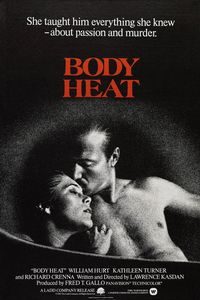
    (In French, On TV, October 2018) I watched Body Heat based on nothing more than availability (it was playing and it ranked fairly high on the list of 1981 movies I hadn’t yet seen) and was pleasantly surprised to find out it was an updated riff on classic noir movies such as Double Indemnity, albeit sexed up for the eighties. William Hurt is fine as the pitiable lawyer protagonist, but it’s Kathleen Turner who leaves a lasting impression as the woman that upends everything for him. If you understand the film’s true genre early on (as the reference to Double Indemnity suggests), there are few true surprises along the way of the film’s many twists and turns, but the execution of the story is good enough that it doesn’t matter. The atmosphere of an unbearably torrid Florida is excellent, and the film delves early and deep in the “everyone is bad” moral attitude—we quickly understand that nobody here turns out virtuous. The homage to noir movies is excellent. It makes for a conventional but satisfying thriller, the kind of film that we don’t nearly see that often almost thirty-five years later. Even watching Body Heat in dubbed (European) French added a special je-ne-sais quoi to the film, making it feel even more of a pastiche than it would have been in its original language.

    (Second Viewing, On Cable TV, July 2021) It went without saying that TCM’s look at neo-noir would include Body Heat, and it was just as given that I’d give it another look. One of the quintessential examples of how noir themes could be reinterpreted decades later, this Florida-set thriller set an example rarely met, let alone exceeded. An impressive cast, led by Kathleen Turner (as a neo-femme fatale) and William Hurt (as a semi-stupid lawyer), gets this sweaty thriller going, but it’s really writer-director Lawrence Kasdan who gets the credit for updating noir tropes to early 1980 Florida, creating a piece that’s timeless forty years later. It’s ingenious, devious, atmospheric and graphic at once – a terrific script is the canvas on which the rest of the film plays. It’s quite wonderful to rewatch even when you know where it’s going, because the execution is so good.

  • The Big Chill (1983)

    The Big Chill (1983)

    (On Cable TV, April 2017) It’s interesting to read that writer/director Lawrence Kasdan interprets the meaning of The Big Chill as the disillusionment that hits thirtysomethings once they trade young ideals for practical realities. Watching the movie, I was most struck by the way is comfortingly presents a small group of friends spending a mostly relaxed time together—i.e.: chilling. But, hey, it’s his film, and a fascinating aspect of The Big Chill is how, nearly thirty-five years and two generations later, it remains intelligible as an expression of friendship, drama, love, lust, regret, grief and mid-thirties reflections. It remains engrossing despite having few laughs and even fewer thrills. Part of its enduring effectiveness has to do with the actors assembled for the occasion. These are early roles for notables such as Glenn Close, Jeff Goldblum, William Hurt, Kevin Kline and Meg Tilly. (Pay attention, and you will even see Kevin Costner’s hairline.) The nearly all-hits soundtrack is also quite good. For a movie that wrestles complex relationships between no less than eight people (that’s 28 different relationships, if my math is OK), the story remains relatively clear at most times. Perhaps most surprising is how somewhat unusual things (hitting on your dead pal’s girlfriend at his funeral, a wife arranging for a friend’s natural insemination by her husband, insider trading, an adulterous affair while the husband’s away with the kids, etc.) are portrayed as being no big deals. The ending is weak, but there’s an upbeat wistfulness (if such an expression isn’t oxymoronic) that permeates the final moments of the film. The Big Chill couldn’t possibly have been more reflective of the late baby-boomer generation, yet it remains relevant today. And despite all the icky things in the movie, it still feels heartwarming and relaxed. Go figure.