Month: October 2013

  • Omertà (2012)

    Omertà (2012)

    (In French, On Cable TV, October 2013) I have fond memories of the original “Omertà” TV series that was broadcast back in 1996: A muscular police thriller set against the backdrop of Montréal’s organized crime, it put Michel Côté on the map, brought Hollywood-like production values to Québec TV and showed that home-grown entertainment could be remarkably enjoyable.  Omertà-the-movie obviously banks on name recognition, as it purports to follow Michel Côté’s character more than a decade after the conclusion of the third series.  The links between TV series and film aren’t thicker than two common characters, though: much of the rest is original, so that viewers without any knowledge of the series won’t miss much.  What follows is a tangled, even opaque, mess of double-agents, organized crime figures, corrupt law-and-order representatives and the occasional victim.  It’s not uninteresting (even featuring a daring death midway through) and filmmaker Luc Dionne’s work is generally solid… but the script leads to a big so-what of an inconclusive ending that doesn’t show bravery as much as it elicits frustration.  While the film has its moments, it seems to lead nowhere, and mishandle its own strengths.  As Québec’s “big movie” of 2012, it offers the usual casting gags and fixtures: Michel Côté and Patrick Huard are omnipresent on the French-Canadian big screen for good reasons, while comedian Stéphane Rousseau is a revelation as a villain (sadly, his characters is repeatedly qualified as a psycho without much on-screen confirmation, and his exit is a big disappointment) while husband/manager-of-Céline-Dion René Angelil as a mob boss is just… funny.  Alas, Rachelle Lefebvre is far less interesting than she should have been in her role.  While Omertà is a decent piece of filmmaking, it’s not quite the slick crowd-pleaser that it aimed to be.  It may be worthwhile to revisit the TV series, though, and I’m still interested in whatever Luc Dionne wants to work on next.

  • Cloud Atlas (2012)

    Cloud Atlas (2012)

    (On Cable TV, October 2013) At a time where big-budget filmmaking seems to retreat in familiar narrative structures and a complete lack of daring, Cloud Atlas comes as a welcome break from the usual.  Clocking in at nearly three hours, it features six loosely-linked narratives spanning centuries and several known actors playing different roles in each story.  Heralding the return of the Wachowskis siblings to the big screen after a few quiet years (they co-direct three of the six stories, with Tom Tykwer directing the remainder of the film), Cloud Atlas is big, ambitious and offers things that cinema doesn’t often get to showcase.  It is, in many ways, a singular movie experience, and one that deserves to be contemplated rather than simply liked or disliked.  As an adaptation of David Mitchell’s sprawling novel, it’s an excellent, even audacious re-working: the film’s structure works in ways that the novel couldn’t, and still ends up a fiercely cinematic work.  Most of the actors playing multiple roles seem to have a lot of fun, with particular notice to Tom Hanks (who gets to tweak his usual good-guy persona), Halle Berry (who gets one of her best roles yet as a 1970s journalist), an often-unrecognizable Hugh Grant, as well as gleefully multifaceted Jim Broadbent and Hugo Weaving –who even gets to play both assassin and nurse. (Some roles don’t work as well, such as when actors get to play outside their ethnicity or gender, but that happens.) The six stories interlock in subtle ways, suggesting both reincarnation of personalities and malleability of interpretation once truth becomes fiction.  For all of the good things about Cloud Atlas, it’s almost too easy to forget that this is not an easy or even completely successful film: You have to give it at least 30 minutes for the six stories to earn narrative interest, and there’s a sense that the film is definitely not tight or focused: it often appears to run off on tangents and forced similarities, and certainly will not please anyone looking for solid links between all elements of the picture.  Still, for jaded moviegoers, Cloud Atlas is as close as it gets to a truly new experience within the big-budget framework: it tries many new things, succeeds spectacularly well at some of them and leaves hungry for a bit more.  I could go on, but the film is too big to be adequately described within the constraints of a capsule review.

  • Gravity (2013)

    Gravity (2013)

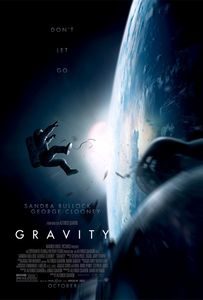
    (In Theaters, October 2013) I’m going to take a break from reasoned movie criticism and indulge myself in a few freefall back-flips about Gravity: This is a movie I’ve been waiting a long time to see, at least ever since I wanted to be an astronaut while growing up.  Alfonso Cuarón’s latest film takes us in orbit for 90 minutes, and I loved every moment of it, jaw hanging open in astonishment for much of that time.  The narrative setup couldn’t be simpler (accident in space; astronaut wants to go home), but the execution is almost perfect: Seen in 3D, Gravity is the definition of an immersive experience.  From the impressive 17-minutes-long opening take, this is a film that attempts something ambitious and manages a delicate balance between showing something new while trusting its audience to follow along without excessive dumbing-down.  It’s not scientifically impeccable (the orbital mechanics are simplified, the plot armor a bit thick at time) but most of the compromises are conscious ones made in good faith so that the story can work on a more emotional level.  Sandra Bullock is spectacular as the quasi-civilian thrust in an impossible situation, while George Clooney is his usual charming self as an old-school “Right Stuff” veteran doing his best to keep the situation under control.  But it’s writer/director Cuarón who earns most of the praise here, because Gravity is an insane gamble that works: A technically-complex film that features grand thrills, thematic depths, beautiful visuals and new ways of telling a story on-screen.  There are a few remarkable moments in this film, from seamlessly going to-and-from subjective perspective, soundless mayhem, zero-gravity fire and strong emotions conveyed without histrionics.  It’s both a science-fiction film (despite the lack of speculative elements, it’s a classic “Analog story”) and a memorable thriller, and it arrives in theaters as an invigorating antidote to the kind of cookie-cutter moviemaking that big studios seem all too eager to present.  It’s worth seeing in 3D, and it’s worth seeing in theaters: how many other films can claim the same?  Assured of a top-ten spot on my year’s end list, and most likely headed straight to the top spot, Gravity isn’t just a great movie: it’s one that makes it worth feeling excited about movies again.

  • Life of Pi (2012)

    Life of Pi (2012)

    (On Cable TV, October 2013) As someone who read Yann Martel’s novel a while ago, Life of Pi held few surprises from a narrative point of view: The big-screen adaptation faithfully recreates the novel’s structure, its main plot beats (including the slap-back ending) and a good chunk of the story’s thematic concerns.  As a result, I’m not overly bothered by the overdone spiritual content, or the trickster nature of the ending.  It remains, at its most basic level, the story of a teenager’s survival ordeal as he’s stuck for most of a year on a lifeboat with a full-grown Bengal tiger.  Still, as with the novel, I was far more interested with the detailed practicality of the protagonist’s lifeboat ordeal than with the multiple levels of interpretation, the spiritual content or the work’s boastful assertion that it will make audiences believe in God.  Much of Life of Pi is immediately accessible as a succession of terrific imagery, you-are-there details of lifeboat survival and good old-fashion resilience in the face of terrible adversity.  The special effects are terrific (the two storm sequences are simply amazing) and director Ang Lee’s skill in making the film both visceral and ethereal is something to behold.  You’d think that the film would start to repeat itself given the limited setting, but Life of Pi remains engrossing for as long as its characters are drifting at sea.  While I suspect that more spiritually-minded audience will get more out of the film, I’m sufficiently impressed that it can still manage to reach and fascinate audiences such as myself, purely as a survival thriller.

  • Tucker and Dale vs Evil (2010)

    Tucker and Dale vs Evil (2010)

    (On Cable TV, October 2013) Oh, we’ve seen this movie before: College kids go deep in the wood for a weekend party, meet creepy hillbillies and numerous deaths ensue.  But the scenario is familiar enough to have spawned parodies, and after The Cabin in the Woods, here’s Tucker and Dale vs Evil, which follows two good-natured rednecks on a weekend outing as they find themselves attacked by college kids following an escalating series of accidents and misunderstandings.  Tyler Labine and Alan Tudyk star as the unlucky pair of heroes, bringing a good-natured charm to already-sympathetic roles.  But the star of the film really is the script, which manages to balance a tricky mixture of gore, comedy, trope inversion and self-aware idiot plotting.  It works, even though there is a moment around the half-way mark where it seems as if the premise runs thin and the gory deaths become a bit too gory for the comedy: Tucker and Dale vs Evil knows what it’s doing, and there’s considerable amusement in seeing would-be antagonists and protagonists switching roles.  Writer/director Eli Craig’s script isn’t bad, and the entire film is a great deal sweeter than anyone could have expected.  (That’s not entirely good, as the largely-useless final scene suggests.)  Of course, as with The Cabin in the Woods (which you can now purchase as a recommended double-feature DVD with Dale and Tucker vs Evil), this is a film that is perhaps best appreciated by those who are aware of the whole “hillbilly horror” subgenre, and who can stomach often-excessive amount of gore with their comedy. 

  • Les Misérables (2012)

    Les Misérables (2012)

    (On Cable TV, October 2013) A quick trawl through these reviews will reveal that when it comes to movie musicals, I’m a very forgiving reviewer.  I have embraced the musical in its post-Moulin Rouge era and a few disappointments aside, I’m usually fond of the genre.  So imagine my surprise when I found myself annoyed, bored and exasperated by Les Misérables, surely one of the most instantly recognizable examples of the genre to come down the Broadway-to-Hollywood route.  I groaned when I realized that Les Misérables would not only be wall-to-wall singing, but that nearly every song would sound the same and drag on forever.  More than once, I left the living room for errands and came back minutes later to characters expressing the same emotion.  For all of its nice cinematography and convicting re-creation of a troubled period in French history, Les Misérables plods on for more than an excruciating two hours and a half, on a musical register than barely varies from one song to the next. Perhaps my powers of concentration are gone; maybe I’m just picky when I should be forgiving.  And it’s not as if the actors are slacking, given how many of them do well with parts that exceed their signing range. Seeing Hugh Jackman, Russell Crowe, Anne Hathaway, Amanda Seyfried, Sacha Baron Cohen and a thoroughly unglamorous Helena Bonham Carter voice their miserable condition is interesting as in we-haven’t-seen-this-too-many-times-before, but they can’t make the pace move more quickly, or change the film’s intention to make nearly every line of dialogue sung.  (Still, I note that the most memorable performance comes from musical-cast-member Samantha Barks, who makes the most out of a limited role as Éponine)  Les Misérables is lavish filmmaking on the highest level –but it’s annoying for idiosyncratic reasons that I can’t fully articulate.  Upon reflection, through, it occurs to me that I’m fonder of original-movie-musicals rather than straight-up adaptations of existing Broadway shows.  Let’s keep the musicals on Broadway, and use the cinema screen for something that fully exploits cinema as a medium.