Month: November 2020

  • I’ll Take Your Dead (2018)

    I’ll Take Your Dead (2018)

    (On Cable TV, November 2020) I don’t often say this, but I really wish I’ll Take Your Dead would have focused more on its dramatic and thriller aspects and removed the supernatural subplots. I generally prefer movies with some imaginary components, but they have to fit, and there’s more than enough family drama and crime thriller in the film to power it to its conclusion without adding vengeful ghosts to it all. The setup is as simple as it is unusual: in an isolated farmhouse, a man with butchery skills is on the retainer of organized crime as someone who can make bodies disappear. His young teenage daughter is used to it, but the weight of his forced commitment to the local thugs is leading him to an escape plan. But before he can bolt, they dump a fresh batch of bodies on him—including a young woman who doesn’t turn out to be as dead as expected. So far so good—and once you add the absent mother (dead from leukemia years before), there’s the making of a family drama as well, as the survivor is restrained and takes on the role of a big sister to a teenager solely in need of female companionship. Alas, the young girl also sees dead people, and while the first few sightings may have been interpreted as flashes of fantasy, those ghosts take an increasingly active role in the proceedings as the situation spins out of control. By the time the ghosts are killing the thugs come to settle a score, we’re way beyond what should have been a tight intimate drama/thriller, and the way to the ending isn’t particularly uplifting either. It does make I’ll Take Your Dead disintegrate in the last stretch, though, as it muddles the story with additional elements that take away from its themes and initial intentions. Which is too bad, because otherwise the work of director Chad Archibald is pretty good—clean crisp images driving home this rural Canadian thriller, and good actors: I’ll watch Jess Salgueiro in just about anything (although she’s better with comic material à la Canadian Strain), while Ava Preston does well as the young teenager, and Aidan Devine is solid in a role meant to depend on pure strength. I’ll Take Your Dead is not a bad film, but it would have been considerably better if it had focused on something interesting.

  • For the Sake of Vicious (2020)

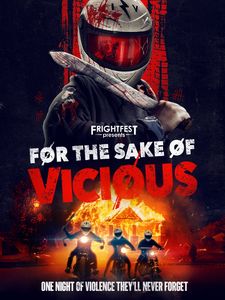
    For the Sake of Vicious (2020)

    (On Cable TV, November 2020) Watching For the Sake of Vicious, I’m reminded of the old complaint against a certain kind of Canadian cinema—that most of it was “kitchen table drama,” in which the low budget and limited ambitions led to stories of low-stake family struggles revolving around the kitchen table. Well, For the Sake of Vicious does spend about half of its duration in the cramped kitchen of a small affordable house, but it’s anything but sedate: The first half has a nurse coming back home and finding two men, one of them clearly intent on torturing the other. As the story unspools, we understand that the torturer is seeking revenge for the rape of his daughter, and that the bound one is an influential real-estate mogul. Much of this first half is an unnerving game between three people, as the nurse wants to make sure that the bound man is guilty of what the other charges. But the film shifts in an entirely different gear once the bound man calls for help, and waves of intruders converge on the kitchen where everything is taking place, intent on leaving no survivors. But then our characters fight back… in a relentless half-hour of bone-crunching, knife-stabbing and head-blasting violence. Tightly directed by Reese Eveneshen and Gabriel Carrer, For the Sake of Vicious ends up being an exemplary piece of how thrilling a low budget can be. I could have used a few wider shots from time to time, but the bloody violence doesn’t let up for quite a while, and even I—who don’t usually like either home-invasion movies or that degree of gore—can’t help but be somewhat impressed by the results. Lora Burke is quite good as the audience stand-in, trying to mediate the violence around her even as it spins out of her control. The story gets thin once the second half begins, and I can’t help but see a Drive reference or two in the subsequent aesthetics, but For the Sake of Vicious ends up being a mean and effective piece of low-budget Canadian genre entertainment.

  • Hall (2020)

    Hall (2020)

    (On Cable TV, November 2020) It’s unnerving to see Hall while in the middle of a global pandemic characterized by lockdowns and social distancing, as the film rests on the notion of a respiratory plague running rampant. Against a pandemic background, a woman stuck in an abusive relationship is mustering the courage to leave her no-good husband while they’re off at a hotel during a long road trip. Much of the story is thus clustered around a long hotel hall, with victims of the illness eventually wheezing on the floor as the drama plays out. This is, so far, solid material. Unfortunately, the story doesn’t focus on the essentials, or properly manages to expand beyond the hall itself. The central drama is quite interesting—even provocative in confronting the personal with the grander-scope epidemic given what we now know about domestic violence during lockdowns. I wouldn’t change anything about it. But then Hall tries to expand its material with the story of a Japanese woman in the next room that feels like a sideshow at best: if the idea was to get the film to feature length, it only half-works: a few more subplots featuring more characters in nearby rooms would have been more appropriate in transforming this in an ensemble story. Then the film takes a significant nosedive with a pair of scenes featuring the always-interesting Julian Richings as a plague spreader and then, during the credits, an unconvincing news report delving deep into conspiracy theories. These are steps taken too far, and they feel especially unnecessary for an audience with first-hand experience with a global pandemic. They also contradict other parts of the film, and make the entire thing feel more artificial than it would have been otherwise. (I’m watching Hall as part of the “Blood in the Snow” virtual film festival, and half of my issues with the low-budget horror films presented are “You should have stopped writing the bad parts,” with the other half being “you should have continued writing the good parts”) Hall’s ending simply… ends, with very little resolution other than the main issue of getting out of the hotel—maybe they’re infected; maybe they’re headed to someone already dead; maybe the conspiracy will succeed; maybe they’re all already dead. I do like the concept of a horror film using a hotel corridor as a central hub—but the haphazard way in which Hall develops is just unsatisfying despite a good performance from Carolina Bartczak and some clever ideas along the way. But then again, I’m scrutinizing this film with far more rigour than it expected during its production: as amazing as that sounds, we’ve all become experts at knowing how a scenario set against a global plague would play out.

  • Black Christmas (2019)

    Black Christmas (2019)

    (On Cable TV, November 2020) Perhaps the best thing a remake can do is to stray from the original, especially if the original has a number of issues. I don’t particularly like the 1974 original Black Christmas, but that has a lot to do with it being a slasher (possibly the first slasher—a dubious Canadian contribution to film history) and me not liking slashers. I haven’t seen the similar 2006 remake, but this 2019 version strikes out on its own, barely holding on to the idea of a sorority under attack from a maniac. This version, written and directed by April Wolf and Sophia Takal, lives and breathes the #MeToo era to an often-caricatural degree, as our heroines are engaged in destroying patriarchy everywhere, from dead men’s busts to the English literature canon. It squarely leads to a feature-film-length denunciation of toxic masculinity that at least takes back some of the misogyny inherent in slasher movies. But the promise of flipping the genre on its head very quickly runs out of steam… if it has any steam to begin with: While Imogen Poots has some innate likability as the lead and Aleyse Shannon looks great, the writing often makes their characters come across as blunt mouthpieces for obvious sentiments. Worse yet is the film’s nosedive into outright supernatural elements in the third act, as if the entire patriarchy wasn’t enough of a formidable antagonist in the first place. Misogynists are clearly the new Nazis, as the film ends with an act of mass murder by the heroines that should at least make anyone pause at the disproportionate retribution of it—but then again those who were killed were eventually going to be nominated as right-wing judges, so the script clearly thinks they deserved it. It’s those excesses and quirks that bother me far more than they should—I should be on the film’s side (and the singing sequence is a great deal of empowering fun), but this Black Christmas overplays its cards in such a way that I’m not left with a lot of sympathy for the characters or the results. How weird is that? On the other hand, well, since I was expecting a straight-up remake of the 1974 original, I was certainly surprised at the twists and turns of the result, even if I can’t quite bring myself to like it.