Month: November 2020

  • “Screen One” Hostile Waters (1997)

    “Screen One” Hostile Waters (1997)

    (In French, On Cable TV, November 2020) It’s rare for a TV movie to take on real-life military history, especially in as rarified a field as submarines. On the other hand, it does seem like a nice fit—If you’re going to go for military intrigue, what cheapest way to do it than with limited sets and a bit of murky CGI to make up the exteriors? Accordingly, BBC production Hostile Waters offers a number of familiar actors in lead roles, starting with Rutger Hauer and Martin Sheen as duelling submarine captains, with supporting roles for Max von Sydow and Colm Feore. Much of the film professes to reflect the truth of the real-life K-219 incident — in which a Soviet submarine suffered a catastrophic malfunction near the eastern seaboard—, based on a book digging into events never formally acknowledged. The result will certainly appeal more to submarine buffs—it does look and feel a lot like other submarine movies (starting with K-19 The Widowmaker), and the limited production values are somewhat offset by good actors and a script that places some emphasis on plausibility. As a submarine film, Hostile Waters is overshadowed by more illustrious theatrically released films, but it holds its own decently enough.

  • Come True (2020)

    Come True (2020)

    (On Cable TV, November 2020) It’s never a good sign when I groan audibly as a film’s ending credits start to roll—a great ending is crucial to a film, especially if it’s a low-budget production that relies a lot on its script to create interest without piles of money to throw on-screen. It’s even more infuriating when an ending comes too early or too late for an otherwise successful conclusion. But here we are with Come True, one of the best Canadian Science Fiction movies of the past few years… if it wasn’t for the way it wraps itself up. There were times during the film where I was giddy with excitement at seeing a film do a lot with little means, exploring relatively new territory in style and going for some nicely creepy moments. It begins as a runaway young woman (the innately appealing Julia Sarah Stone) signs up for a sleep study. But as the film’s synth retro-aesthetics suggest, there are many stranger things going on here, and it doesn’t take a long time for the official explanation to be stripped away: it’s not a sleep study as much as a glimpse into the volunteers’ dreams, and they are all simultaneously having the same dream. At that point, I was really invested in the film—writer-director Anthony Scott Burns is able to do much with little, and the visual polish of the film easily rivals much bigger productions. But then… well, the script goes off the rail. Or maybe not off the rail as much as ever farther away from the rails: the story here is never developed conventionally, which is part of the charm, except when the film seemingly gets rid of its plot to come up with even stranger tangents that get away from what could have been a solid narrative core. There’s a long walk through deserted nighttime Edmonton that takes us farther and farther away from the narrative strengths of the middle act, and a final scene that echoes a classic Internet creepypasta—only to stop there, whereas ending five minutes earlier or five later would have been far more satisfying. Hence my groan, made even worse by the fact that Come True is actually really good in its middle portion. I’m still recommending it to SF fans, albeit with a giant billboard-sized caveat about its disintegrating third act and especially its ill-fitting conclusion.

  • Le Dep (2015)

    Le Dep (2015)

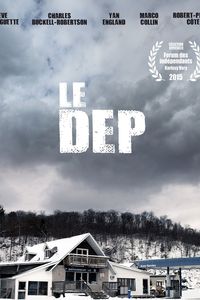
    (On TV, November 2020) I often refer to Montréal-based filmmaking as being “local”… which is ludicrous given that there’s a good two hundred kilometres between here and there. For truly local filmmaking, movies such as Le Dep would be a much better example—after all, it was shot barely forty kilometres away from here, at 903 Route Principale, Val-des-Monts, QC. The unimposing convenience store located there here doubles as Northern Québec establishment, with a young Innu woman keeping the store open during a snowy winter night. There are complications, of course—a white policeman boyfriend, a junkie brother and, especially, a big thick stash of cash in the safe. This ultra-low-budget effort makes the most out of its quasi-theatrical structure, setting quite a bit of drama and suspense in the confines of a small department store. Eve Ringuette is quite good in the lead role, holding her own against the other men who make up the cast. Writer-director Sonia Boileau cleverly stretches the limits of the film’s micro-budget (less than C$250,000) in making the most of its limited location, enhancing the tension of taking place in such close quarters. Le Dep is not a big movie, but it’s nicely made and often engaging in its down-and-dirty earnestness. It’s got social issues and criminal thrills within a low-six-figure budget—what else would you want?

  • Mexican Spitfire (1940)

    Mexican Spitfire (1940)

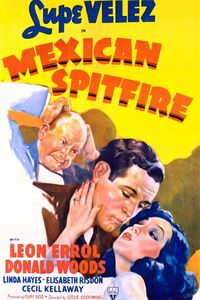
    (On Cable TV, November 2020) Lupe Velez played the character of Carmelita Fuentes in a series of eight films beginning with 1939’s The Girl from Mexico. But there’s a reason why the last six films of the series were all named a variation of “Mexican Spitfire” rather than “the Girl from Mexico” – Mexican Spitfire is a clear case of filmmakers looking at a movie, and essentially remaking it with an emphasis on what works. The humdrum The Girl from Mexico becomes the far more farcical (and Velez-centric) Mexican Spitfire, and the highly formulaic nature of the series is established. There’s not much missed in going directly to this film as an introduction—it begins with the newly married husband-and-wife coming back to New York after their Mexican honeymoon. Complications quickly accumulate, most of them focused on the dual roles played by Leon Errol as a kooky unclean and also a British lord coming to New York for business. Then there’s Lupe Velez, the titular spitfire that makes a scene during every scene, reverting to rapid-fire Spanish during her frequent tirades. It’s a stereotype (one easily imagines Salma Hayek, Sofia Vergara or Penelope Cruz playing the role in exactly the same way), but she plays it well—it’s tough not to smile once she gets going, and much of the film knows that appeal. The various other vaudevillian shenanigans are equally amusing, especially when the identity confusions pile up and everyone runs away to Mexico (obviously!) to patch things up. The male lead is bland to the point of being easily forgotten, but that’s the point—this is Velez’s series, and Errol is there to provide the comic insanity. Short but densely packed, Mexican Spitfire is not a great film—but it does have its charm. The only warning I have, based on seeing this and the later Mexican Spitfire at Sea, would be to space any viewing of the series’ films—they strike very similar notes, to the point of repetitiousness.

  • The Enemy Within (1994)

    The Enemy Within (1994)

    (In French, On TV, November 2020) Tomorrow is 2020 US election day! As the United States is voting in their most consequential election in recent history and there are hints of trouble in the air, what better way to relax while waiting for the election results than to have a look at a movie in which the US military attempts a coup against a budget-slashing president? If it turns out that The Enemy Within feels familiar, it’s because it’s a made-for HBO remake of 1964’s Seven Days in May, with 1990s colour cinematography, post-cold-war geopolitics, a somewhat streamlined plot and a slightly different ending (but not that much). Forest Whitaker stars as the loyal lower-level military officer who discovers the impending coup, and much of the film has him running from one Washington, D.C. location to another in the hope of warning the president, then preventing the coup. It’s not badly made, although the age of the film now shows through a 4:3 TV ratio, slightly lower production values, and typical 1990s picture softness. As far as TV movies go, it’s better than average—although it doesn’t even come close to the meticulous execution of the original film. Watching The Enemy Within on the eve of a presidential election likely to be contested from within the White House itself offers a weird escape into reassuring fantasy—the plotters of this imaginary coup are well-identified, rational in their actions, emotionally stable and somewhat easily defeated. Things are not so comforting in the real world. Oh well, time to tune in to CNN for the next few days….

  • Body Double (1984)

    Body Double (1984)

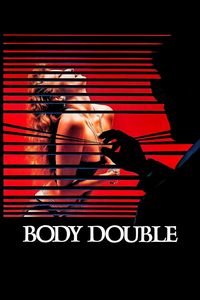
    (In French, On TV, November 2020) Classic Brian de Palma movies could be crazier than anything else at the multiplex, yet Body Double still easily leaps over that high bar for crazy. Obviously designed as an homage to Hitchcock fare such as Rear Window and Vertigo, it’s a film that gets started when an out-of-work actor peeks at another house and is powerless to stop a drill-driven murder. That part is wildly over-the-top, but still understandable: the real fun begins afterward, as our protagonist takes a trip through a fantasyland version of Los Angeles’ porn underworld, gets mixed up with another actress and tries to convince everyone that something weird is going on. Don’t be surprised to realize, maybe two-thirds of the way through, that you don’t know what’s happening any more—Body Double is obviously derived from high concepts rather than developed organically, and there are maybe ten minutes during which you have to wait for further answers to be dropped into your lap before any of this makes sense. But as usual for classic de Palma, the fun here isn’t for the overall plot than the individual set-pieces and shots that illustrate it: The frantic race to prevent a murder, for instance, or the nightmarish climax. It all makes up for wild viewing very much in-line with his best movies. There is a good use of Los Angeles locations (most notably the Chemosphere house), and those with fresh memories of the film’s Hitchcockian inspirations will find even more fun to be seen. Clearly, de Palma’s most outlandish films aren’t for everyone—but if you’re willing to tolerate some weird quirks, there’s still little like Body Double.

  • The Last Voyage (1960)

    The Last Voyage (1960)

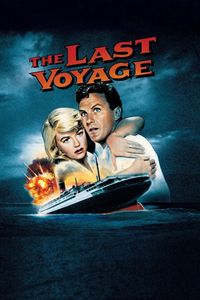
    (On Cable TV, November 2020) It’s fascinating to dig into movie history and find early precursors of later trends. The disaster movie isn’t new and traces back its roots to silent cinema, but the very specific strain of 1970s disaster movies has a clear predecessor in 1960’s The Last Voyage, in which an aging ocean liner suffers catastrophic damage and starts to sink, trapping one of our protagonists under a steel beam. It’s not a perfect example of the form that Airport would formalize a decade later, but it’s close enough. It doesn’t get completely crazy like The Poseidon Adventure, but the intensity of the disaster steadily grows throughout the film—and the end sequence in which the survivors walk, then waddle through a progressively sinking promenade deck is suitably intense, made even more urgent by the very long duration of the shot. Perhaps the best decision made by writer-director Andrew L. Stone was to rely on an actual ocean liner destined for destruction as backdrop for The Last Voyage—the ship feels old and past its glory, making for an interesting change from most ocean disaster films taking place on maiden voyages, and imparting quite a bit of faded golden-age atmosphere to the aged sets. Robert Stack decently plays a father trying to rescue his beam-trapped wife and keep his daughter calm—it’s a prototypical tough guy’s role, and he gets it. Meanwhile, Dorothy Malone does well in a role that has her stuck on the same set for most of the film, eventually with the complication of rapidly rising water. George Sanders is also remarkable as the ship’s captain, whose bad decisions only make a bad situation even worse. The suspense builds up despite being based on very familiar elements, and the colour cinematography helps in making the film feel closer to its 1970s inheritors. The Last Voyage is still a remarkably effective watch, even more so for being somewhat specific in its thrills, and not seeking to overwhelm viewers with a CGI frenzy of exploding stuff.

  • Höstsonaten [Autumn Sonata] (1978)

    Höstsonaten [Autumn Sonata] (1978)

    (On Cable TV, November 2020) The paradox with Ingrid Bergman’s film is that I usually don’t like them very much, but I can usually find in them one or two things worth being impressed about. Autumn Sonata begins on what feels like a high note to me, as a narrator walks into frame and gestures at the protagonist he’s introducing—his wife, as played by the very cute Liv Ullmann in round glasses. But the best is yet to come, as the film takes care to build up the introduction of its other main character—her mother, as played by Ingrid Bergman (making this the only Bergman-Bergman film). She has come to visit to go over some old family tensions, and much of the film can be experienced as a steady ratcheting of tension until the spectacular make-no-prisoners verbal showdown between the two women, as they go over the mom’s neglect of her children, and the daughter’s feelings of inferiority when measured against the world-class renown of her mother. (Our narrator hears it all, but wisely steps away rather than intervene.) There are echoes of other Bergman movies here, as well as a number of his more annoying tendencies, but the film holds up for those moments of pure dramatic intensity between Bergman and Ullmann, with a too-long epilogue to wrap things up. I’m only watching Bergman movies because they keep popping up on best-of lists, but as far as these go, Autumn Sonata is more interesting than many others.

  • The Happy Road (1957)

    The Happy Road (1957)

    (On Cable TV, November 2020) Gene Kelly was an outspoken Francophile, and while you don’t have to dig deep in a filmography that includes An American in Paris and Les demoiselles de Rochefort to realize it, there are a few other films lower down his filmography that make an even bigger case for it. How else, for instance, would have Kelly found himself in a film entirely set and shot in France, playing a father on a road trip to find his boy after he ran away from school? Today, The Happy Road ranks as one of Kelly’s least-remembered films—a lighthearted trifle in which Kelly teams up with the mother of another runaway from the same school in a series of adventures from Switzerland to Paris, going through the back roads of small-town France. It’s more lighthearted than funny, often a bit too twee in the way it finds the escapades of the kids funny rather than terrifying for the parents trying to reunite with them. The Happy Road is not a low-budget affair—by the end of the film, we even run in the French army conducting manoeuvres in the field. Kelly is his usual charming self, helped along by co-star Barbara Laage in a role that inevitably turns romantic. The Happy Road can’t be classified as an essential film, or a particularly memorable one. But for Kelly fans, it’s a welcome illustration of one of his most endearing traits, and another occasion to see him set against a French backdrop.

  • The Paper Chase (1973)

    The Paper Chase (1973)

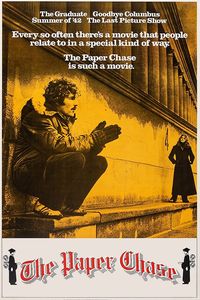
    (On Cable TV, November 2020) There’s something almost mythical to the first year of a university degree that, frankly, very few movies seem to get beyond the frat-party surface. For many people, it’s a first year away from home, thrown into the pressure-cooker of a highly competitive environment. The Paper Chase goes for the big leagues in describing the first year of a student at the Harvard Law School, under the tutelage of difficult teachers. Now, the story gets a bit melodramatic once it follows a romantic relationship between the protagonist and a young woman who ends up being a feared teacher’s daughter—while this introduces many dramatic complications, it also distracts from the main strength of The Paper Chase: Students thrown in a sink-or-swim environment, trying to out-think the course material and dealing (not always gracefully) with the stress. The film is at its best when it deals with academic material, with harebrained schemes (such as breaking into a law school archives) that often turn out to be not especially useful—except as a way to realize that there isn’t much of a difference between students and the teachers at their age. Timothy Bottoms makes for a great audience stand-in as the protagonist, even if the characters surrounding him are nearly all more interesting—with that going double for John Houseman’s Oscar-winning performance as the exemplary teacher. (The big irony of the film is that he exerts a terrifying influence over his students… but can’t even recognize them in an elevator at the end of the year.) There are some great set-pieces along the way, including nothing less than a climactic study session in a hotel room. The 1970s setting shows, but much of the material still rungs true today: The Paper Chase is quite an enjoyable film for those of us who still have final-exam nightmares about our first year of university.

  • It’s a Wonderful World (1939)

    It’s a Wonderful World (1939)

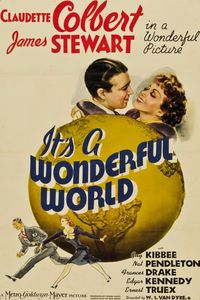
    (On Cable TV, November 2020) As far as 1930s screwball comedies go, It’s a Wonderful World is a competent but not particularly striking example of the form. The crime shenanigans propelling the plot have less to do with a rich businessman and a private eye being framed for murder than they do with getting James Stewart playing alongside Claudette Colbert for much of the film. The ever-cute Colbert is up to her usual standard here, a curly blonde haircut acting complementing some good banter back and forth. Stewart is a bit off-persona here, playing his PI character with a bit more roughness than usual, less drawling and with more cutting remarks. Still, it’s a decent-enough romantic caper, as both run from the law in order to establish the protagonists’ innocence. The comic convolutions get a bit overdone by the end—especially as Stewart goes undercover in an actor’s troupe, all to justify a third act with theatrical jokes. Still, there’s real fun to be had watching Colbert and Stewart play off each other, each of them bringing a different style to it. If you’re a fan of the form, It’s a Wonderful World should be fun enough.

  • Hua jia da ren zhuan nan hai [Back to the Good Times] (2018)

    Hua jia da ren zhuan nan hai [Back to the Good Times] (2018)

    (On TV, November 2020) If I understand the film’s lineage correctly, Back to the Good Times is the feature-film follow-up to a seven-episode TV series that first introduced the characters, and that explains a lot about my mixed reaction to the film. In the grand tradition of romantic time-travel comic fantasies, this is a film in which the main character gets a chance to travel fifteen years in the past to correct history by… farting in a dresser. Yeah. We’ve probably reached another level in nonsensical time-travelling mechanisms here, but it’s the thought that counts. Singer-turned-actor Crowd Lu is a likable protagonist as the slightly awkward young man who, finding himself in 2003, sets out to correct his family’s biggest problems. While much of the story is simple enough to follow, there are times in which the film spends so much time on tangents and sub-lot far less interesting than the main plot that it becomes a bit of a chore to sit through those fragments. The multiplicity of characters is bewildering, and I gather that some of their built-in eccentricities were introduced more gradually in the TV show. Still, I enjoyed the trip across time and space into a very different context: it’s messy, but it ends with a big romantic finale, and I really had fun with the cute future fillip at the end. As a standalone film, Back to the Good Times could have benefited from a more even tone (what’s with the one-shot action scene at the beginning?), fewer characters (although Heaven Hai is very cute here) and a more focused narrative… but I’m not looking at this in the same way as most of its target audience did, with the added background of seven episodes to introduce the characters.

  • Here Comes the Navy (1934)

    Here Comes the Navy (1934)

    (On Cable TV, November 2020) Clearly, Here Comes the Navy could not have been made at any other time than 1933-1934, for both obvious and not-so-obvious reasons. From a factual perspective, the film is about a young man enlisting to be a sailor, and serving both on the USS Arizona (destroyed in 1941 during the bomb attack on Pearl Harbor) and then on the dirigible USS Macon (destroyed in 1935 by an accident, bringing an end to the fleet of US Navy rigid dirigibles). For a thematic perspective, we also have a man enlisting for the wrong reasons (romantic revenge!), serving poorly, openly contemplating quitting, and maintaining a somewhat disrespectful attitude toward the service—that kind of script would not have flown during the Production Code years, or the moment the United States contemplated World War II, and especially not when Hollywood decided to become a pure propaganda effort for the American war machine. But since Here Comes the Navy was made just in time, we are left with this somewhat spirited comedy in which James Cagney plays a pugnacious suitor who gets in trouble with a navy officer and, out of spite, joins the service to annoy him and (later) date his sister. This eventually leads him to a court martial, and then two incidents in which his valour is rewarded. All of this was completed with the full cooperation of the Navy, meaning that we get some fanciful but still fascinating look at the operations of a now-sunk warship, and a now-equally sunk dirigible in their heyday. Beyond the historical documentation factor, Cagney is occasionally very amusing in the lead, while Gloria Stuart (yes, that Titanic Gloria Stuart) makes for a bland but effective female lead. Here Comes the Navy is not that funny, but it is amiable and navigates an interesting line between being cynical about the service and upbeat about it. It’s a Pre-Code film in non-obvious ways: not so much given to racy themes, but far more irreverent than you’d expect from something that, at times, does look like the propaganda films of the early 1940s.

  • The Racket (1951)

    The Racket (1951)

    (On Cable TV, November 2020) Probably the best thing about The Racket is seeing bad-boy Robert Mitchum take on the role of a two-fisted police captain hellbent on taking down a major organized crime leader played by Robert Ryan. The film, a remake of one of the first movies ever nominated for the first Oscars, is essentially a grand strategy game between the two, as they vie for the affection of a cabaret singer (Lizbeth Scott), try to manipulate politicians in doing their bidding, and have proxy battles through surrogates. There’s some awareness here of the tricky intersection between justice, politics, the media and the personal emotions of the characters themselves. Mitchum may not be ideally cast as a square-jawed icon of law and order (his celebrated arrest and conviction for drug offences were still fresh in the public’s mind at the time), but I found that his screen persona actually worked in his favour here, as the character didn’t seem above a few horrible actions in order to fight his criminal counterpart. Having seen and rather enjoyed the 1928 original, I wasn’t bowled over by the remake—while Mitchum is remarkable, Scott is good and Ryan isn’t bad (switching roles may have been a better casting decision, but then again no one would have cheered for the police in that case), the rest of the film is merely solid, whereas the original had a few moments of innovative brilliance. (Although the remake keeps the spectacle factor: woo-hoo, a big car crash!) But it may be more fascinating for its behind-the scenes drama, as producer Howard Hugues kept tinkering with the film (as was often his habit) and brought in no less than five directors to complete it. The result can occasionally feel disconnected with too many subplots and plot turns underdeveloped. I still enjoyed The Racket—it’s compelling viewing as a film noir (which the first one wasn’t really, instead heralding the gangster movies of the 1930s) and it clicks in the same ways a competent crime story does.

  • The Leopard Man (1943)

    The Leopard Man (1943)

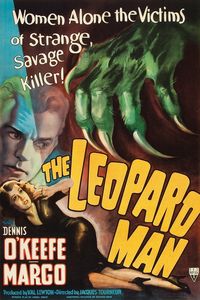
    (On Cable TV, November 2020) I won’t try to pretend that Jacques Tourneur is a forgotten director, but he does seem consistently undervalued, especially given the strength of his filmography. The early-1940s horror films he made for producer Val Lewton seem particularly influential, bridging the atmosphere of gothic horror with the tricks that would soon end up in film noir (including Tourneur’s own classic Out for the Past). Compared to other horror movies of the era, Tourneur was more restrained, more thematically-minded and far less exploitative—qualities that have helped his work survive well into the twenty-first century. The Leopard Man initially seems to have strong ties to the previous year’s Cat People, but that ends up being clever misdirection, as the feline menace suggested by the title ends up being a masquerade for an unusually dark (for the time) thriller about what’s now known as a serial killer. There are plenty of chills and thrills, distasteful deaths (even when suggested), a New Mexico atmosphere and a great use of shadows and sounds in creating an atmosphere more disturbing than the images. It’s handled quite well, and manages to impress even today. The Leopard Man is clearly not of the same calibre as some of Tourneur’s most celebrated works, but it still works.