Wicked, Wicked (1973)
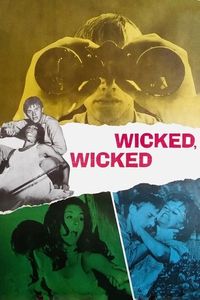
(On Cable TV, November 2021) Considering the long and often-amazing history of split-screen cinematography, I’m not sure we can call the late 1960s to be the heyday of the techniques, but it certainly still seems to be the era during which filmmakers discovered (many of them at Montréal’s Expo 67!), got infatuated by, and overused the technique. I’m not sure anyone pushed it as far, or as long, as Wicked, Wicked, though: A feature-length psycho-killer thriller (what would soon be called a slasher) that’s almost entirely shot in split screen. (“Duo-Vision” as the film calls it.) It almost goes without saying that such a conceit leads to very unusual directorial choices — almost a new grammar of film invented for the purpose. For instance, one side of the screen will focus on a character walking in the lobby of a hotel, while another will gradually zoom on the ceiling, revealing detail… and then a camera looking at the new guest. Other moments use the two cameras for context, for alternate angles, for flashbacks, for mild irony and sarcastic counterpoint. At least the audio remains focused on one side of the screen or the other. In case you’re wondering, no, the entire film isn’t all split screen: Brief moments revert to single-image shooting, usually for impact. It’s certainly interesting and worth a watch if you’re interested in cinematic technique. The film even has a slight layer of self-aware comedy to supplement the familiar knife-wielding psycho stuff. This being said, it’s almost inevitable that Wicked, Wicked can’t quite sustain its conceit for even its brief 95-minute duration — it doesn’t help that the slasher shtick is more than painfully familiar now, and that, from a plot perspective, the film often runs through the same motions as countless other movies. Then there’s the filmmaking team’s lack of experience — writer-director Richard L. Bare was known more as a television director than a feature film one, and the sorry state of the film’s restoration (it’s still shown on TCM with intrusive video scan lines) hints at the film’s low budget and even lower reputation. It’s no exaggeration to say that much more could have been done with the premise, either through more cleverness or better means. Still, there’s a small and entertaining place in cinema history for Wicked, Wicked, perhaps as precursors to Timecode, Unfriended and other movies pushing the limits of what can be done within the confines of a single screen.