Author: Christian Sauvé

  • The Inventor: Out for Blood in Silicon Valley (2019)

    The Inventor: Out for Blood in Silicon Valley (2019)

    (On Cable TV, March 2019) I didn’t go in The Inventor: Out for Blood in Silicon Valley cold—I too had been charmed from afar by the rise of Elizabeth Holmes and Theranos, taken in by the photogenic Holmes (seriously; people have been talking about how Jennifer Lawrence was going to play her in a film for years!) and the Silicon-Valley-promises of revolutionary health care. Everyone wanted to believe that it was true. But then I saw the implosion of the firm, the ways it had been overhyped and the deliberate attempts at deception and fraud. Apparently, documentarian Alex Gibney (perhaps the best in the business at this time) assumed that most of his viewers came from the same place, because The Inventor does not merely focus on the events surrounding Theranos’ rise and fall, but explores (more interestingly through interviews with ethicist Dan Arialy) the reasons why such a deception could be effective. The Inventor comes closest to excusing Holmes’s behaviour by suggesting that a well-intentioned lie may have ballooned into something much bigger. But the rest of it doesn’t pull any punches in describing the pattern of deliberate deception (with journalists expressing naked anger at the way they’d been duped), and strong-armed legal coercion at their whistleblowers and critics. They emerge from the film as the true heroes, whereas everything about Holmes seems deliberate, and manipulative—even her deep voice, featured without commentary, seems to have been faked. The direction is quite good, with some cute visual puns (such as cacti used as visual metaphors during a discussion of blood-drawing needles) and a good mixture of styles to present what is essentially a talking-head documentary. Gibney draws widely on pictures and video shot during Theranos’ heyday by none other than fellow documentarian Errol Morris. There’s a thicket of issues tackled in The Inventor that may have gotten a bit more play (perhaps most damningly the failure of the gate-keeping older white men that were supposed to be good judges of character when faced with an attractive younger woman—all of the women interviewed in the film are clear-eyed about what was really going on), but the finished documentary remains a satisfying exposé. Also tackled along the way; the built-in duplicity of Silicon Valley, the Steve-Jobs worship as a substitute for real knowledge; and the false god of disruption. But if you’re fascinated by the brazen lying (at a time when the country is having a truth problem at its very top elected offices), dig deeper in the Theranos story—the stuff that’s not in The Inventor is even more mind-boggling … to a point where Gibney may have been too even-handed in his approach to the topic.

  • The Fly (1958)

    The Fly (1958)

    (On Cable TV, March 2019) I suspect that most people who approach the original 1958 version of The Fly will do so with a good working knowledge of the 1986 Cronenberg remake, which will probably set a very different set of expectations. Clearly, the 1950s film won’t be as gut-churningly gory as the 1980s one, but it does have its own sense of eeriness and dark comedy. All of this is helped along with Vincent Price in colour, sweet-talking his way through a mad-scientist role. The experience is so different that it certainly has its attraction. Even from the start (which features a mild-mannered murder mystery as we try to figure out why a wife says she has killed her husband with a hydraulic press, despite a complete absence of evidence to the matter), it takes us somewhere different. (As a bonus, this version is “set” in Montréal.)  While The Fly can be silly at times (I’m thinking of the much-criticized audio comedy of the final spiderweb, for instance), it’s still a horror film, and it still carries a punch such as the revelation of the fly head (despite the unconvincing makeup). It even gets tense and disturbing at times. That’s pretty much the best-case scenario for looking at a film with a famous remake: Perhaps not quite as striking, but distinctive and effective in its own way.

  • The Sea of Grass (1947)

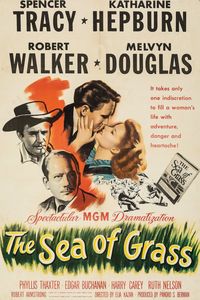
    The Sea of Grass (1947)

    (On Cable TV, March 2019) As someone who’s spent too much time getting interested in Katharine Hepburn’s career (wait, is that even possible?) the 1940s were an interesting decade for her, going from the career renewal of being a young romantic interest in The Philadelphia Story to the more mature role in Adam’s Rib. In those ten years, she met Spencer Tracy, her hair went shorter, her roles became more complex and she managed the transition from girlish ingenue to matronly powerhouse. This transformation is very much at work in The Sea of Grass, along with a striking odd note in her screen persona: As the story heads west for another tale of homesteaders against cattle ranchers, we also get one of the very few departures from Hepburn’s very urban screen persona—Aside from Rooster Cogburn, I can’t recall another western of hers, which is almost statistically improbable considering that she lived through the rise and death of westerns as a dominant film genre. Anyway—here she finds herself on the frontier along with Spencer Tracy (another largely urban type, albeit to a lesser extent) in a multi-generational epic drama of colonization of the grassy plains. (This being said, this is one of the few westerns in which the importance of big cities is recognized and exploited.)  The time skips, when they first take place, are a bit startling and feature far more dramatic twists and turns than you’d expect from a story with a shorter time span. On the other hand, this adaptation from a hefty novel does feel long and the melodramatic turns of the narrative are not necessarily what we now associate with a Hepburn/Tracy film. Ah well—if you’re forewarned that the film lasts 131 minutes and there’s a lot of heartbreak on the way to a milder conclusion, then it may be successful—as long as you’re in the mood for a low-violence, high-melodrama western. The really funny thing, in retrospect, is that while The Sea of Grass is not usually ranked very highly on the list of the nine Hepburn/Tracy films, it was at the time the highest-grossing of them.

  • Raising Cain (1992)

    Raising Cain (1992)

    (In French, On Cable TV, March 2019) If, for the sake of argument, we consider that Brian de Palma’s best body of work roughly dates from 1976 (Carrie) to 1996 (Mission: Impossible), then Raising Cain is perhaps the last pure-crazy de Palma thriller, the last to bear his imprint absent commercial imperatives or budget limitations. It’s completely ludicrous like few of his other films, meaning that it flirts with meaninglessness but remains perversely entertaining. The first few minutes set the deliberately confusing tone, what with split personalities and dream sequences creating a constant sense of reality anxiety. John Lithgow is suitably unhinged in the lead role, playing multiple parts that are not always in his own mind. Much of Raising Cain stretches believability, with some sequences only making sense when shot in their close frame—a wider composition would make the entire thing look silly. People being dead but not really, fake-outs and dreams-within-dreams sequences ensure that the film, for all of its twists and turns, isn’t really meant to be taken seriously, and that includes the end—it’s a good thing that the film doesn’t even make it to 90 minutes, because it does feel like a big ball of nonsense by the end. In some ways, Raising Cain is perhaps the last and most depalamaesque of de Palma’s trillers… bless his twisted shrivelled heart.

  • Gilda (1946)

    Gilda (1946)

    (On Cable TV, March 2019) Even after watching film noir movies for years, I’m still not all that sure about an exact definition for the subgenre. But that’s not a problem—far smarter people than me have also thrown up their hands in surrender at trying to provide a specific formula for noir/not-noir. The best I can do it to follow the crowd and ask myself: does it feel like noir? It doesn’t necessarily have to have Private Investigators chasing down criminals in American metropolises—in Gilda for instance, we find ourselves in South America, largely within a casino/mansion where an American expatriate gets involved with the casino owner and his new wife—who turns out to be an old flame. Add in a few German criminals, crunchy narration, some smouldering musical performances, gambling, a faked death, beat downs and a strong romantic antagonism and you’ve got quite a noir stew going on. The spectacular love-hate dialogue between the film’s two main characters is particularly successful, complemented by very good cinematography, lush when it needs to (such as the carnival scene) and visually complex throughout. Rita Hayworth gets the femme fatale thing down, not so much by gunning down male characters but by playing the dark bombshell to the limit—we even get her singing “Put the Blame on Mame” twice—once with her voice, the other with her entire body. It helps that her character is fiery, strong and an equal partner to Glenn Ford, who does well in a budding hustler role. But this is Hayworth’s movie—she easily outshines even the evocative South American casino setting. Gilda may not check all of the boxes of the traditional film noir, but it does so well on those checked boxes that it leaves quite an impression.

  • To Have and to Have Not (1944)

    To Have and to Have Not (1944)

    (On Cable TV, March 2019) On paper and on the screen, you really have Classic Hollywood running on overdrive in To Have and to Have Not: Let’s see—Howard Hawks directing from a script by William Faulkner from a story/treatment by Ernest Hemingway; Humphrey Bogart and Lauren Bacall as the lead couple, while they were having an affair behind the cameras that would lead to their marriage later on. Coming from Warner Brothers, there’s an obvious kinship here to be made with Casablanca, especially as the story delves into wartime shenanigans between the French Resistance and the Vichy government. Bogart himself clearly plays his own screen persona as the tough and glum smuggler, while Bacall (despite her young age) delivers an exemplary Hawksian-woman performance with more iconic lines of dialogue than most actors get in an entire career. None of this is particularly new (although the Hemingway/Faulkner collaboration is noteworthy), but it’s fun to have another go-around when it works so well—and the Bogart/Bacall chemistry would itself lead to a few encores. Typically for Hawks, there are a few choice quotes, and the direction is limpid, going to the heart of what you can do with Bogart-as-a-rogue and a luminescent Bacall as a strong wartime dame. Not quite noir but certainly not fluffy, To Have and to Have Not is so much fun to watch (although you may want to space your viewing away from Casablanca due to the inevitable parallels) that it ends a bit abruptly, although not without having Bogart shoot a guy, as it should be. The work of several craftsmen all working at the best of their abilities, it’s quite a treat, but also a good example of what the studio system could do when it was firing on all cylinders.

  • Ace in the Hole (1951)

    Ace in the Hole (1951)

    (On Cable TV, March 2019) I’ve said it before, but it’s worth repeating: the more I dig into classic Hollywood filmmaking, the more I realize that satire, social criticism and acerbic commentary have always been part of the package. This especially holds true for the 1950s, traditionally seen as a conformist decade but which also featured some of the bitterest take on media ever put on film. Coming in right before the rise of television and so perhaps at the apex of newspapers as a dominant form of media, Ace in the Hole gets downright nasty in describing how an unscrupulous newspaperman milks a personal tragedy for all it’s worth. As a man is stuck in a mine shaft and awaits a delicate rescue, our repellent protagonist (Kirk Douglas in a top-tier performance) decides to start manipulating events to his benefit. Within a remarkably short time, the mine entrance is surrounded by a circus of print journalists, broadcasters, opportunists and hucksters. Viewers beware—For all of the mordant wit of writer-director Billy Wilder’s film, Ace in the Hole is not meant to end well: it’s a deeply cynical work without many sympathetic characters to latch on. We’re meant to be awed but not charmed by Douglas’s wily, amoral protagonist, even as his great dialogue is undermined by despicable actions. Visually, there are some very evocative wide shots of cars, people and the media circus created around the scene of the news. As usual for Wilder, the film deftly manages to navigate a tricky labyrinth of tones even as it settles for more cynicism than usual even for him. It’s got a strong scene-to-scene watchability, and some clever-yet-transparent direction. The darkness of the ending may account for both its initial lack of popularity, and for its enduring nature. Show Ace in the Hole with A Face in the Crowd and Will Success Spoil Rock Hunter? for a surprisingly grown-up triple feature of 1950s media criticism.

  • Searching (2018)

    Searching (2018)

    (On Cable TV, March 2019) Technology changes movies, specifically changes the grammar of movies, and after more than a decade of staring at computer screens, it makes sense to see the rise of a sub-genre of films executed as if from a computer screen from start to finish. Searching comes hot on the heels of films such as Open Windows and Unfriended (the last of which shares producer Timur Bekmambetov), but it manages to feel like something more than a cinematic experiment. It’s clearly more confident in what it can do, and so the execution incorporates different computers screens (to show the passage of time), zooms, flashbacks and multimedia variance. Even from a more nuts-and-bolts narrative perspective, it’s significantly stronger in terms of characterization, suspense, plot details and Easter eggs (I caught parts of the alien-invasion subplot, but not all of it). John Cho is quite good as a grieving father doing all he can to find his missing daughter—the first two thirds of the film are more about style than substance, but the last act eventually gets to the point of delivering some emotional payoffs as well. Searching is compelling viewing, paced for the Internet era and clearly eliding details that are taken for granted by modern audiences. (I’m having fun imagining what an average 1950s viewer would make of the film.)  Some of the new film grammar invented by writer-director Aneesh Chaganty is quite clever, and so is the way that it makes use of the big Internet structures that we now consider part of our lives. I have no clue how well this is going to age, but I suspect that at the very least it’s going to be a fascinating time capsule of circa-2018 Internet use. (Complete with concern trolling, social media hypocrisy and anonymous attacks.)  I liked Searching quite a bit, and as more than just a showpiece of a different kind of way to tell a story—although that counts for it as well.

  • The Fabulous Baker Boys (1989)

    The Fabulous Baker Boys (1989)

    (On Cable TV, March 2019) I’m not going to suggest that Michelle Pfeiffer peaked at the end of the 1980s, not with the length and substance of her career since then. But The Fabulous Baker Boys does look like an early apex of sorts, cementing her rise to fame during the 1980s and solidifying her stature as a serious actress that could also turn up the sex appeal when needed. Considering that she’s the terrific centrepiece of the film, it’s good that she can take the pressure. As a lounge singer that acts as the push and pull between two musician brothers, she gets to play drama and sultriness—her “Making Whoopie” number while lying on a piano is deservedly remembered as the highlight of the film. Still, The Fabulous Baker Boys is also remarkable for a few other things. Detailing the personal and professional challenges of two brothers working the music lounges of the Seattle area, it goes for a retro feeling that makes it still timeless thirty years later. Writer-director Steve Kloves succeeds in creating a tone as sexy and jazzy and melancholic as the soundtrack suggests. Pfeiffer is accompanied by great performances from real-life brothers Jeff and Beau Bridges, with Jennifer Tilly showing up in a small two-scene role. As bittersweet as the film can be, the conclusion remains curiously satisfying: the characters don’t get what they initially want, but they’re probably better off from where they were at the start. The Fabulous Baker Boys all wraps up to a modest, but successful film—see it for Pfeiffer first, but stay for a well-controlled, well-executed small-scale drama.

  • Fantômas (1964)

    Fantômas (1964)

    (In French, On TV, March 2019) If you want to immerse yourself in 1960s French pop film, you can do much worse than to look at Fantômas. It’s bright, colourful, loopy and a bit messy. The premise is slightly annoying in its childishness—having to do with a super-competent criminal villain always in control who’s obviously never going to get caught by our pursuing protagonist. The predictability of his slipperiness is magnified by the film’s tendency to loudly announce what it’s going to do in the next five minutes … and then do exactly what we can see coming. Having renowned comedian Louis de Funès in the protagonist’s role certainly doesn’t help, as his comic grimacing and antics keep the film shifting between an attempt at serious action filmmaking (as limited as it could be in 1960s France) and a far broader comedy. Fantômas is still decently entertaining, but it suffers from a lack of tonal control that feels odd to modern audiences. This being said, there are a few decent action beats here, considering that the French industry was busy taking lessons from the James Bond series and had (at the time) very little of the professional resources and tricks of the trade that today’s action filmmakers take for granted. (Even small things as stuntmen—a lot of the stunts were made by the actors themselves, or by first-time stuntmen.) Helping to tie things together is Jean Marais, quite good in a variety of roles, including Fantômas and one of his pursuers. Ultimately, though, Fantômas’ ever-shifting tone and sometimes-amateurish filmmaking do add to its period charm—you won’t see a film like this today, and while that’s not a bad thing, it does mean that you’ll have to go back to the vintage Fantômas to get the full experience.

  • Dolores Claiborne (1995)

    Dolores Claiborne (1995)

    (In French, On TV, March 2019) The history of Stephen King movies across the 1990s is … shaky, but Dolores Claiborne is not going to count as a bad one. Much of this success can be traced back to the original material, which (despite featuring murder in most unusual circumstances) lends very little freedom for filmmakers to go wild in bad ways. Keeping the tone close to the novel, screenwriter Tony Gilroy and director Taylor Hackford deliver a film that sticks close to reality—and thankfully so, considering the film’s themes of domestic violence and abuse: inserting supernatural elements would have been a distracting mistake. A great sense of place, in a small island community off the coast of Maine, certainly helps in creating the film’s convincing atmosphere. Dolores Claiborne is Kathy Bates’s show as she delivers a full-featured performance, but the supporting cast is unusually strong, what with Jennifer Jason Leigh as an estranged daughter, Christopher Plummer as a detective and a pre-stardom John C. Reilly as a policeman. There’s some skill in the way the film blends a modern-day timeline with flashbacks, complete with specific colour schemes and makeup. The eerie colour manipulation throughout the film—and most intensely in the eclipse sequence—clearly prefigures more ambitious (and now commonplace) efforts in current movies. The result, as skillful as it is, can’t avoid a few missteps that reinforce its melodramatic nature—the soundtrack is too insistent at times, adding far too much to something that didn’t need it. The slow start of the film reinforces the impression that it is too long and overdone—a shorter climax would have helped. Still, Dolores Claiborne does stand as a rather good adaptation of the King novel, despite taking a few justifiable liberties (notably in beefing up and adding more characters to the present-day frame). Dolores Claiborne is probably too often forgotten in the King filmography—not horrific enough, not necessarily fitting the mould of what people expect from him—but it’s a successful effort, and one that can still be watched with some satisfaction nowadays.

  • Doctor Moreau’s Island (1996)

    Doctor Moreau’s Island (1996)

    (In French, On TV, March 2019) The making of Doctor Moreau’s Island is one of the most legendarily troubled production of the past few decades, so it’s fascinating to find that the film itself is spectacularly dull. Quirky, twisted, off-putting at times, maybe, but once you take away the menagerie of human/animal hybrids designed by Stan Winston’s company, not a lot is left to contemplate. Handled by directors Richard Stanley then John Frankenheimer, the story is dull, muddled and uninteresting—even updating the classic story to modern technobabble doesn’t do much to help. Casting-wise, Fairuza Balk always fun to see, while Val Kilmer has a much smaller role than expected and David Thewlis is the film’s true protagonist. Let’s not talk about Marlon Brando, who’s a walking disaster (hey, let’s cast him in a role of a legendary eccentric lost in the jungle—what could possibly go wrong?)  The film’s big budget doesn’t really help things—even the credit sequence is terrible. If you want better entertainment, read about the film’s production rather than just watch the film.

  • Jurassic World: Fallen Kingdom (2018)

    Jurassic World: Fallen Kingdom (2018)

    (On Cable TV, March 2019) I dearly love the first Jurassic Park film, but the rest of the series I can drop in an instant, especially once you take away the action set pieces that the rest seem structured around. I do believe that there are no creative or artistic impulses to the series—well, other than filmmakers jumping up and down while screaming DINOSAUR ACTION!!! Each new film seems intent on undermining the series’ laughable mythology, marginalizing people in favour of their reptilian overlords. This reaches a climax in Fallen Kingdom as the series seems intent to replace humans with dinosaurs. Inelegantly structured in distinct halves, the first chunk of the film takes us to a thrilling end-of-the-world segment on a self-destructing island for poorly justified reasons, but at least there’s a thrilling gyrosphere one-shot that’s suitably claustrophobic. The second half, on the other hand, gets worse and worse despite some interesting gothic atmosphere early on. The ending snatches a sequel out of the jaws of victory, releasing dinosaurs into the wild for obvious sequel-baiting action, and passing the action off as a muddled kinship of cloned entities. Still, even with the stench of uninspired moneymaking intent, there are good spots here and there. Director J. A. Bayona does have a bit of Spielbergian flair in the way he moves his camera and choreographs the special-effects-heavy action. Bryce Dallas Howard (in more sensible footwear) and Chris Pratt remain likable, with noted contributions by Toby Jones and Daniella Pineda. This being said, it doesn’t take much to be vexed by the inevitable, unnecessary, slightly obnoxious result. Fallen Kingdom simply feels fundamentally broken in how it, motivated by greed, tries to pass survival of dinosaurs as noble cause. We all know it’s to sell even more tickets later on, and that the follow-up movies will get worse and worse.

  • The World According to Garp (1982)

    The World According to Garp (1982)

    (On Cable TV, March 2019) I recall reading The World According to Garp in high school and being bemused at the novel’s obvious artificiality, going from one attempt to shock to another. Even today, it would probably be seen as a checkmark exercise in hitting as many hot-button issues as possible, from violent feminism to adultery to transgender characters to sexual assault to many other issues. The film adaptation, for all its faults (most of them self-inflicted) is relatively faithful to the book, although the actors do an incredible job in humanizing what, on paper, often feels like an exercise in authorial fiat. Should we give a bullhorn to John Updike? Many smarter people than me haven’t come to a conclusion. So it is, though, that the film adaptation is a blend of extreme characters, out-there hijinks (many of them sex-related), a writer obsession about being a writer, and so on. A young Robin Williams is in fine form with a character that’s not entirely aligned with his later screen persona. Glenn Close is good as his mother, but John Lithgow is even better as a transsexual friend—and the film, fortunately enough, has aged far better than expected in this regard, largely because it treats its character with respect and affection, making up for an otherwise lack of sophistication. I’ll admit that The World According to Garp remains interesting on a basic what-the-heck-is-going-to-happen-next level, but there is an extreme contrivance to much of the plotting that make it hard to take seriously upon reflection. It was a weird book and it remains a weird film, so at least it has that going for it.

  • Navy Seals (1990)

    Navy Seals (1990)

    (In French, On TV, March 2019) The 1980s were about as bad as things got when it comes to exporting violent American imperialism through the magic of Hollywood movies (not-so-coincidentally climaxing with the TV-friendly Gulf War of 1991), and if the release of Navy Seals missed the end of the Reagan administration by two years, it started production years before, with a script from a retired Navy SEAL, pre-production stopped by director Richard Marchand’s death and several script rewrites slowed down by the 1998 WGA Writer’s Strike. None of those delays mattered much considering that the Middle East was still a hotspot during the Bush I administration, and so was the projection of American power in the area. The plot, as conventional as it is, has Navy SEALS tracking down errant Stinger missiles and getting into all sorts of shenanigans. As you’d expect from a Hollywood film, the Navy SEALs protagonists are presented in a very mainstream-friendly way: They fight for America, and they’re bad boys! They don’t play by the rules! They do dangerous things for fun! TO THE EXTREME! As befit a muscular military action film of the 1980s, it does very much feel like an attempt at a recruitment film, albeit not quite as slick or successful as Top Gun. There is some ironic value in seeing Charlie Sheen here in full bad-boy soldier mode, not only considering his troubled personal history later, but specifically his role as the lead of the Hot Shots! military spoofs starting the following year. Still, once you put away issues of geopolitical power projection and ironic casting, there isn’t much here to report—Navy Seals is about as basic as military action films were during that period.