Reviews

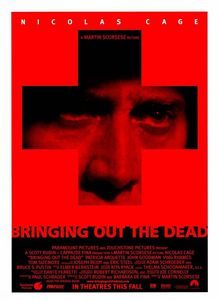
  • Bringing Out the Dead (1999)

    Bringing Out the Dead (1999)

    (In French, on Cable TV, July 2016) As an entry in Martin Scorsese’s filmography, Bringing Out the Dead is often forgotten alongside his classic movies. Which is weird, considering that it’s a drama featuring Nicolas Cage as a paramedic at the height of the New York City crime epidemic of the early nineties. Directed with some of Scorsese’s flamboyance, it portrays NYC nights as barely repressed war zones in which paramedics are helpless to help their dying charges. Crime, drugs, heart attacks and accidents kill scores of victims, while Cage’s character goes crazy knowing that he hasn’t saved anyone in ages. As a Cage performance, it’s a rare blend between his Oscar-winning dramatic intensity and his borderline-insane grandiosity. The overall nightmarish atmosphere of the film seems just as unhinged as its lead actor, with the film taking place nearly entirely at night, in-between a hospital where everybody’s is shouting and bleeding, and the streets where the only people they meet are doing badly. Cage’s paramedic colleagues (the pretty good trio of John Goodman, Ving Rhames and Tom Sizemore) are even more screwed up than he is and what’s more, he can’t quit even when he asks. Stripped of its showy hallucinatory sequences (including a flipping ambulance that should have been held in reserve for later during the film) Bringing Out the Dead isn’t much more than the story of a protagonist undergoing a nervous breakdown and picking himself up thanks to romance and a few ironic epiphanies. Set to Scorsese’s own rhythm, it’s a bit more than that, even though the pacing of the story severely slows down at times. It’s worth noting that the film was written by Paul Schrader, and fits squarely in the rest of his filmography as well. Scorsese’s affection for his city is obvious even when he’s portraying it as its lowest (and who doesn’t have a soft spot for the hellish NYC of the 1970s?), and it’s that kind of pairing (alongside Scorsese/Cage and Cage-the-actor/Cage-the-scenery-chomper) that makes Bringing Out the Dead interesting to watch even fifteen years later, perhaps as a time capsule yet unseen by many.

  • Hyena Road (2015)

    Hyena Road (2015)

    (On Cable TV, July 2016) The Canadian film industry is so cash-strapped and the country so reluctant to military intervention that the idea of a Canadian war epic seems almost impossible. But considering the near-mythology that has sprung from the Canadian intervention in Afghanistan and the zeal with which writer/director/actor Paul Gross has pursued Canadian myth-making throughout his career, it was inevitable that the two would meet. The result in Hyena Road, an attempt to portray the Canadian Afghanistan war experience on the big screen à la Hollywood. Much of the film is by-the-numbers war-movie stuff: the band of heroes, the heroic sacrifices, the forbidden romance, the shootouts… Unfortunately, Gross can’t help but reach for a tragic ending in an attempt to heighten the impact of his story. Too bad we can see it coming from far away, along with the double-crosses, tangled allegiances and “what are we even doing here?” musings. On a certain level, it’s a wholly average film even in the way it frustrates its audience and really wants them to cry at the end. On another level, it’s hard to be Canadian and not feel at least a frisson of national pride at the result. Consider: the Big Mission of the film is building the eponymous Hyena Road. That’s right: infrastructure building as a national priority in foreign intervention! Still, much of the film actually works just well enough: screenwriter/director Gross leaves the young-sniper hero role to Rossif Sutherland, keeping for himself the far more interesting character of an intelligence officer trying to navigate the dangerous Afghan politics and history, while being the voice of cold hard experience for his protégé. The action sequences are well handled and the production values are convincing (especially on the film’s modest budget). As much Hyena Road’s ending smacks of melodrama, it is remarkably far, far less self-important as Gross’s previous Passchendale. That may take away some of the mythic grandeur of the previous film, but it makes the result more palatable. As Canada reflects upon its afghan experience in the coming decades, I expect more war dramas to make it to the big screen—but as a first attempt, Hyena Road is a modest success.

  • The Secret Life of Pets (2016)

    The Secret Life of Pets (2016)

    (In French, in 3D, In theatres, July 2016) There’s little doubt that The Secret Life of Pets often feels like a derivative of other, better-animated movies. Cute pets being revealed as sentient then going on an adventure? Not much of a stretch for a computer-animated feature. But there’s some charm and fun in the execution of the premise, as we get a look at New York from a pet’s eye view. Fast and funny direction by Illumination Entertainment (best known for the Minion franchise) makes the film easy and entertaining to watch. While the plotting can get sloppy at times (such as a gratuitously dramatic interlude about a pet’s master’s death, intercut soon after a gloriously funny sausage factory fantasy), it does introduce a quirky group of characters, move the pieces effectively around the board and, perhaps more importantly, provide a solid emotional conclusion. (The effectiveness of the “masters coming home to their pets” sequence may depend on whether you are yourself a pet owner.) The Secret Life of Pets amounts to a film that should please entire families: funny and frantic for the kids, not entirely objectionable for parents and hopefully leading to treats for the family pet. A sequel is inevitable.

  • Precious Cargo (2016)

    Precious Cargo (2016)

    (Video on Demand, July 2016) It’s been increasingly difficult not to notice that Bruce Willis shows up in a lot of straight-to-video movies lately. He usually shows up playing the chief bad guy, mumbles aimlessly for a few scenes, then is dispatched by the hero and goes back home to collect what I presume must be a substantial and much-needed paycheck. His performance in Precious Cargo is up to his newest standards. Fortunately, he’s only a small part of a film that focuses on a professional thief (Mark-Paul Gosselaar, wisecracking merrily) who gets recruited by an ex-lover (Claire Forlani, who seems to have belatedly gotten Angelina Jolie’s looks from non-natural means) to get herself out of some trouble. For a low-budget film (and the key to appreciating Precious Cargo is half in remembering the film’s limited means), Precious Cargo does a few things well: there are a few good action highlights (including a boat chase that looks as if it cost half the film’s budget), the characterization and wisecracking elevates the film from many other similar thrillers, and for all of its sins, it doesn’t try to be dour or downbeat. As the ending plays, everything is fine and thieves get their money. Roll the credits, don’t expect much more and the result is just good enough to warrant a viewing when you’re all out of other options. I’ve seen worse.

  • Misery (1990)

    Misery (1990)

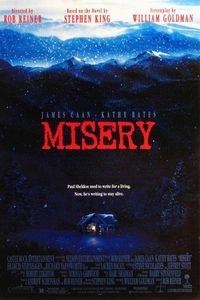
    (In French, On TV, July 2016) Stephen King’s Misery is a memorable novel (even and especially now, touching upon the themes of fannish entitlement that have grown so tediously familiar latterly), and its movie adaptation (partially thanks to screenwriter William Goldman) manages to be as good, in its own way, as the original book. James Caan ably plays a best-selling author who, thanks to an accident, comes to rest in an isolated farmhouse under the supervision of his self-professed “number one fan” (a terrifying Kathy Bates in a career-best performance) who turns out to be completely crazy in dangerous ways. What follows is so slickly done as to transform King’s writer-centric thriller into a horrifying experience for everyone. Director Rob Reiner is able to leave his comedic background behind in order to deliver a slick thrill ride, gradually closing off the protagonist’s options even as it becomes clear that he’s up against a formidable opponent. While the film does soften a few of the book’s most disturbing or gory moments, it does not lack for its own unbearable scenes. A solid, competent thriller, Misery easily ranks near the top of King’s numerous adaptations, and remains just as good today as it was a quarter of a century ago.

  • Pan (2015)

    Pan (2015)

    (On Cable TV, July 2016) We did not need Pan. Not now, when Hollywood studios addicted to the mirage of guaranteed profits are busy trying to take a hundred years of pop culture and hammering it into their three-act paradigm. Here we have Peter Pan reimagined (gag, spit, eye roll) in a sequel in which nothing of particular importance happens except remind us of other better takes on the same story. Director Joe Wright is too much of a professional to make an entirely boring film, and so the poor souls forced to watch the film will be able to, at least, enjoy a Spitfire-versus-galleon fight (don’t ask), colourful visuals and a tribal rendition of Nirvana’s “Smell Like Teen Spirit” that is so misguided and out-of-place as to defy any reason. I highlight this as one of Pan’s better moments because by the end of the film, it’s obvious that bad is better than boring. The script tortures the Peter Pan myth until it can be treated like one of so many disposable fantasy films, dispensing colourful visuals over a story so familiar as to inspire annoyance. Known actors such as Hugh Jackman, Amanda Seyfried and Rooney Mara do their best with badly written characters, to no avail. Pan was a box-office failure and a critical disappointment, and it’s not hard to see why: far from being colourful and original, it feels incoherent and disjointed, rushing through the motions of a CGI-heavy fantasy adventure while never having anything of its own to bring forward. It’s more tedious than anything else, and it’s depressing to wonder what other movie could have been green-lit for this amount of money.

  • Brooklyn (2015)

    Brooklyn (2015)

    (On Cable TV, July 2016) “Slightly less dull than I expected” isn’t exactly the kind of blurb that’s reprinted on DVD boxes, but that’s probably the nicest thing I have to say about Brooklyn. The story of an Irish girl who comes to America to find love and fortune, then returns home and is confronted with either staying or leaving, Brooklyn is thoroughly familiar material, albeit executed with some degree of competence. There’s a decent amount of wistfulness to the protagonist’s final realization that she has grown up, and the production values of the film are high enough to convincingly plunge us into 1950s New York and Ireland. Saoirse Ronan is very good as the protagonist, with Emory Cohen and Domhnall Gleeson playing romantic foils. What Brooklyn doesn’t have (nor may need) is energy, originality or even sustained wit: it seems perfectly content playing things safe, with polished but forgettable dialogue, scenes and emotional stakes. It does aspire to be the kind of movie that your grandmother will find “nice”, so I suppose that there’s no real reason to begrudge its success if it manages exactly that. At another time in cinema’s history, Brooklyn would have been a significant studio release, a star vehicle, a popular film and a critical hit. In today’s blockbuster driven environment, it’s merely a good solid independent film that got some critical attention. No shame, no shame. Plus, it is indeed slightly less dull than I expected.

  • A Few Good Men (1992)

    A Few Good Men (1992)

    (On TV, July 2016) Nearly everyone can quote Jack Nicholson’s furious “You can’t handle the truth!” but watching A Few Good Men highlights how that line works best as a culmination rather than a standalone quote. A somewhat sombre judicial drama in which a hotshot lawyer (Tom Cruise, remarkably good) takes on the US Marines establishment in an effort to discover what happened to a dead soldier, A Few Good Men is the kind of slick mainstream drama that has almost disappeared from the box-office top-ten. Slickly made with a roster of good actors, it has the means to present its story as effectively as possible. The result is a good comfortable film, handled with old-school care. It may not be all that efficient (the opening act is notably slow, and missteps in initially focusing on a character who’s not the real protagonist) but it’s competent and slowly makes its way to a conclusion heavy on shouting and courtroom excitement. Jack Nicholson is good in a surprisingly small role (it looks as if he showed up for a few days of work), Kiefer Sutherland pops up as a soldier, while Demi Moore doesn’t impress all that much in a fairly conventional role that leaves far too much glory to Tom Cruise’s character.

  • Approaching the Unknown (2016)

    Approaching the Unknown (2016)

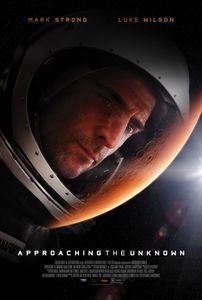
    (Video on Demand, July 2016) At first glance, Approaching the Unknown has a kernel of potential. The trailer promises a somewhat introspective look at space exploration, alongside an astronaut travelling alone to Mars. There’s been a recent mini-boom in space-exploration films, and while no-one expected this low-budget production to match Interstellar, it could have found a place alongside Europa Report. But even after a few minutes, it becomes horribly clear that Approaching the Unknown is a big heap of nonsense choked in pseudo-profound meandering and then smothered in interminable pacing. I don’t often fall asleep during boring movies, but Approaching the Unknown got me, and it got me good: I actually had to go back and re-watch the second half, which made it even worse given how the film disintegrates even further in its second half. It’s a multifaceted failure, from nonsense science (I could give you a list of ten things from the movie that are actually dumber than the Transformers series) to meaningless musings to a direction job that kills any interest the film may have held. It’s just a terrible movie-watching experience that I wouldn’t wish on anyone else. It even made me think less of Mark Strong for choosing the role, as well as Sanaa Lathan and Luke Wilson for showing up in supporting roles. I get that the film is meant as a meditative character piece about sanity, exploration and self-discovery, but as the old SF truism goes, if the literal level doesn’t work, the metaphorical level can’t either. I don’t particularly like to dismiss low-budget passion projects, but Approaching the Unknown is a damning debut for writer/director Mark Elijah Rosenberg and I hope he’ll be able to do better the next time around. (I’ll at least acknowledge that the film may be best suited to people who liked Under the Skin.)

  • Room (2015)

    Room (2015)

    (On Cable TV, July 2016) One of the most curious facets of a developing movie critic’s mind is the ability to recognize competence and detach it from enjoyment. For various reasons, I find Room’s subject matter almost unbearable and I do not ever want to watch it ever again. It is, after all, the story of a young boy, result of years of abuse between a sexual psychopath and his captive subject—his world at the beginning of the film is solely limited to the room in which he and his mom are held captive. This is the kind of thing nightmares are made of, and if Room hadn’t come to cable TV channels with its “Oscar winning” distinction (and assorted armful of critical attention), there is no way I would have watched it. But it has won a boatload of awards, and watching the film underscores why: For one thing, it takes a terrible story and filters it through the innocent perspective of a young boy, making it less aggressive but more disturbing in its implications. The protagonist of the story arguably isn’t the viewpoint character (much of the third act is about the mom, even in absentia), and the antagonist disappears surprisingly quickly from the film. The script, interestingly enough, is written by Emma Donoghue, the author of the novel on which it is based. Room benefits greatly from a handful of good performances, the best of which (with apologies to the Oscar-winning Brie Larson) has to be Jacob Tremblay’s performance in the lead role. It’s also fiendishly clever in its cinematography, in showing the Room as its own expansive universe, and then revisiting it later to show its true oppressive confinement. But it’s also a story in which people get better, overcome terrible adversity and manage to move forward. For a small movie shot in suburban Toronto, it packs quite an emotional punch, even if it’s one that few will strictly enjoy. So there we go: A few reasons why Room is worth seeing at least once … even though you, too, may never want to see it again.

  • The Night Before (2015)

    The Night Before (2015)

    (On Cable TV, July 2016) By this time in his career, Seth Roger has such a defined persona that “Seth Rogen does a Christmas movie” is enough to suggest a fairly accurate picture of The Night Before. We’re going to see crudeness (especially penile jokes), copious drug use, dumb jokes, a paean to male friendship and some anxiety about (finally) growing up. Roughly half of Rogen’s movies in the past ten years have played variations on the same themes and this latest one isn’t any different. For all of the emotional scaffolding about three friends wondering whether their Christmas traditions are holding them together or holding them back, this is really an excuse for Christmas-themed drug jokes and assorted shenanigans. It does work reasonably well, but usually thanks to the actors more than the jokes themselves. Joseph Gordon-Levitt, Anthony Mackie, Lizzy Caplan, Michael Shannon, and, yes, Seth Rogen all bring something extra to their roles even when they’re just doing what they usually do best. (Well, that’s not exactly true for Michael Shannon, who seems to be enjoying himself in a coarser role than usual.) Mindy Kaling, Ilana Glazer, James Franco and Miley Cyrus also show up in small but striking roles. Some of the comic set-pieces work well enough, and the film’s conclusion is just as gooey-reassuring as we’d like in a Christmas movie. As far as holiday classic go, The Night Before aspires to a place alongside Harold and Kumar’s 3D Christmas and Bad Santa, which isn’t terrible company when the syrupy nature of year-end celebrations becomes a bit too much to bear. “Seth Rogen does Christmas movie” it is, then.

  • My Big Fat Greek Wedding 2 (2016)

    My Big Fat Greek Wedding 2 (2016)

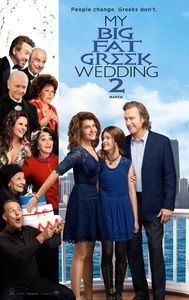
    (Video on Demand, July 2016) The original My Big Fat Greek Wedding was a perfectly likable romantic comedy, but it’s a bit of a disappointment to realize, fourteen years later, that writer/star Nia Vardalos never quite made the leap to superstardom following the success of that film. A look at her filmography since then has revealed a stream of work (hey, I’ve seen Connie and Carla in theatres!), but nothing approaching the massive success of her breakthrough feature. I suppose that a “generation later” sequel was inevitable, and now that My Big Fat Greek Wedding 2 is available, we’re left to contemplate a sequel that pretty much delivers exactly what anyone could have expected from it: A gentle and familiar brand of humour equally devoted to cultural differences and family obligations. Here, the plot has something to do with unsigned wedding papers and the need for the protagonist’s parents to marry again, but it’s really an excuse for sequences with eccentric family members, reflecting on the rigours of an established marriage in which the only child is about to leave the nest, and throwing a few sitcom moments. Among the performers, Vardalos is just as likable as in her breakthrough role, but it’s Andrea Martin who gets the laughs as Aunt Voula. John Corbett once again look pleasantly bemused by the Greek-themed madness around him, while Elena Kampouris establishes her character without too much trouble—a feat given how loud the other actors can be. Some of the Greek-community jokes would approach stereotypes if they weren’t so affectionate. My Big Fat Greek Wedding 2 is not particularly good, but it’s certainly not bad, and if the result feels too much like an extended television series finale, it does provide viewers with what they were expecting from such a sequel.

  • Four Weddings and a Funeral (1994)

    Four Weddings and a Funeral (1994)

    (On TV, July 2016) Curiously enough, I’d never seen Four Weddings and a Funeral, even despite being familiar with the stream of romantic comedies inspired by its success. Going back to the roots of the subgenre shows a film with the quirks and strengths of a relatively original script trying something its own way … rather than copying what’s been done before. Richard Curtis’s script is loosely structured around, yes, four weddings and a funeral (not in this order), this romantic comedy follows a foppish man (Hugh Grant, in a persona-defining performance) falling for a mysterious woman over a few key events. There’s a refreshing chaos to the amount and nature of the exposition required to set up a film with a core of friends and their acquaintances, and Four Weddings and a Funeral is perhaps most notable for the amount of stuff it doesn’t spell out along the way, trusting viewers to make up their own minds. This, however, can be taken too far: As much as I like Andie MacDowell in general (to the point of tolerating some dodgy line readings), she’s simply not given much to say here and the film feels weaker for being built on such a mystery. You can see how a modern retelling of the film, based on its imitators, would try to streamline the various charming little imperfections of the film—restricting the time continuity of the story to the days of the five events, spelling out subtleties, polishing some of the rough moments. It probably wouldn’t be as good, though: part of Four Weddings and a Funeral’s charm is how unassuming it is, and how it succeeds almost against all odds. That the result was often imitated yet rarely surpassed may be the ultimate compliment.

  • Spirit: Stallion of the Cimarron (2002)

    Spirit: Stallion of the Cimarron (2002)

    (In French, Netflix Streaming, June 2016) While largely forgotten today, there’s a lot to like in DreamWorks Animation’s Spirit: Stallion of the Cimarron. It goes beyond the basic story-of-an-animal level to deliver a somewhat harsh take on western colonization, domestication and the relationships between Natives and Whites. The animation is beautiful, with imperfect but audacious integration of CGI and cell animation. It may be a bit too intense for very young kids (some of the action sequences are relentless, and the degree of cruelty experienced both by the horse protagonist and the native characters can be hard to bear) but it’s perfectly adequate for older kids and interesting to adults. Unusually enough, Spirit doesn’t anthropomorphize its horse characters too much (aside from some inner monologue, the animals don’t speak). It also avoids comic sidekicks and atonal comedy, making it feel somewhat more respectable than many other similar animal-centric movies for kids. Well worth discovering, Spirit is a film that almost measures up to much of what Disney had to offer at the time—and that does mean Brother Bear. Interestingly enough, Ryan Adams sings a translation of his own songs on the French-dubbed version.

  • Pretty Woman (1990)

    Pretty Woman (1990)

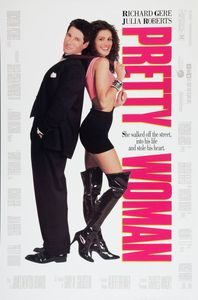
    (On TV, June 2016) As twenty-five years of commentary has it, Pretty Woman is a feel-good romantic comedy featuring a corporate raider and a Hollywood hooker. Any serious look at the film will highlight the differences between the original, somewhat darker script and the one that ended on screens. But what’s amazing is that it actually works: Largely based on the charm of Richard Gere and Julia Roberts (whose star-making turn here eerily echoes her character), Pretty Woman manages to take a biting premise and transform it into a fairytale in which everyone ends up happy, rich and vindicated. Business dealings are innocuous, drugs are avoided, and uncomfortable issues of sex and power relationship are avoided or nullified by even worse behaviour by the film’s antagonists. (Who’s worse? An attempted rapist or a snooty shopgirl?) On some level, Pretty Woman is a case study of Hollywood techniques for disarming anything that may disturb a large audience. On another, it’s a romantic comedy that packages Pigmalion into a set of tropes fit to be absorbed in a Hollywood subgenre (which it did, the film arguably revitalizing the romantic comedy subgenre for more than a decade). Much of it remains timeless, even though Gere’s character still belongs in the eighties, and sharp-eyed viewers will spot newspapers harkening back to 1989’s Panamanian invasion. Despite the film’s darker edges, Pretty Woman still works well as a crowd pleaser. Stranger things have happened between a daring script and a box-office success.