Reviews

  • American Ultra (2015)

    American Ultra (2015)

    (Netflix Streaming, May 2016) I’ll leave the scholarly analysis to others, but it’s possible that the gradual liberalization of drug laws in the US has something to do with the growing number of movies in which stoner aesthetics are blended with other unlikely subgenres. Or maybe it’s just Seth Rogen’s fault. No matter why, here’s now American Ultra, which takes a small-town chronic user and drops him in a Bourne-style action thriller. It’s not an accidental event, considering the protagonist’s repressed memories and other small revelations, but the result is along the lines of “what if a stoner discovered he was an unstoppable killing machine?” Imagine the movie it could have been, then temper your expectations, because American Ultra is a generic treatment of a promising idea, limited by its budget and (more crucially) a lack of willingness to do more than the usual paranoid “government’s coming to kill you” thriller with small-city drug humour … and not that much humour either. Jesse Eisenberg isn’t too bad as the protagonist finding out that his existence is a hazy lie, but Kristen Stewart doesn’t impress much as his girlfriend. The script has a few issues (many of them having to do with Stewart’s character) but doesn’t try very hard to break out of formulas. Nima Nourizadeh’s direction does have a few flourishes, even though some of them are overplayed such as the flashforward framing device, or the epilogue-as-cheap-animation credit sequence. As with a surprising number of stoner movies that try to blend themselves in more serious genre, American Ultra’s level of violence seems grotesquely excessive, as if it hadn’t earned the right to showing that much gore in what should be a far more amiable context. It wouldn’t be so bothersome if it wasn’t for the cheap use of anti-government clichés such as assassin squads—not to spend too much time on my soapbox, but it’s trashy thrillers like American Ultra that normalize the idea of a government willing to kill its citizen, and I’m finding less and less to like about that. It’s also in the service of so little: no inspiring message about taking back government, more effective checks and balances or new roles in a digital surveillance age—just dumb drug jokes, a modern “forgotten prince” fantasy trope and bloodshed for all. Alas, American Ultra only amounts to something you’d watch late at night and forget about by the next morning.

  • Dumb and Dumber (1994)

    Dumb and Dumber (1994)

    (Second viewing, On Cable TV, May 2016) I didn’t have very good memories of Dumb & Dumber, and a revisit twenty-some years later only highlights why: I don’t react well to deliberately dumb humour, and this film has enough of it to fill a trilogy. I spent the film’s first half-hour in an increasing state of self-loathing, wondering why I was re-watching it and feeling my IQ dropping every minute. Eventually (specifically during the diner scene where a seasoned criminal unsuccessfully try to kill the protagonists), I reached an equilibrium of sorts, and the film finally started feeling funny. Not exceptionally funny, but funny enough to coast until the end. Jim Carrey does deliver a remarkable performance (alongside Ace Ventura and The Mask, it’s part of his astonishing 1994 breakout year), and seeing Jeff Bridges abase himself so low does have an interest of its own. The humour is dumb enough that it’s easy to forget that two skilled comedians (the Farrelly Brothers) wrote this stuff, but some of the film’s more outlandish moments (such as the fantasy sequences, or the living-large segment) do show some invention going beyond the dumb humour. I’m not going to claim that I was seduced by the results, but Dumb & Dumber does become good enough to escape the confines of its chosen dumb-jokes subgenre, and it’s that kind of success that highlights a better-than-average effort. This being said, I’m more than OK with the thought that I may not have to watch this again for another twenty years.

  • The Trust (2016)

    The Trust (2016)

    (Video on Demand, May 2016) When Nicolas Cage started showing up in direct-to-video movies a few years ago, it felt odd but fun, as he was usually able to raise the level of a production just by showing up. But as he keeps working to (rumours say) pay off his tax debts, the charm of his regular appearances in non-theatrical movies is starting to wear thin. The Trust isn’t completely empty of fun, but it’s one more in an increasingly generic series of bland thriller that happens to feature an actor named Nicolas Cage without taking full advantage of his grandiose Caginess. Taking place in the low-budget areas of Las Vegas, The Trust features Cage as a forensic investigator who gets the urge to rob an illicit safe. Enlisting a younger partner (played by Elijah Wood, suitably nebbish), he sets up the heist … until everything goes wrong. While generally well executed, The Trust makes the mistake of going dark and gritty rather than cool and exhilarating like so many other heist movies. The ending couldn’t possibly be more downbeat, but it doesn’t come as a surprise after an increasingly grimmer series of events. Cage, as mentioned, delivers what’s expected of him but doesn’t do much more than that. Some of the film’s most intriguing plot threads are left unexplored, while it spends a considerable amount of time on far more familiar material. It’s easy to see why the result went straight to video—in an increasingly competitive theatrical environment, a Cage-neutered The Trust simply doesn’t have what it takes to warrant the trip out to the multiplex … but it may have just enough to justify picking it up at home for an evening’s entertainment.

  • From Dusk Till Dawn (1996)

    From Dusk Till Dawn (1996)

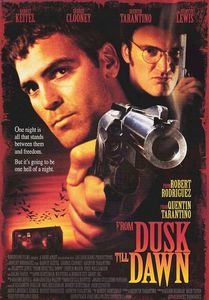
    (Second viewing, On TV, May 2016) Even twenty years later, From Dusk Till Dawn still holds up as a reference point. It’s one of the first titles in any “which movie changes genres midway through?” discussion, it still presents a fine collaboration between Quentin Tarantino (who also stars) and Robert Rodriguez, it showcases a prime-era Salma Hayek and it’s completely crazy when it counts. I thought I remembered quite a bit from a first viewing in the mid-nineties, but it turns out that I had forgotten a lot since then. There are more lulls than I remembered (it doesn’t help that the plot is straightforward), the special effects are a bit cheaper than in my mind and I had somehow managed to forget that iconic final shot. I had also forgotten how dark-haired George Clooney carries the picture through sheer charm and energy, and how insufferable Tarantino’s character is. The moment where the true nature of the film is revealed still carries a punch, and the film’s constant succession of gags from that moment on is still enjoyable, much like the dialogue carries quite a bit of the film. (I’m fond of “I don’t … believe in vampires, but I believe in my own two eyes, and what I saw, is … vampires.”) There is a good rock-and-roll rhythm to the film that propels From Dusk Till Dawn forward even today, and I’m glad I got to revisit it with just enough memory blur to make it fun again.

  • American Reunion (2012)

    American Reunion (2012)

    (On DVD, May 2016) Thirteen years after the original American Pie, the goal was to bring back nearly everyone associated with the series for one last (?) bash. Wisely embracing its entire cast of characters, American Reunion goes back to high school (sort of) to bring back everyone for a summer reunion. Some stuff seems out of place, such as a curiously vicious feud between our protagonist and some lunkheads, but in other ways American Reunion does make a more conscious attempt at recapturing the original. Interestingly enough, it does so in a context where it acknowledges the evolution of its characters, showing them married and mature while still hanging on to some of their initial wildness. Sequels that acknowledge the time between their instalments tend to carry more poignancy that those who don’t, and it’s this heartfelt sentiment that excuses some of American Reunion’s less compelling moments. Perhaps fittingly for the series, Seann William Scott’s Stifler is now a full-fledged member of the main cast, and he gets a victory of sorts in the series-old MILF feud. American Reunion isn’t at the same level as the first film or arguably the second, but it’s well handled enough to bring some joy still.

  • American Wedding (2003)

    American Wedding (2003)

    (On DVD, May 2016) This third entry in the theatrical American Pie series deviates from the first two in at least two fundamental aspects, one good and the other not-so good. On the good side, it does try to make its characters grow up: Our series protagonist is now ready to marry his high-school sweetheart, and much of the movie repurposes the good old humiliation-comedy framework of the series to the wedding shenanigans. It works, and provides a nice sense of continuity and meaning to the series. More puzzlingly, the film chooses to focus on a subset of characters and a scope that seems far more narrowly focused. It simply seems as if something is missing. It doesn’t help that Stiffler’s been promoted to a lead character and that he seems to be made even more obnoxious early on to justify his eventual redemption. His final screw-up is so contrived as to defy explanation. Still, there’s some good work here by Jason Biggs and Seann William Scott, a few capable set pieces (the gay-bar sequence works well, for whatever reason) and the spirit of the series carries forward even in a more limited scope. I’ll say one thing, though: American Wedding is now partially redeemed by the existence of a fourth entry (American Reunion) that returns more closely to the roots of the series rather than letting it end on such a limited note.

  • American Pie 2 (2001)

    American Pie 2 (2001)

    (On DVD, May 2016) To its credit, this sequel to American Pie doesn’t take the easy way out of trying to do the same thing in college. Surprisingly enough, it returns to the same characters one year later and follows them as not much has changed in the interim. The action eventually moves to a beach house for even more rowdy fun, the same comedy engines powering this follow-up: one string of humiliation comic set pieces after another. (The fake-lesbian sequence is probably the film’s highlight, and it does manage a nice balance between lust and laughs.) Stifler’s back in an expanded role, Stifler’s mom’s return is highly anticipated, but most of the characters are back with various things to do. The standout actors are pretty much the same: Jason Biggs as the hapless protagonist, Eugene Levy as a well-meaning dad, Seann William Scott as the life of the parties. American Pie 2 isn’t quite as fresh as the first film, but it offers more of the same pleasures without too much fuss along the way.

  • American Pie (1999)

    American Pie (1999)

    (On DVD, May 2016) Everyone has their list of movies that other people can’t believe they haven’t seen (“What, you haven’t seen Star Wars?!?”) and American Pie was high on mine. For years, I thought I didn’t need to see the film because I felt as if I had seen it all already: Hadn’t I heard enough pop-culture references, suffered through endless imitators? But there’s no substitute for the actual experience of watching the film itself, especially given how it still has a charm that has eluded many of its copycats. It remains one of the definitive teenage sex comedies of the past few decades, focusing on the pursuit of sex as a rite of passage, and the conclusion that it’s not that important compared to love. Despite then-cutting-edge Internet jokes (early streaming humour!), it has aged surprisingly well, largely because it’s so heartfelt. The structure is squarely built on embarrassment set pieces, with comic sequences strung one after another within a solid but unspectacular plot. I am far away from the target audience for this film now, but it’s refreshingly free of smirking in how it treats its characters. Despite being male-centric, American Pie isn’t cruel to its female characters—in fact, the males usually take up the brunt of the humiliation, while the women are too smart to embarrass themselves. Standout performances include Sean William Scott, Natasha Lyonne, Eugene Levy and Jason Biggs as the much-humiliated protagonist. Surprisingly enough, many of the pop-culture references about the film actually concern bits that took bigger importance in the sequels: I’m particularly thinking about Stifler’s character and his mom, not to mention Alyson Hannigan’s quasi-cameo considering her role in latter movies. (The MILF thing is the MILF thing, though, even though I was surprised to be reminded that John Cho is the one who made it mainstream.) Still, even more than fifteen years later, American Pie holds up relatively well … as long as you can stand the sex = humiliation comedy equation.

  • Self/Less (2015)

    Self/Less (2015)

    (Netflix Streaming, May 2016) If you ask written Science Fiction fans why they’re so frequently annoyed by media SF, you’re likely to get variations on a common theme: Media SF doesn’t do much with the ideas it plays with. It’s rare to see a SF movie that plays with ideas longer than the duration of a trailer: More often, the SF premise leads to an intensely familiar plot transplanted from other genres almost as-is. A representative example of this problem can be found in Self/Less, which barely has time to explain its premise (Rich old dying man transplanted in younger body, discovers that the body belonged to someone else and vows to fight those who lied to him before then exterminate him) before settling into a very familiar chase thriller. It’s not exactly a new premise (although viewers should be forgiven if they don’t remember 1966’s Seconds), but the execution’s lack of wit instantly relegates Self/Less to undistinguished bargain bin status. Too bad for Ryan Reynolds, who once again doesn’t have much of a role to play. Too bad for Ben Kingsley, who deserves better. Too bad, too for director Tarsem Singh, who delivers perhaps the blandest film of an otherwise colourful career: Aside from some memory flashes, there’s little in Self/Less to justify using a strongly visual director like Singh. The result, sadly, is almost instantly forgettable: The plot is bland, the action sequences are dull and the emotional beats are intensely predictable. For a film based on class exploitation (as in “being rich enough to buy a new body”), Self/Less doesn’t seem particularly interested in exploring them, nor anything else moderately interesting. While Self/Less is competently made, it’s also safe to the point of being featureless. No wonder SF fans often prefer turning to a good book.

  • The Revenant (2015)

    The Revenant (2015)

    (Video on Demand, May 2016) From the first moments, it’s obvious that The Revenant is going to be a beautiful film, a long film and a film with a lot more on its mind than a survival/revenge story. It could have been a cheap and efficient 90-minute exploitation film, considering the nature of the story: As far as incredible stories of survival are concerned, it’s hard to beat a gravely wounded man in 1790s American wilderness travelling 300 kilometres to seek the man who left him for dead and killed his son. Extreme survival, justified revenge, beautiful nature backdrops… No-one would have faulted The Revenant for focusing on the primal survival/revenge story. But in the hands of director Alejandro González Iñárritu, the result is a few steps above the strictly necessary. A savvy blend of nature shooting and cutting-edge special effects allows for lengthy, almost unbearable sequences of violence set against spectacular natural landscapes. In-between harsh weather, aggressive bears, warring white groups and wronged natives, there are many moving parts in The Revenant, and the script effortlessly plumbs at the complexities to be found in even such a so-called wilderness. Leonardo DiCaprio is remarkable as the hero of the story, even though Tom Hardy also does a lot as the antagonist. Still, the stars here are cinematographer Emmanuel Lubezki and director Iñárritu, transforming an exploitation premise into A-grade filmmaking. It’s true that the result could have been a bit shorter and less repetitive, but it feels a bit ungrateful to ask for less of an excellent film.

  • Project Almanac (2015)

    Project Almanac (2015)

    (Netflix Streaming, May 2016) Seen from a comfortably middle-aged perspective, there’s something almost endearing in science-fiction movies that plays with familiar genre tropes from a very specific demographic perspective. So it is that when the teenage protagonists of Project Almanac discover time-travel, they rush to use it for … passing exams, seeking love, winning the lottery and attending Lollapalooza. Go, teenagers, go. Of course, things get complicated very quickly in the film’s haphazard sense of causality—they can always go back to fix mistakes, but the rules for doing so seem to change depending on the whims of the script. The main message, predictably, remains the bad old “don’t mess with the timeline” shtick. There is a lot to dislike in Project Almanac for those who are north of thirty: Director Dean Israelite’s found-footage angle is exasperating, the focus on teenage obsessions can be twee and there’s a lot of noise both literal, visual and figurative in the film. Still… I didn’t have a bad time watching it. It has a bit of energy, some self-awareness and a few clever moments when the camera settles down. As a playful take on a familiar SF device, it earns some fair attention. It’s not necessarily for everyone, but at a time when SF devices can always benefit from being introduced to younger audiences, Project Almanac is a bit better than you’d expect. Consider watching it on your mobile device to minimize the shaky-cam cinematography.

  • Fantastic Four (2015)

    Fantastic Four (2015)

    (Netflix Streaming, May 2016) The release of this Fantastic Four reboot was accompanied with wild rumours of a troubled production, an out-of-control director and such vehemently bad reviews that the worst could be expected from the final result. Unfortunately, most of those low expectations are met: Fantastic Four is a mess of a movie, dull and bland in the ways that comic book movies used to be before their formula was perfected, and disjoint to the point of incoherence. The detailed story of the film’s production may or may never be known, but, in the meantime, we’re left with a dour film that rehashes an overly familiar origin story, veers into a generic third act and can’t be bothered to make us care about archetypical characters that, let’s face it, shouldn’t take much work to flesh out. No matter why directory Josh Trank lost control of his film, the result feels botched and hurriedly completed to satisfy contractual obligations: There’s no sense of joy to comic book characters that should exemplify it, and if Fantastic Four very briefly forays into a fascinating body-horror sequence, it quickly forgets all about it moments later. What’s too bad is that it features good young actors who can’t be blamed for the mess: Miles Teller, Michael B. Jordan and Kate Mara, in particular, can’t do much with the featureless material they’re given. (Mara, in particular, is given material fit to make her exceptionally unlikable, which is not how she comes across in other films.) Fortunately, all three have made better movies before and after, so their careers are probably OK. The inanity of the script may be organic or due to studio meddling—it’s hard to tell, but it’s not hard to be disappointed for the results. While some of the most vitriolic reactions to Fantastic Four may be due to frenzied Marvel fan-activism (as in: “Marvel should be doing Fantastic Four films! Let’s hope it tanks so that Fox give the rights back!”), the movie as made available feels like a throwback to fifteen years ago when studios given comic book properties didn’t even bother to treat the material with respect. No surprise is the result is almost instantly forgettable and (as hard as it may be to type this), makes Fox’s previous two Fantastic Four movies look good in retrospect. Strange world. But mark me down as interested if ever “Fantastic Four: The Director’s original vision with unfiltered commentary” ever comes out.

  • The Exorcism of Emily Rose (2005)

    The Exorcism of Emily Rose (2005)

    (On Cable TV, May 2016) I will admit it: I expected far worse from The Exorcism of Emily Rose, and I’m pleasantly surprised at the result. Keeping in mind that expectations may be the key to good reviews, there is something fascinating in the way this film blends a courtroom procedural and religious possession horror, cleverly allowing dual versions of events to be shown on-screen. (Of course, as with nearly all horror movies, the paranormal version is far more compelling—otherwise why are we watching it?) This unusual sensibility helps explain why the film can boast of such a good cast, from Laura Linney’s conflicted lawyer protagonist to Tom Wilkinson as a tortured priest, with a good supporting turns by relative newcomer Jennifer Carpenter in the title role. Considering director Scott Derrickson’s subsequent filmography, we can already see in The Exorcism of Emily Rose the atmospheric conviction that would elevate many of his later films. It’s certainly enough to paper over the script’s overly dramatic manifestations of evil that would strike many as ridiculous. Still, this film’s biggest strength is to do the usual in a slightly unusual way, almost hiding behind the trappings of a legal thriller to blur the shape of its horror thrills. It does manage to keep audiences interested, which is more than we can say about many other similar movies. The tension between rationality and the supernatural is explored competently—just don’t pay too much attention to the claims that it’s based on a true story. Now popping up late at night on cable TV channels The Exorcism of Emily Rose remains a nice little surprise, especially for anyone expecting a formula exorcism horror thriller.

  • The Transporter Refueled (2015)

    The Transporter Refueled (2015)

    (Netflix Streaming, May 2016) Rebooting the Transporter series without Jason Statham’s bigger-than-life stature wasn’t a good idea, and the best that The Transporter Refueled can do is fight its way to a generic thriller with a few occasional good moments. Ed Skrein is serviceable but unremarkable in the lead role: he doesn’t embarrass himself, but doesn’t shine either. Ray Stevenson is more fun as his father, and one of the film’s two good ideas is to make the film turn around a father/son relationship too rarely portrayed in movies—let alone action movies. The Transporter Refueled’s other good idea is to put much of the film’s propelling motivation on a group of vengeful women—although your mileage may vary on this, given the camera’s leering gaze on them and the feeling that this is merely another way to crank up the film’s exploitation content. It wouldn’t matter so much if the result were memorable—but sadly, The Transporter Refueled feels far too much like everything else in writer/producer Luc Besson’s Europacorp’s generic action portfolio, with merely adequate direction, by-the-numbers writing and uninspired performances. Writing this review a few days after seeing the film, I can testify first-hand that the film doesn’t leave much of a lasting impression. Actresses presented as being more attractive than they are, unusually prominent father/son relationship, a climax set in an airport, some car chases and shootouts … and that’s pretty much it for the details. As far as the overall impression is concerned, you can line up The Transporter Refueled alongside a list of other similar thrillers and have a hard time picking them out of a line-up. As a franchise reboot, that’s not exactly a confident first step.

  • Z for Zachariah (2015)

    Z for Zachariah (2015)

    (On Cable TV, May 2016) As post-apocalyptic thrillers go, Z for Zachariah plays things more intimately than most. There are only three characters in the story, hence the drama: Margot Robbie initially stars as a young woman who has almost unexpectedly lived through a global nuclear disaster, her universe now limited to a small valley where the radioactive fallout can’t enter. She’s managing to hang on, but her world is turned upside down when she comes across another survivor, a scientist played by Chiwetel Ejiofor. Their relationship is difficult to begin with, yet things get even more complicated when a third man, much younger and friendlier (Chris Pine) also makes his way in the valley. The resulting tension isn’t pleasant for anyone, especially when science and religion are set up as mutually incompatible pursuits, and an unhealthy rivalry begins between the two men, leaving our heroin scared and disturbed from her lonely life. Far from being cheerful, Z for Zachariah works well as an acting showcase for all three actors (with Robbie earning a chance to prove the kind of dramatic talents that don’t fit with her persona in blockbuster movies) but get annoying when it aims for simplistic allegory. As a feminist twist on post-apocalyptic stories, it’s inconclusive—another five minutes of definitive resolution may have helped matters, especially given the liberties taken from the original novel. It amounts to a film that qualifies as mildly interesting but not essential, unless you’re a post-apocalyptic junkie or a fan of the three actors. At least it does a few unusual things in the sub-genre, and it handled with some competence.