Reviews

  • Erased aka The Expatriate (2012)

    Erased aka The Expatriate (2012)

    (On Cable TV, February 2014) The prototypical thriller follows a familiar formula, but that’s no excuse to make a film as immediately forgettable as Erased. From the get-go, we are served well-worn elements: the highly-competent hero with a shady past, the woman to protect, the betrayal that upends everything that the hero knows and sends him on the run… In a few minutes, Erased sets its expectations downward and keeps them there. The bland European scenery doesn’t add much, and the progression of the plot to the hero turning the tables against the conspirators isn’t handled with any wit or freshness. It’s not as if formula by itself is bad: there are countless examples of dull premises made interesting by competent execution. But Erased doesn’t have that. Aaron Eckhart (a much better actor than most of the roles he plays) is stuck without much to do except look tough and run fast. (His transformation from super-geek to ex-CIA operative is a bit abrupt, although it’s the kind of stuff allowed on principle in thrillers, otherwise the result would be far less interesting.) In a word, Erased is dull and (ironically) instantly forgettable. It’s not actively bad or unpleasant, but it quickly blurs between what seems to be a countless number of films all telling pretty much the same story.
  • Inventory, The Onion A.V. Club

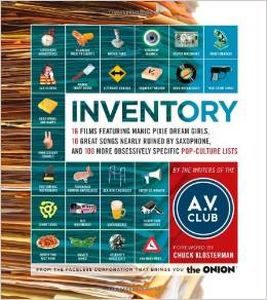
    Inventory, The Onion A.V. Club

    Scribner, 2009, 256 pages, C$24.00 tp, ISBN 978-1-4165-9473-4

    Seven ideas gleaned from reading the Onion’s A.V. Club Inventory

    1. The web’s lowest-common-denominator excuse for content has finally crossed over to the paper world. Oh, I jest, but only barely: For one thing, books of lists have a long pedigree (From David Wallechinsky’s The Book of Lists series to David Letterman’s books of Top Ten Lists). For another, while Buzzfeed.com has recently perfected the idea of using lists as cheap ways to grab viewer eyeballs on the web to a science, the folks at The A.V. Club have been at it for years, delivering weekly lists of pop-culture trivia. Inventory is a collection of their best lists, along with some original material all wrapped up in pleasant page design.
    2. Pop culture is hopelessly tribal: Since The A.V. Club is entirely dedicated to pop-culture, expect the lists in Inventory to focus on movies, TV, music or (more rarely) books or video games. Of course, since the lists delve deep into minutiae, their interest is likely to be proportional to your own knowledge of the area. I’m generally knowledgeable regarding movies, a bit less so regarding books or video games, and sort-of-lost in TV and music (it’s a vast universe, and one can’t be expected to know everything) and my interest in the lists was generally proportional to my expertise in the area. Some of the music stuff was dreary and pointless enough to make me skip to the next list; other lists about movies, video games or books felt far more interesting. Inventory is a buffet; take what you want.
    3. At their dullest, lists are wastes of meaningless trivia: Especially if you have no perceptible interest in the central focal point of the list. “Songs about taking the bus?” Meh. “Songs under 3 minutes.” Really? I don’t need a list of movies about specific things when I can just go get one from IMDB.com
    4. At their best, lists are a decent way to chunk a larger thesis: Beyond trivia, well-conceived lists become something else: Some of the most remarkable material in Inventory end up building an argument through an accumulation of examples, or a categorization of the same. “Approaches to DVD commentary” isn’t a list as much as a systematic breakdown of how directors approach their DVD commentaries. “Videogames that outraged a nation” paints a capsule history of how videogames pushed the envelope throughout their history. And “Manic Pixie Dream Girl” practically codifies a trope that illuminates a certain kind of self-indulgent filmmaking. All a far more satisfying than listing songs about public transit.
    5. Talking about Pop Culture is a waste of time… unless you enjoy it: Reading Inventory, it’s hard to avoid the ghastly realization that the book is essentially useless. That lists of trivia are useless. That pop-culture itself is useless. Why, then, does it compel us so much? Perhaps because, as the very name implies, that pop-culture is the glue that binds us to our own self-chosen subcultures. Discussing shared interest is fun, not for the things themselves but for the sentiment of belonging to a group with someone else. Inventory is clearly meant for the cyber-fluent quasi-hipster: The “Heaven/Hell” bits clearly identify the audience as young(ish), urban, progressive and multi-media literate –although classifying Coke as Heaven and Pepsi as Hell is a good way to get on my list of pretentious posers. In keeping with the “Inventory is a buffet” thesis, the most interesting pieces of the book are those that most closely align with our own projected persona.
    6. Parents of toddlers trying to get back into reading could do worse than beginning with a book of lists: Let’s face it: toddlers require less attention than infants, but they don’t like to be ignored for more than a few minutes. A book of list, easily digestible in chunks of 2-3 minutes, is ideal for reading in such circumstances: Even trivial interruptions don’t feel as annoying when they happen on the eighth item of a meaningless list. Plus you can hand over the bookmark for the toddler to play with and not feel too concerned about losing one’s place in the book.
    7. There’s not need to go all the way to a top-10 when you’ve said enough.
  • Snow White and the Seven Dwarfs (1937)

    Snow White and the Seven Dwarfs (1937)

    (First-through-fiftieth viewings, Toddler-watching, In French, On Blu-Ray, February 2014) How strange is it that I still hadn’t seen Snow White and the Seven Dwarfs until now. Or have I? The problem with a long-lived pop-culture reference such as this one is how I may have watched it a dozen times during childhood and forgotten all about it. I’m certainly catching up, though, because watching Snow White and the Seven Dwarfs with a toddler means watching it on a continuous loop, skipping over the credits, the legendarily scary forest sequence, the witch scenes and the violent end climax. What’s left, though, is more than enough: fantastic animal animation sequences dense in detail and charm; toe-tapping musical numbers (“Whistle While You Work” and “Heigh-Ho” are classics, of course, but I like “Bluddle-uddle-um-dum” and “The Silly Song” a lot.) While my daughter is busy singing and dancing, I’m left to reflect upon how, even by 1937, Walt Disney had hit upon the magic formula that would inform animated features all the way to 2014 and beyond: The use of animation to portray things impossible to shoot in real life (in this case, most notably, the dozen of animals in intricate gags), the necessity of strong showcase sequences, the blend of animation and song, the prototype of the Disney heroine… it’s all there, predating everything we think is modern. As a result, Snow White and the Seven Dwarfs still feels incredibly modern, especially within its standout sequences: I defy any modern CGI creation to do better than the sequence in which Snow White and the animals clean up house. When my daughter goes to sleep, it’s time to watch the astonishingly expressionist forest sequence and be amazed at the fact that it’s in a kid’s movie. The one thing that doesn’t quite work, and may reveal much about the fragile production of this first Disney feature film, is the rushed ending, dispensing with about five more minutes of animation through a quick narration of on-screen text: the kind of shortcut that no filmmaker in their right minds would now attempt without self-consciousness. Still, even without a few flaws, Snow White and the Seven Dwarfs remains an impressive film –no wonder it remains a crown jewel of Disney studios even nearly eighty years later.

  • You May Not Kiss the Bride (2011)

    You May Not Kiss the Bride (2011)

    (On Cable TV, February 2014) I had low expectations for this low-budget romantic comedy, which came out of nowhere with a bland premise, no-name leads and a featured performance by Rob Schneider. Somehow, though, You May Not Kiss the Bride overcomes most of its shortcomings to deliver an entertaining-enough blend of sympathetic protagonists, gorgeous Hawaiian cinematography and effective screenwriting. Here, a Chicagoan photographer is manipulated into fake-marrying a mob daughter to ensure her citizenship. A honeymoon is arranged for the purpose of misleading government authorities, but our protagonist has been warned that he may definitely not kiss or otherwise touch the bride on promises of painful death. Naturally, things don’t quite go according to plan. There isn’t much more to the film than a few performances. Dave Annable and Katharine McPhee make for an appealing lead couple, while Tia Carrere has a welcome supporting role, Mena Suvari repeatedly mugs for laughs and Rob Schneider proves to be far less annoying than expected. Vinnie Jones shows up for a typical turn as the film’s designated heavy, but this isn’t a film that lives on the strengths of its antagonists. While You May Not Kiss the Bride isn’t particularly ambitious (and kind of fumbles its landing by stretching it out), writer/director Rob Hedden should be happy: his film is good enough to make its target audience happy, and may even qualify as a pleasant late-night-cable discovery.

  • Safety Not Guaranteed (2012)

    Safety Not Guaranteed (2012)

    (On Cable TV, February 2014) For decades, the horror genre has thrived on genre ambiguity: Are there truly supernatural horrors out there, or is it all taking place in the person’ mind? Now here we have a science-fictional example of that tension between fantasy and reality, as a trio of journalists descend upon a small town to assess the craziness of a man who has posted a classified ad asking for a time-travel companion. True to its low-budget mumblecore inspirations, Safety Not Guaranteed is a low-energy affair, meandering and contemplative as a young female intern befriends an eccentric man convinced that he’s about to travel back in time. Is he insane? The film’s conclusion settles the question definitively, but it’s the journey that matters more than the answer. Safety Not Guaranteed‘s biggest asset is the unconventional charm of Aubrey Plaza as a disaffected young cynic: Her performance more than overshadows Mark Duplass as the would-be time-traveler. Otherwise, it’s all low-key until the end, with half-hearted attempts at a thriller not really registering against the off-beat romance at the heart of the script. The conclusion, as obvious as it may be, comes as a bit of a disappointment. Still, Safety Not Guaranteed remains a quirky film, and one that goes by easily.

  • Films of Fury: The Kung Fu Movie Movie (2011)

    Films of Fury: The Kung Fu Movie Movie (2011)

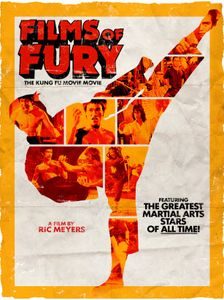
    (On Cable TV, February 2014) A quick look through my archives will show that I spent much of 1998-2003 watching an astonishing number of Chinese-language movies from the Hong Kong film industry. (It helped that a local TV station was broadcasting them on a weekly basis and that video stores were there to catch up on the classics.) Given this, I’m reasonably sure that I’ve seen most of the major Chinese action movies made between 1990 and 2005. But that’s just a sliver of what’s available out there as the prototypical “kung-fu movie”, and Films of Fury: The Kung Fu Movie Movie (written by Ric Meyers, based on his book of the same name) is there to explain how kung-fu movies developed as a genre, and where they are now. After pointing out that the genre has its origins as much in dance than in action, Films of Fury gives an overview of its development, from the often-ludicrous early examples to the emergence of Bruce Lee, the golden-age of the eighties-and-nineties, the emergence of stars such as Jackie Chan, John Woo and Jet Li, and the Hollywoodization of the form toward the turn of the millennium. The film’s definition of a kung-fu movie is reassuringly expansive: not only does gun-fu gets its own section, but the film points out that the first inroads of kung-fu movies in western cinema were made in early James Bond movies. Films of Fury avoids talking-head syndrome by featuring narrated animated segments in-between tons and tons of archival footage. The effect is much like hanging out with an enthusiastic video-store clerk for an hour and a half. While the animation style grated on my nerves, the collection of archival footage, sometimes milliseconds long, is astonishing: It seems as if every major kung-fu film is featured on-screen at least once, along with several not-so-major ones. Films of Fury answered my perennial question as to why kung-fu movies disappeared from the big screen after such a strong presence around 2000 (answer; economic downturn, increased post-takeover restrictions on the Hong-Kong film industry by the Chinese government, lack of charismatic stars) while providing reassurance that at least I managed to catch or purchase some recent masterpieces (Kung-Fu Hustle, Red Cliff) and suggesting a few titles that I missed (SPL, Warlords). It amounts to a quick introduction and refresher on a fun genre, and a must-see for anyone interested in a kung-fu movie movie.

  • Art School Confidential (2006)

    Art School Confidential (2006)

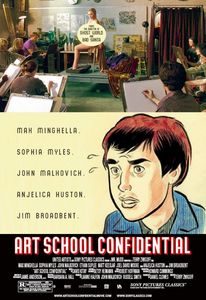
    (On DVD, February 2014) If you’re going to subvert the expectations of a coming-of-age college comedy, it’s not a bad idea to follow in the iconoclastic traces of screenwriter Daniel Clowes and director Terry Swigoff as they take on the mystique of fine-arts education in Art School Confidential. Max Minghella stars as an idealistic artist trying to thrive during his first year at a not-so-prestigious specialized college, alongside flawed teachers played by such notables as Jon Malkovich and Angelica Huston. While the film flirts with convention (fresh in the big city, our hero discovers girls, makes friends, has academic reversals of fortune and uncovers unsavory truths about teachers), it gleefully plays with them in a second half that leads up to a darkly cynical ending. As a portrait of the strange sub-culture of art school, the film earns its laughs. It’s later on that the film become less and less satisfying, as the various threads are either tied up perfunctorily, or not at all. (Witness one of the early scenes, showing various students by how they arrive at school –rather than introduce characters, it just presents people we never see again.) The details don’t add up to much of a story despite the subversion of expectations. At least Art School Confidential offers a few chuckles, and that’s already not too bad.

  • You Are Here (2010)

    You Are Here (2010)

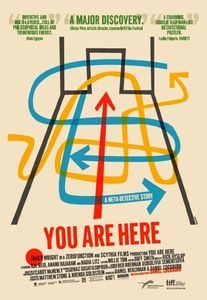
    (On Cable TV, February 2014) I’m not sure if there’s something wrong when a movie has me daydreaming furiously… about things that it doesn’t do. Low-budget Canadian production You Are Here is a big grab-bag of philosophical ideas thrown haphazardly on the screen in what approximates a science-fiction premise but ultimately isn’t much more than random stuff strung together. Hence my hesitation: While it’s fun to see John Searle’s Chinese Room thought experiment presented on-screen, while You Are Here’s writer/director Daniel Cockburn (better known as a conceptual artist) occasionally plays with clever ideas, unorthodox presentation format or compelling vignettes, it doesn’t add up to anything more than a collection of things, not a satisfying coherent narrative. So it is that I found myself drifting away from the movie, more interested in what it could have done with the same ideas had it been more disciplined, -heck- had it even been interested in delivering a story rather that bite-sized vignettes. I really wanted to like this film better than it did, but there is something about its execution that doesn’t work.

  • Dallas Buyers Club (2013)

    Dallas Buyers Club (2013)

    (Video on Demand, February 2014) Three decades after the beginning of the AIDS crisis, twenty years after the obvious tears of Philadelphia, we’re not talking about the disease the way we used to, even in historical retrospectives. Dallas Buyers Club may go back to 1986, but it does so with the knowledge that AIDS has, in some ways, become a treatable chronic disease. Rather than focus on the inevitable death sequence (although we do get that), it’s a film that dare to blend all-American entrepreneurial spirit, antiestablishment smuggling and expert-defying hunches into a fight-back story against AIDS. Anchoring the film is Matthew McConaughey’s astonishing physical transformation into a gaunt but indomitable figure, as his radical post-Lincoln Lawyer career renaissance had led him to a pivotal dramatic role (and modified audience expectations accordingly). Jared Leto and Jennifer Garner turn in serviceable supporting roles, but this is really McConaughey’s movie. Skillfully directed by Jean-Marc Vallée, Dallas Buyers Club offers a look at the early AIDS era that is both unflinching and more than occasionally entertaining as we see the protagonist defy the medical establishment’s glum predictions to provide a better life for other afflicted people. It’s a surprisingly entertaining film that keeps the preaching to a minimum –as should be, considering how attitudes have changed.

  • The Devil’s Double (2011)

    The Devil’s Double (2011)

    (On Cable TV, February 2014) Perhaps the most interesting thing about dictators is how they represent a case study in what happens with humans given almost-unlimited power. So it is that The Devil’s Double imagines a fanciful story about an ordinary man coerced into becoming Uday Hussein’s doppelganger. Along the way, he discovers the insanity of the man, tries to escape and take revenge for what he has seen. Dominic Cooper doubly stars as both Uday and his double, relying on basic but effective acting tricks so that there is never a moment’s hesitation in knowing who we’re dealing with. The Devil’s Double is never as interesting as when it becomes an excuse to dramatize the life of excess in which Uday Hussein lived: fast cars, faster women, unchecked power and blatant sadism all abound here. What’s less compelling is the by-the-numbers nature of the story, which adheres faithfully to the good-old templates for innocents brought near sources of raw power –it does feel a lot like a gangster film. Also rather less than interesting is the film’s raw violence, which often crosses far beyond the necessary to indulge into sheer gore. Director Lee Tamahori keeps things moving briskly, and gets a great performance from Cooper… but the end result does feel too conventional. Worse yet: The Devil’s Double is based on a book that pretends to be a true story, but investigations have revealed no evidence that this ever happened. At least we get a passable thriller out of the fanciful story.

  • Killing Them Softly (2012)

    Killing Them Softly (2012)

    (On Cable TV, February 2014) While Killing Them Softly has the admirable ambition of using a crime story to tackle much-bigger social and economic themes, it looks as if, along the way, it has forgotten to entertain viewers on a minute-to-minute basis. Adapted from a seventies crime novel but updated to be set in the middle of fall 2008’s presidential/economic crisis, it’s a film that attempts to make parallels between low-level mob desperation and wider social problems. As such, it’s got a lot more ambition than most other crime thrillers out there. It all culminates into a tough but compelling final scene, in which America is unmasked as a business far more than a community, and in which getting paid is the ultimate arbitrator of fairness. Stylistically, Killing Them Softly has a few strong moments, perhaps the most being a slow-motion bullet execution. Alas; it’s so kinetically entertaining as to be atonal with the rest of the film, which takes forever to makes simple points and delights into long extended conversations in-between bursts of violence. Still, Brad Pitt is pretty good as a mob enforcer trying to keep his hands clean (it’s another reminder that he can act, and is willing to do so in low-budgeted features once in a while), while James Gandolfini has a one-scene role as a hit-man made ineffective by his own indulgences. Richard Jenkins also has an intriguing role as a corporate-minded mob middle-man in-between men of violence. Otherwise, though, Killing Them Softly‘s tepid rhythm kills most of its interest: Despite writer/director Andrew Dominik’s skills and lofty intent, the film feels too dull to benefit from its qualities.

  • Ruby Sparks (2012)

    Ruby Sparks (2012)

    (On Cable TV, February 2014) I have an obvious soft spot for movies about writers, so it didn’t take much to get me interested in this story in which a novelist so powerfully imagines a love interest character that she shows up the next day. Everything he writes is reflected in her, and it doesn’t take a long time for the goofy romance to cede ground to weightier matters. Never mind the theme of authorship and dealing with one’s characters: as a Pygmalion-inspired meditation on control within relationships, Ruby Sparks works well and culminates in a hair-raising sequence of existentialist horror. Fortunately, it’s not where the film ends, and the satisfying wrap-up is enough to bring back the film in the romantic-comedy genre. Paul Dano is good in a role that requires us to find the protagonist annoying, sympathetic and even despicable at times. But it’s Zoe Kazan who steals the show as the eponymous Ruby, turning in a vivid performance in the middle of a film that she has written. It’s not an easy role as the character is artificially manipulated to and from self-determination, in-between polar emotional states. (There’s something trivially interesting in knowing that the film’s lead couple is also a couple in real-life.) While Ruby Sparks may be a bit too low-key to earn much attention in an age of blockbusters, the high-concept premise is executed with wit and charm, touching upon a variety of themes (just the material on male insecurity within relationships is enough for an entire movie) while keeping a sharp focus on the characters. It’s an intensely likable film despite a few intensely unpleasant moments and is well-worth a bit of time –doubly so for would-be novelists.

  • Last Vegas (2013)

    Last Vegas (2013)

    (Video on Demand, February 2014) Hollywood is growing old alongside a significant proportion of its audience, so it’s not surprising to find more and more movies aimed at older audiences. Suffice to say that Last Vegas is at least better than The Expendables series is confronting how yesterday’s superstars can go gently into semi-retirement. Focusing on four older men coming to spend a wild weekend in Vegas to celebrate one of their own’s nuptials to a (much) younger woman, Last Vegas soon turns to debauchery of a gentle kind, winking in The Hangover‘s direction without quite committing to such outrageousness. It’s sort-of-hypocritical to see stars like Michael Douglas and Robert de Niro (both of whom married significantly younger women) espouse the rightness of marrying age-appropriately, but when the object of their affection is the astonishingly good-looking Mary Steenburgen (still seven years their junior, one notes), it’s hard to complain that much. It helps that the film has a middle-of-the-road comic sensibility, amusing without being outrageous, and carefully pacing its development to gently lull viewers to a surprise-free climax. Kevin Kline and Morgan Freeman provide able supporting performances in filling an aging brat-pack. De Niro sort-of reprises his tough-guy persona (De Niro scholars are already talking about the self-referential second half of his career), Douglas oozes a slightly-oily charm, Kline does fine comic work, while Freeman is fun just being Freeman. Director Jon Turteltaub faithfully directs a decently-structured but timid script, and Vegas’s attractions do the rest. Last Vegas doesn’t amount to much, and that’s probably the point: this is mass-market comedy aiming older, and there’s no need to be bold or outrageous when nostalgia and gentle chuckles will keep the target audience happy. So it goes that the film is light entertainment, almost instantly forgettable but decently pleasant while it plays.

  • The Fifth Estate (2013)

    The Fifth Estate (2013)

    (Video on Demand, February 2014) It’s far too soon to even think about contextualizing the Wikileaks saga of 2010-2011 and Julian Assange’s place in history when so much still remains to be written and a self-exiled Assange looks spent as a significant political force. Still, director Bill Condon and writer Josh Singer do their best with The Fifth Estate, an attempt to craft a dramatic story out of too-recent world events. The film starts and ends pretentiously by spouting once more the rhetoric that the kind of open-reporting exemplified by Wikileaks is an inevitable and destabilizing evolution in the history of the world. But once it settles down and focuses on substance, The Fifth Estate becomes an exemplary demonstration of how to do a biographical film about a controversial figure: by focusing on acolyte Daniel Domscheit-Berg’s infatuation and subsequent disenchantment with Assange, The Fifth Estate avoids getting into Assange’s mind and lays the ground for a solid man-learns-better dramatic structure on which to hang the various historical events and ideas. It works, but in a familiar well-worn fashion: The film feels familiar even when it discusses the revolutionary, and the structure can’t quite sustain the amount of detail that the script feels forced to include (although the look at the European hacking scene has its moments). If this fairly ordinary film has a standout element, it’s got to be Benedict Cumberbatch’s performance as Assange, charismatic and repellent in turn, hitting a sweet spot between hero-making and warts-and-all reporting. The real story is considerably messier than the dramatic arc of the film (Domscheit-Berg’s actions after leaving Wikileaks will strike most as deplorable), but the Assange’s portrait seems reasonably consistent with other published accounts of the man [February 2014: including a recent damning profile by his once-ghostwriter] which is already something. The Fifth Estate famously flopped at the box-office, turning in results that were more in line with small art-house releases than A-list Hollywood productions, but the film itself is more bland than bad, and should still please anyone with an interest in the modern maelstrom of information-sharing. It’s not because the final chapter has yet to be written that we can’t look at the first few drafts of history.

  • The World’s End (2013)

    The World’s End (2013)

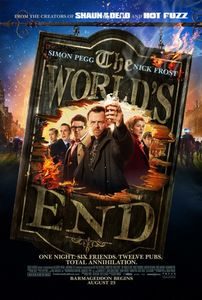
    (Video on Demand, January 2014) Given the quasi-classic status that Shaun of the Dead and Hot Fuzz enjoy in my own personal ranking, I was waiting for The World’s End with loaded expectations: As the concluding entry in the so-called Cornetto trilogy, would it be as funny, as tightly-written, as visually innovative and as purely enjoyable as its two predecessors? Well, while it may not be as hilarious as Shaun of the Dead, nor as satisfying as Hot Fuzz, The World’s End definitely holds its own as a great piece of genre moviemaking. A boozy nostalgic comedy that eventually evolves into something far more outrageous (with a daring ending that crams another film’s worth of content in the last five minutes), The World’s End is perhaps most impressive for the interplay between structure and surface, as written signs comment upon the action, as the story is outlined in-text as a flashback before re-occurring during the film, or for the various (sometimes less-than-pleasant) questions raised by the ending. There is a lot of depth here, and some of it may not be entirely apparent at a first viewing. Still, The World’s End is no mere puzzle box: it works well on a surface level, whether it’s the actors reunited for the occasion (Simon Pegg and Nick Frost interchanging their hero/cad roles, obviously, but also Martin Freeman, the lovely Rosamund Pike, and a glorified cameo by Pierce Brosnan), the impressive fight choreography, the ironic dialogue and Wright’s usual attempt to push film grammar in new directions. While a first viewing leaves a bit unsettled, The World’s End steadily grows in stature as you reflect on it –another characteristic it shares with its predecessors. Mission accomplished for Wright/Pegg/Frost, then, as the wait begins for their next films.