Brian Keith

  • Violent Road aka Hell’s Highway (1958)

    (On Cable TV, February 2022) Little-seen thriller Violent Road will strike most viewers as a cut-rate imitation of Le Salaire de la peur, but that’s not necessarily a bad thing. The thrills of transporting a dangerous substance over a lengthy distance are still an effective way of stringing together a bunch of suspense sequences, and the tactile mechanical focus of the events ensures that the film remains far more approachable today than other more abstract suspense films, depending on social mores that died along with Classic Hollywood. Our story gets going with a rocket explosion, and the need to bring some very unstable fuel from the refinery to the launch pad in a short amount of time. Unable to get on the highway, the convoy sets out on twisty back-roads, and there’s a new threat every ten minutes. Not all of the suspense sequences work: the sudden appearance of a school bus will strike many as too obviously contrived, for instance. But some of the other episodes of the film are compelling. Brian Keith (as a veteran driver) is a solid presence at the heart of the film, which also benefits from a stark black-and-white cinematography. Psychodrama among the ensemble cast, mechanical problems and environmental concerns all fill up the film’s zippy 86-minute running time. It’s not that good of a film, but Violent Road holds up in its finest moments, and nearly distinguishes itself from its illustrious predecessor.

  • With Six You Get Eggroll (1968)

    (On TV, January 2022) There’s both a familiar and an unusual aspect to With Six You Get Eggroll that makes it interesting even if it’s not an exceptional film. On the one hand, it’s Doris Day in a very Doris-Dayish comedy: a twist on the usual romance angle, a bit outrageous but not necessarily outlandish. Day herself plays the usual kind of character that characterized her biggest box-office years: white middle-class slightly-goofy American girl, perhaps a bit more independent than most by virtue of playing a widow running her ex-husband’s blue-collar business. The more unusual key to the film comes from treating Day’s character as someone her age rather than trying to pass her off a thirtysomething virginal debutante: here she plays a woman with accumulated history (although the film clearly avoids talking about what happened to her former husband) and what happens when she begins a romance with another middle-aged man. (Brian Keith, not bad.)  Much of the first half of the film is an amiable look at middle-age romance with a few misunderstandings and complications. Then, following a smash cut that’s arguably the funniest thing in the film, the second half of With Six You Get Eggroll focuses on the we’re-married-now-what reality as they tell their kids and try to blend their two families into one. There’s the usual amount of stepparent hate from the kids, practical issues (although their solution to “Let’s get an extra bedroom” is mildly amusing) and external complications ultimately bringing the family together. It’s not that much of a film, but it is interesting to see Day playing older and into a world that is very recognizably the late sixties rather than the fifties most closely associated with her. While With Six You Get Eggroll was reportedly a commercial success, it proved to be the final film performance of her career—maybe acknowledging that such plum roles for middle-aged women working in her comic style were (and remain) few and far apart. As last performances go, it’s not a bad one: she gets a few comic showpieces, she’s rarely less than likable and it’s still recognizably a role that fits her, even if it takes place about a decade later, both in tone and setting, than the string of movies that made her famous.

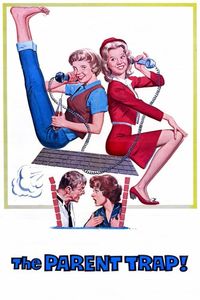
  • The Parent Trap (1961)

    The Parent Trap (1961)

    (Disney Streaming, April 2021) I’m coming to the original The Parent Trap a few years after watching the 1998 remake featuring Lindsey Lohan. I still think that the premise is among the dumbest, most ludicrous ever suggested on film: Oh sure, what divorcing parents of twins wouldn’t each grab one and raise them on opposite coasts in complete ignorance of each other? But if you go with it, the film does work well. The young Hayley Mills is clearly the star of the film, what with her dual roles as a California tomboy and a Boston debutante. The special effects to put them both on screen at once are crude but effective, and they get the point across. While Brian Keith is serviceable as the dad, Maureen O’Hara does get a few great sequences as the mom, especially when she (softly) declares war on her ex-husband’s fiancée and they go at it with veiled insults and catty remarks. The film actually gets more than its fair share of laughs through some good screenwriting, grounding the idiotic premise into something almost believable and executing it with skill. Even the supporting characters get good moments. The atmosphere of the early 1960s is more charming than you’d think… especially considering that much of the film takes place in settings—summer camp, posh Boston house, California mountain ranch—where the passage of time isn’t as obvious. I was, frankly, a bit surprised at how well The Parent Trap still plays today. Sure, it’s a film of its time, but it still hits its marks.

  • The Wind and the Lion (1975)

    The Wind and the Lion (1975)

    (On Cable TV, November 2020) A tale of a president and an outlaw, The Wind and the Lion is unconventional—an adventure story about the rescue of a western woman from the Moroccan rebel who kidnapped her, but also a character portrait of that cultured rebel (played by Sean Connery) but also, half a world away, of Teddy Roosevelt in his eccentric glory, as the kidnapping hopes to upset geopolitics. Clearly a passion project from writer-director John Milius, this adaptation of the 1904 Perdicaris affair is deeply unconventional and, at times, a bit messy. My interest varied from scene to scene—while Connery is his usual compelling self, his storyline is often far too lengthy to be wholly interesting. Meanwhile, I couldn’t get enough of Brian Keith’s brilliantly oddball Theodore Roosevelt as he lives and reacts to the developing situation: much of his behaviour is of public records, but it’s fun to see it portrayed on-screen. The reconstitution benefits from a decent budget, and the film does have a few marquee sequences—perhaps most interesting being a scene in which troops march down the streets of Tangiers and intervene in the conflict in a rather surprising fashion. Still, the result feels quite uneven, with high highs and dull lows. The Wind and the Lion is more interesting than usual, but not necessarily successful.

  • The Russians Are Coming the Russians Are Coming (1966)

    The Russians Are Coming the Russians Are Coming (1966)

    (On TV, February 2020) I’m always baffled when acclaimed films fail to meet their own hype, and I really would not have expected a broad humanist comedy to be so… dull? But the case of The Russians Are Coming the Russians Are Coming may be unique as well—a comedy directed by Norman Jewison, it was an attempt to find common humanity with the then-fearsome Soviets. Half a century and the end of the Cold War later, it’s not quite as striking or relevant. What played like gangbusters and won critics over in 1966 feels either obvious or hopelessly dated by 2020. Oh, it’s still amusing (the premise of a Soviet sub running aground in New England and its crew “invading” a small village remains high-concept), but I’m not sure I cracked a single laugh during the entire film. Since a lot of the jokes revolve around the same idea, the film quickly becomes repetitive. Some elements still work just right: Alan Arkin (in his big-screen debut) has plenty of his youthful energy as a Russian, while notables such as Carl Reiner, Eva Marie Saint and Brian Keith are featured ensemble players. I don’t usually have trouble putting myself into the mindset of a specific era, but that proved more difficult than usual in The Russians Are Coming the Russians Are Coming—absent the era’s specific quirks, it feels hollow and underwhelming.