Cyd Charisse

  • The Kissing Bandit (1948)

    The Kissing Bandit (1948)

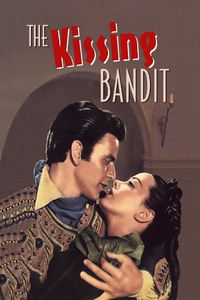
    (On Cable TV, September 2020) Movie history is not kind to The Kissing Bandit: It’s recognized by Wikipedia as “one of the least successful musicals in MGM history,” and “an acknowledged low-point in the careers of Frank Sinatra and Kathryn Grayson.” Is it such a terrible film, though? Of course not. While almost obscure these days, it’s quite entertaining to watch if you’re a fan of Technicolor MGM musical. Gorgeously shot against California mountains with very colourful costumes, the film clearly doesn’t take itself too seriously. The premise alone does a lot of mileage out of blending Robin Hood with Zorro as a Boston-educated young man comes back to 19th-century California to take over his father’s inn, only to discover that he’s expected to step into his father’s true occupation: leader of a masked gang, otherwise known as “the Kissing Bandit” for his habit of, well, kissing female victims. That premise wouldn’t fly today for obvious reasons, but even then—the film seems determined to minimize any unpleasant connotations this may have: our hero spends nearly all of the film shying away from any kissing, and the film spares no means (opening titles joke, comic sound effects, overacting) to let us know that this is a big broad comedy and nothing bad is ever going to happen. A young Sinatra with relatively long hair does well in the lead role, while Grayson is simply lovely as the governor’s daughter. Still, I’m burying the lead here because the single best reason to watch the film as far as I’m concerned is a single number toward the end of the film that has two of my biggest MGM crushes, Ann Miller and Cyd Charisse, in billowing dresses dancing a number with none other than Ricardo Montalban—whew! Let’s not argue that The Kissing Bandit is a great film—it has trouble with tone, and the rather promising opening act somehow doesn’t quite lead to a satisfying middle before the film picks up again toward the end. But it’s fun, funny and offers some great Hollywood stars doing some singing and dancing. Its relative obscurity may even mean that even fans of the era haven’t seen it yet.
  • Two Weeks in Another Town (1962)

    Two Weeks in Another Town (1962)

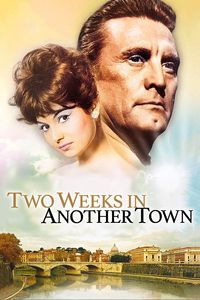
    (On Cable TV, April 2020) If you want to see the results of the Hollywood-on-the-Tiber era, during which Hollywood studios headed to Rome’s Cinecittà in order to take advantage of lower production costs and a studio built by Mussolini, then watch any of the dozen sword-and-sandal epic of the era. If you want a film about that filmmaking era, however, there’s Two Weeks in Another Town to bring back, a decade later, many of the main creative forces behind The Bad and the Beautiful in a thematic follow-up examining how Hollywood stars lived in their little Roman bubble far away from California. There are differences, obviously—Two Weeks in Another Town is in colour, and not quite as purely entertaining in its examination of Hollywood. But it does star Kirk Douglas as a washed-up actor trying to find a new place for himself in the movie industry, and a behind-the-scenes fictionalization of a difficult film shoot. Douglas is surrounded by notables such as Cyd Charisse (who’s not given enough to do), Edward G. Robinson (as a director at the end of his rope), and George Hamilton hilariously cast as a brooding artiste-type actor. While the film is interesting, it also has plenty of misplaced cues and darker themes that ensure that it’s not a feel-good film despite its hopeful ending. Studio meddling is apparently to blame for not delivering the core vision, but even in its adulterated form, the film features themes of suicide, professional uselessness, jealousy and isolation—all of which clash with the Dolce Italia atmosphere occasionally showcased. It’s a shame that some terrible rear-projection work takes away some of the late-film scene’s emotional effectiveness. Let’s just say that Two Weeks in Another Town gets about three-quarter of the way there—it’s interesting to give us a glimpse at an episode of Hollywood history, but not as great as it could have been had it figured out what it wanted to say and found a more disciplined way of telling it.

    (Second Viewing, On Cable TV, June 2021) The “Hollywood on the Tiber” era is one of the most interesting episodes in film history – Hollywood going to Rome in order to take advantage of fiscal incentives and Cinecitta, a top-notch studio built by Mussolini as a propaganda instrument. Hence the slew of swords-and-sandals films of the early 1960s and the numerous American films somehow set in Rome in the 1960s. Two Weeks in Another Town is one of the few productions of that era to be about itself, as our troubled protagonist (Kirk Douglas, reliably fascinating as always) gets a new chance to help a friend complete a Hollywood production shooting in Rome. There are glimpses at moviemaking, dramatic situations alluding to the reality of how movies were made at the time, and characters almost entirely portraying a fictional film’s cast and crew. The rather good cast also helps, what with Douglas playing a recovering alcoholic former star actor, Cyd Charisse as his ex-wife, a young and trim George Hamilton as a rising actor, and Edward G. Robinson as an aging director. On paper, there are plenty of reasons why Two Weeks in Another Town shouldn’t work, starting with the lead character: Who should care about a former movie star putting back together his life after alcoholism? Who should care about Charisse’s character when she barely has any dialogue? The film was apparently cut short by fifteen minutes by the studio, and those seams are more blatant when you start looking at the dramatic structure of the film. But, fortunately, there’s quite a bit more to it – the focus on filmmaking is strong enough (similarities with The Bad and Beautiful are all over the place, from its theme to a shared team of creative leads) and the glimpse at the Hollywood on the Tiber era is frequently charming enough to create a bit of longing for what it must have been at the time. It’s also hard to go wrong with Douglas in the middle of it all – Two Weeks in Another Town probably wouldn’t have worked with another actor.

  • It’s Always Fair Weather (1955)

    It’s Always Fair Weather (1955)

    (On Cable TV, April 2020) A very strong selling point for It’s Always Fair Weather is that it reunites a good number of people who worked on Singin’ in the Rain: Director Stanley Donen, choreographer-star Gene Kelly, dancer-actress Cyd Charisse, and so on—this was, after all, one of the “Freed Unit” musicals handled with impeccable craftsmanship by people who knew what they were doing. The lineage from Singin’ in the Rain to The Band Wagon to It’s Always Fair Weather is not only obvious—it’s playful and very much self-aware. There is a lot to like here: Many distinctive musical numbers (trashcan tap-dancing, roller-skate tap sequence, boxing-ring serenade), innovative filmmaking (decade-passing montage, triple-split screen), some cultural commentary (poking at the advertising culture of TV, with a live-confession climax that must have felt far more innovative back then), clever musical touches (such as the brilliant use of Blue Danube as an internal musical number) and a far more wistful tone than you’d expect from a 1950s movie musical. Plus, well, there’s Cyd Charisse—her green dress is wonderful, her first long scene in a taxi is a delight, and those are only two of the reasons why she gets here one of her most substantial roles—singing, dancing, comedy and romance, almost as much as in Silk Stockings. It’s not exactly perfect—the missed opportunity to make this a sequel to On the Town still rankles—but sometimes, even its flaws are endearing. The wolf-whistling bit, for instance, is awful by today’s standards, but it’s so dated, so overdone (and kind of cute) that it becomes hilarious. The 1950s were a very strong decade for musicals, and the production history of It’s Always Fair Weather suggests that this was the beginning of the end of an era at MGM, with slashed budgets and less interest in the result. No matter—I’m ranking this film high on my list of top 1950s musicals, and if it signals the end of an incredible streak, then it’s a pretty high note on which to go out.

  • Party Girl (1958)

    Party Girl (1958)

    (On Cable TV, March 2020) There’s a truly fascinating mix of ingredients in Party Girl: Cyd Charisse with a meaty dramatic role (her last contract role for MGM—indeed, one of the last contract roles in the entire studio system), director Nicholas Ray bringing his usual set of skills to a rather conventional story; Lee J. Cobb as another mobster; and Robert Taylor in a noticeably more dramatic role than usual. Some musical numbers, a few Prohibition-era plot points inspired by real life, expensive colour cinematography, expansive sets, and a plotline that gleefully mixes organized crime, barely-repressed prostitution, crooked lawyers and nightclub showbiz. By all rights, this should be quite a movie—alas, Party Girl merely settles for being just fine. It’s certainly watchable, and Charisse gets one of her last big-budget roles here—but most of the time, it fails to meet expectations as more than a standard mob-nightclub riff. Ray’s direction is competent, but fans of his deeper films may find something missing here. Maybe there’s too much going on; maybe it’s just not made of strong-enough writing. Maybe the actors were just a bit past their prime—no matter why, Party Girl is entertaining without being as memorable as it should be.

    (On Cable TV, June 2021) Frankly, I expected more of a gangster musical comedy featuring Cyd Charisse, director Nicholas Ray and a plot that brings together a fusion of chorus girls dance sequence and mobster drama. But Party Girl does not feel quite like a musical (too few musical sequences), nor quite a noir (there’s a happy ending), not quite a romance (not showing much heat between lead Robert Taylor and the notoriously restrained Charisse) and not quite a comedy (viz the criminal element not played for laughs). It is occasionally well directed and photographed in impressive colour, but somehow the elements don’t quite mix well. There’s probably an issue in Party Girl coming from the late-1950s, at a time of creative exhaustion by the studios (as per the film’s rote musical sequence, aware that the musical was fading away but not quite knowing what to do instead) but also an increasingly unworkable production code that couldn’t allow filmmakers to go where the story needed to go creatively. It’s certainly watchable, but also disappointing in the way it doesn’t fully use the material at its disposal. In many ways, Party Girl is more interesting as a last gasp of the MGM studio system (this was Charisse’s last film under contract and the next-to-last film for Taylor’s contract – they were the last two stars in the MGM firmament) than by itself.

  • The Silencers (1966)

    The Silencers (1966)

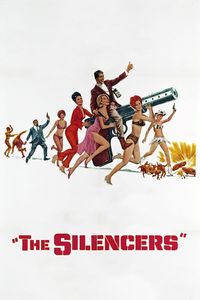
    (On Cable TV, October 2019) No doubt about it: The Silencers is a trip through time. First in the Matt Helm series of films made to lampoon the Bond series and featuring no less than Dean Martin, it’s like an authentic 1960s version of what Austin Powers was going for. Not as farcical, but certainly playing up the most ridiculous elements of the Bond formula: the women, the gadgets, the women, the lavish lifestyle, the women, the ridiculous villains and, of course, the women. (“NOT FOR CHILDREN,” shouts the poster after stating, “Girls, Gags and Gadgets: The Best Spy Thriller of Nineteen Sexty-Sex.”  But don’t worry—it’s tame by today’s standards.)  Rat-packer Martin is near-perfect as the suave womanizing agent Helm, whose conquests multiply throughout the movie. The women all look great, although classic Hollywood fans will be overjoyed to see the great Cyd Charisse strut her stuff in two dance sequences—her legs still go up to there, and she looks fantastic with longer hair. Don’t pay any attention to the plot, though: It’s all familiar plot devices meant to string the gags in the correct order, including a car fully equipped with a driver-accessible minibar and switch-activated privacy drapes for, well, whatever spies do in this kind of movie. Alas, the villain is pointlessly stereotyped along Fu-Manchu lines. Still, The Silencers is a big broad caricature, fully capturing a kind of spoof that would later be re-imitated. I watched it on a whim, attracted by the casting of Charisse, but ended up liking it quite a bit.

    (Second Viewing, On Cable TV, June 2021) I thought I’d have another look at The Silencers after only a few months… if only to verify that my wild memory of the film wasn’t an invention. It wasn’t. Revisiting suave Bond-like secret agents in a hyperbolic fashion, this film stars Dean Martin as (what else?) a top-notch special operative who serially romances a succession of beautiful women (for late-1960s definitions of “beautiful” – despite Stella Stevens doing her best as a redhead, contemporary viewers may be more intrigued by Daliah Lavi as the bad girl with the black-and-white hairdo). If you see nothing else, simply watch the first fifteen minutes, which begins with three successive dance/stripping routines by sultry performers (the third being none other than Cyd Charisse), followed by an introduction to the protagonist at home, surrounded by fancy gadgets and bedroom partners. It’s wild enough that Austin Powers fans will feel at home. The weirdness doesn’t stop after that, what with Martin singing some of his standards at the drop of a hat (even tuning in the car radio away from Sinatra to his own song), and the villain being a rotund white guy made up to look Chinese. It all leads (as it should) to a villain’s lair confrontation. Clearly, The Silencers doesn’t take anything seriously and neither should you: it’s intended as a spoof of 1960s Bond movies and if it works despite the obvious sexism and racism, it’s largely because of Martin’s charm and the excessive nature of the gags. When the protagonist (who became a fashion photographer in retirement) daydreams about the girls of his photoshoots and the film briefly pauses to allow them to prance a little on screen, its unabashedly retrograde nature almost becomes cute. Much of the middle section of the film can’t quite measure up to the wild introduction or the cranked-up final act, but the result is not without distinction. Keep watching until the end of the credits, if only to see what’s been identified as the first post-credit comic sequence in the history of movies. (Although be aware – weirdly enough, the version of The Silencers shown on TCM apparently does not include that post-credit sequence, even if it’s well-documented online.)

  • Silk Stockings (1957)

    Silk Stockings (1957)

    (On Cable TV, March 2019) Sadly, I’m counting down the last few Freed-unit MGM musicals on my list—I can see why they were hailed as the best in the business, and there aren’t that many left for me to watch. I would expect a downward quality trend in getting to the less famous movies, but Silk Stockings is a strong entry in the musical corpus. It’s a decent musical adaptation of 1939’s Ninotchka, with Cyd Charisse stepping into the Garbo role in a movie at the measure of her legs—her solo number “Satin and Silk” is both funny and sexy, within a role that takes advantage of both her dancing abilities as well as her ice-queen acting range. The film has Fred Astaire as a movie executive trying to put together a project in Paris, which requires convincing Russian artists to work for the capitalistic west. Charisse plays a humourless Soviet operative gradually seduced by the leading man and Paris’s considerable attractions. The West-versus-East element of the original 1939 film plays far better in the middle of the Cold War, and this mid-1950s film also captures other obsessions of the era—most notably the decade’s obsession in distinguishing movies from TV through colour cinematography, widescreen framing and “Stereophonic Sound.” (It’s, by far, my favourite number of the film despite a dodgy cadence.)  Another highlight is “Red Blues,” as the gentle poking at Soviet rigidity finally makes its way over the Iron Curtain. There’s plenty to like in the acting, as long as you accept Astaire once again being in Paris with a much younger partner (as in the same year’s Funny Face)—if it helps stomach the 22-year age difference between them, keep in mind that few actresses, no matter their age, could keep up with Astaire’s dancing. This being said, Astaire is up to his usual very high standards (he keeps the best for last with an iconic final “The Ritz Roll and Rock”), but Charisse has the tougher role as the rigid accented Nina, slowly transforming over the course of the film. Their duet is quite good as well, perhaps echoing their comfort together after working on The Band Wagon four years earlier. Peter Lorre also has a funny small role. While Hollywood history is rife with disastrous musical remakes of earlier works, this certainly isn’t the case with Silk Stockings. Much like the quasi-contemporary High Society, it takes a good film and delivers something equally good in a slightly different way. It’s one of the essential musicals of the 1950s.

  • The Band Wagon (1953)

    The Band Wagon (1953)

    (On Cable TV, February 2019) As a seasoned cinephile with thousands of reviews filed on this very web site, I’m far too jaded to start saying things such as “an instant personal favourite!” … but The Band Wagon is something different. Sometimes billed as “everyone’s second-favourite movie musical after Singin’ in the Rain,” it lives up to the hype: filled with striking numbers, bolstered by a cast headlined by Fred Astaire and Cyd Charisse, directed by Vincente Minnelli and produced by Arthur Freed, this is as good and as fun as musicals ever got. Astaire anchors the film in a role that smirks at his own personal situation at the time—coming out of retirement to play an entertainer looking for a comeback picture. Opposite him is Charisse, and romantic dance duets don’t get any better than their “Dancing in the Dark” with two of the greatest-of-all-time dancers playing together. But that’s a rare serious/romantic moment in an otherwise comedy-filled picture. “That’s Entertainment” is a pure earworm classic with plenty of sight gags, while “Triplets” is a darkly funny number that will surprise a few and “Shine on Your Shoes” gets Astaire dancing up a solo storm. Still, my favourite number has to be “Girl Hunt Ballet” which mixes two of my favourite movie genres—musicals and film noir—into an incredible, consciously over-the-top result. The theatrical setting of the story (in which a Broadway troupe rallies together to rescue a failing show) allows for plenty of show-business in-jokes and commentary, in keeping with the best musicals of the time. I’m not so happy at the 23-year age difference between Astaire and Charisse, but which fifty-something actor/dancer could hope to keep up with a talent as singular as Astaire? It’s a small blemish on an otherwise incredibly compelling picture—I’ve already watched The Band Wagon twice before writing this review, and—indeed—I’m placing it right under Singin’ in the Rain as one of my favourite musicals.

  • That’s Entertainment! III (1994)

    That’s Entertainment! III (1994)

    (On Cable TV, March 2019) Third instalment in the now-classic anthology series, That’s Entertainment! III is farther away from its 1950ish source material than its predecessors and consequently much less reverential. It innovates by featuring behind-the-scenes footage, cut numbers (some of them better than those that replaced them), a focus on lesser-known stars (such as my favourites Ann Miller and Cyd Charisse—who looks amazing in her sixties as she presents a segment of the film) and some attention to non-white performers (with Lena Horne even acknowledging that Hollywood wasn’t ready for them). Under this new focus, there are plenty of things to wow about: Eleanor Powell’s dancing remains as astonishing at the techniques used to film it, a wonderful ditty sung by Horne in a bathtub, and a split-screen comparison of a Fred Astaire routine performed several weeks apart shows the amazing control that he had over his performances. On the other hand, I’m not a big fan of the stupidly racist Judy Garland bit “I’m an Indian Too,” which should have stayed buried in the vaults. As with the other films of the series, That’s Entertainment! III can be revisited at several stages in a classic movie cinephile’s evolution: As an introduction to some terrific movies and performers, as an exploration of a few familiar favourites, or as delightful complements to one’s existing knowledge of the era. No matter how you choose to see it, it’s a great anthology movie, and it’s well-worth watching alongside the others.