Dana Andrews

  • The Frozen Dead (1966)

    (On Cable TV, July 2022) The corpus of zombie-Nazi movies has at least one more film than I expected, and The Frozen Dead does have the added interest of coming from the mid-1960s, well before Romero defined the zombie genre. It features Dana Andrews (in a late-career performance prefiguring what other Classic Hollywood stars would do for a paycheque in the 1970s) as a mad Nazi scientist—as if there was any other kind—working twenty years after the war to resurrect 1,500 frozen Nazis to revive the Third Reich. (Our history shows that it would have been far more efficient for him to create a hard-right cable TV news channel, but I digress.)  Much of The Frozen Dead is cheap and laughable—the sets are about as convincing as a high school play, the contrivances run sky-high and the writing is clunky. But there are some moments of poignancy as well—most of them focused on an innocent young girl who gets decapitated but kept alive, and provides the film with a surprisingly effective closing tag. Still, that surprisingly effective element seems overwrought for such a silly film—and the rest of it is close to a snooze. With writer-director-producer Herbert J. Leder clearly operating from an unbuilt trope, the film doesn’t quite seem to know what to do with Nazi zombies—it has a few lulls, especially when it doesn’t seem to want to go any further than the elements strictly essential to the plot. Keep your expectations low: The Frozen Dead remains a disappointment, even if it has a few things going for it.

  • I Want You (1951)

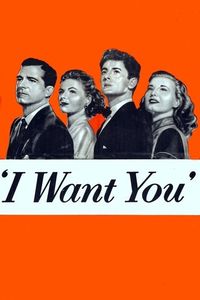
    I Want You (1951)

    (On Cable TV, December 2021) There’s a clever double sense to I Want You’s title that hints at its dual nature — an expression of romance, of course, but also an exhortation to enlist: “I want you for U.S. Army,” says Uncle Sam. And that, in a nutshell, is what the film is about — small-town romantic drama as the Korean War heats up and American men are once again asked to go back into combat despite knowing exactly what this means this time around. This film is very much of its time, and that’s perhaps what’s most interesting about it: it’s a slice-of-life dramatization of what must have been an overwhelming topic of conversation across American circa 1950 and the film’s decidedly low-key approach makes it feel more convincing than an overblown melodramatic approach. Director Mark Robson can depend on decent performers (Dana Andrews and Dorothy McGuire in the lead) to get the film’s rather delicate drama across. It’s probably not the kind of film that you want to sit down for thrills and laughs, but it’s a remarkable film for its own specific reasons — capturing America at a specific time, not a dramatic one but still a pivotal one.

  • While the City Sleeps (1956)

    While the City Sleeps (1956)

    (On Cable TV, December 2020) The more I discover lesser-known movies from the 1950s, the more I realize that, despite the conformist fairytale that many would like to make you believe about the decade, it was filled with social criticism, technological doubts and satires about the post-WW2 order. While the City Sleeps benefits from the outsider’s gaze of director Fritz Lang: it is at its core a crime drama that becomes an excuse to examine the growing power of media in American society. When a media magnate dies as a serial killer terrifies the city, the directors of the three divisions of his empire (newswire, newspaper and television) are encouraged to find the killer first in order to secure a prestigious new job. As an excuse to study the tensions between personal gain and news ethics, While the City Sleeps exploits its plotting for all it’s worth: the directors scheme and draw audacious plans that directly put others in danger in an attempt to seize the headlines (and accessorily catch the killer). A great cast complements the story – Dana Andrews at the protagonist, a suitably slimy Vincent Price as an underestimated heir, George Sanders as one of the competing directors and a great-looking Ida Lupino as a clever writer. It all amounts to an absorbing film, clearly going beyond film-noir clichés to attempt an ambitious study of how personal greed can corrupt institutions meant to be trusted by the public. It’s suitably cynical at a high level, but can rely on a likable protagonist to anchor the film. Lang’s Hollywood career was not perfect, but I don’t recall truly disliking any of his films during that period. While the City Sleeps is no exception.

  • Where the Sidewalk Ends (1950)

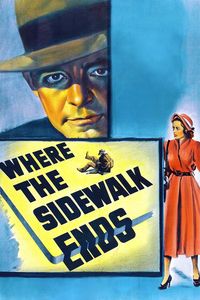
    Where the Sidewalk Ends (1950)

    (On Cable TV, October 2020) I’m always game for an Otto Preminger movie, and while Where the Sidewalk Ends doesn’t have the cachet of some of his better-known productions, it’s a perfectly fine example of a crooked-cop film noir. Dana Andrews plays a cop with a bit of a problem roughing up suspects, but things quickly turn ugly for him when a routine interrogation becomes manslaughter—covering up his traces only endangers the father of his newest flame, and much of the film consists in following him as he sees his scheme unravel and his conscience attempts one last stand. Cleanly directed, competently acted and almost perfectly following the classical noir atmosphere, this is an easy to watch, tightly-constructed film that tightens up the suspense and delivers a satisfying finale. Gene Tierney plays the love interest that ends up being the protagonist’s moral beacon, and Ruth Donnely has a small but very effective role as a bantering café owner. While twenty-first century viewers would frown at the idea of a rough cop being the hero, twenty-first century viewers would also expect his transgressions to be more extreme—in that light, there’s a curiously refreshing lower-stake approach to Where the Sidewalk Ends that almost makes it comforting viewing even when it gets into the gritty details of cop work in New York City.

  • Beyond a Reasonable Doubt (1956)

    Beyond a Reasonable Doubt (1956)

    (On Cable TV, April 2020) Director Fritz Lang ended his American career with late noir Beyond a Reasonable Doubt, and it’s not a bad way to go out. It does have a lot of things I like—a newspaper setting, an author as a protagonist (played by Dana Andrews), a cynical view of humanity, and a corker of a final twist. The high-concept premise (framing oneself for a murder in order to expose the insanity of capital punishment) initially looks like the dumbest possible idea anyone could ever have, but it’s somewhat redeemed by a few more twists and turns along the way. It’s definitely noir, and that ending certainly highlights it. If I keep talking about the final twist, well, there’s a reason for it: it’s contrived, but it makes Beyond a Reasonable Doubt go from interesting to spectacular in only a few beats, and then wraps it all up after a mere 80 minutes.