Desi Arnaz

  • Being the Ricardos (2021)

    (Amazon Streaming, April 2022) Nobody ever sees the same movie. No, I’m not questioning the permanence of films as objects or artifacts – no spooky Mandela Effect theories from me. But even in considering unchangeable spools of celluloid or digital files with certified checksums, no viewer brings the exact same set of knowledge, assumptions and expectations to any viewing of any film. Even a second viewing can be a radically different experience. Maybe you’ve seen Being the Ricardos without any knowledge of Lucille Ball, Desi Arnaz and I Love Lucy. Or maybe, like me, you have approached it with a near-encyclopedic knowledge of 1940s Hollywood after the full eight-hour TCM podcast on Ball’s life. I don’t seriously believe that too much knowledge can be a bad thing, but it certainly colours the viewing experience in a different way – both appreciative and irritated. Writer-director Aaron Sorkin goes for a compressed biographical snapshot here – picking a specific date in the life of the Ball/Arnaz couple, and turbocharging it with as much drama as could be plausibly inserted in the specific time-frame, even if a few years have to be collapsed in order to do so. We find ourselves on the set of I Love Lucy during a particularly eventful week in which Ball is accused of Communist activities, in which she has to confront Arnaz about his infidelities, and in which she must announce to everyone that she’s pregnant at a time when such things were unmentionable on TV. A rather weak framing device (by actors pretending they’re the real older people we follow in flashbacks) provides historical material and context. Let’s get something out of the way first: Neither Nicole Kidman nor Javier Bardem are much of a match for the real-life Lucille ball or Desi Arnaz: They can certainly act, but the film is not going for close physical resemblance (which is also true for Nina Arianda and J. K. Simmons in supporting roles). Also, Being the Ricardos is definitely, almost obstinately, determined not to make its audience laugh. Aside from brief black-and-white staging of a few of the show’s moments, it doesn’t really try to convey Ball’s gift for comedy as much as her keen understanding of how comedy works. A justifiable choice if you assume that people are familiar with the show (still funny in reruns seventy years later!) or that it doesn’t want to expose Kidman to the task of being as funny as Ball, but it’s still an eyebrow raiser. Sorkin would rather focus on the drama of being Lucille Ball when the cameras aren’t rolling – her professionalism in analyzing what’s funny or not, her sometimes-curt manners, and her complex relationship with Arnaz even through his infidelities. (It’s a measure of the film’s unorthodox touch that it resists the easy impulse of making Arnaz the out-and-out villain for cheating on her – although Bardem’s considerable charisma has a lot to do with that.)  As a big Classic Hollywood buff, I was very impressed by much of the period detail – all the way to having someone play Ann Miller’s legs (and namechecking her on the set of Too Many Girls). On the other hand, I was also able to spot a few details that were strikingly out of place (that anachronistic Stromboli poster bothered me a lot, even if I can guess the thematic reason for showing it). Still, compared to many “snapshot biographies,” Being the Ricardos gets the basics right, shoehorns its references rather gracefully, and does mix its elements well. Sorkin’s dialogue isn’t quite as showy as usual, and I’m always up for more Alia Shawkat. I would have changed a few elements of the climax, but I’m generally happy at how it all turned out despite a few unusual choices, and how much of a rather good homage it is to the Ball/Arnaz couple. But my reading of the film is likely to be very different from yours.

  • The Long, Long Trailer (1954)

    The Long, Long Trailer (1954)

    (On Cable TV, January 2021) Anyone would be forgiven for thinking that The Long, Long Trailer is an “I Love Lucy” movie spinoff—after all, it does star both Lucille Ball and Desi Arnaz as a married couple getting into all sorts of comic situations as they travel around the country with a travel trailer, and it was released ran in the middle of their TV show’s run. But as close as it may appear, it’s its own separate thing—a way for MGM to showcase Ball and Arnaz in colour against picturesque American tourist destinations. Ball being Ball, the physical comedy is top-notch even when it’s predictable—the sequence in which she’s trying to cook inside a movie trailer was inevitable but still a lot of fun to watch. As far as the narrative goes, The Long, Long Trailer often feels like a collection of episodes inspired by a writer’s experience in the 1950s RV lifestyle, from the eye-watering complications of the initial purchase to the sense of aimlessness that not having a fixed address can create. (Indeed, even circa 2020, I can testify that one retirement course recommendation remains “Don’t sell your house to buy an RV!”)  The narrative cohesion is provided by the marital strife between the leads, culminating in a quick conclusion (made longer by a framing device) that perfunctorily ends the film on a happy but not necessarily believable note, as all of the tension factors are still present. Still, the fun of The Long, Long Trailer remains—filmed in colour (although not in bright Technicolor), it offers a look at a specific recreational form of American touring as of the mid-1950s and the performances of the leads are good enough to capture what was special about them.

  • Too Many Girls (1940)

    Too Many Girls (1940)

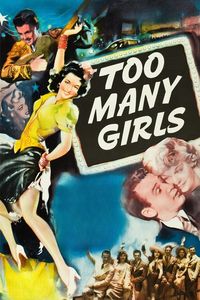
    (On Cable TV, March 2020) In Hollywood history, Too Many Girls usually gets a footnote mention as “the movie where Lucille Ball met Desi Arnaz,” leading to their long and fruitful marriage/partnership. Some commentators often feel compelled to comment in the same breath on the film itself being not good. Well, phooey to that—I’m here to tell you that Too Many Girls is a perfectly entertaining blend of college comedy, implied naughtiness and some football thrown in for good measure—plus the excellent Ann Miller tap-dancing. The premise is something that could have become a splendid 1980s sex comedy: As a millionaire’s daughter (played by a good-but-not-yet-great Lucille Ball) decides to attend a college far in the west, the rich man hires four strapping lads to act as bodyguards unbeknownst to her. Complications ensure when the four young men turn around the winning record of the college’s football team and one of them falls in love with the heiress. While an adaptation of a Broadway Musical, Too Many Girls is curiously forgettable when it comes to the songs and dances. Also not present enough is Ann Miller—while she’s there and performs, she’s clearly in an early-ish supporting role with little opportunity to shine in the spotlight. OK, all right—Too Many Girls is, at best, an average musical of the era for low-budgeted RKO: watchable, even amusing, but not all that memorable. It would be far less fondly remembered (and for that, largely for Ann Miller’s filmography) if Lucy and Desi hadn’t met on set. [April 2022: Being the Ricardos even features a scene meant to recreate the film—complete with what’s supposed to be Ann Miller’s legs!]

    (Second viewing, On Cable TV, March 2021) As a silly college comedy (yup, they had those in the early 1940s!), Too Many Girls is perhaps more interesting for its setting than its content, although it does have an unusual spark to its premise. Everything begins as four ace football players are convinced (somehow, by a billionaire) to let go of a bright college career in order to act as bodyguards/chaperones to his rebellious daughter going to study in the American south-west. What makes the film a bit unusual is the location of the college, and its refusal to stick to Ivy-league atmosphere: “Pottawatomie College” in New Mexico is proudly set in a desert, and the Mexican influence is felt throughout: Too Many Girls is colourful despite being in black-and-white, and Ann Miller plays a character meant to be of Hispanic origins (which mostly consists in letting her curls run wild and calling her “Pepe”) – her signing segments are predictably some of the highlights of the film. Many musical set-pieces take the form of vigorously choreographed crowd dancing, which is not a bad thing at all. The cast does have its attraction as well – other than Miller, who really plays a supporting character, there’s Lucille Ball as the supposedly rebellious daughter (she’s mildly energetic at best), the very likable Desi Arnaz as one of the bodyguards (not the one who romances her, but no matter – in real life, they married two months after the film was released!) Perhaps overly slavish to the original Broadway musical, the plotting sort of loses its way midway through and the ending doesn’t quite satisfy. Too Many Girls is a pleasant-enough time, but there are many ways in which it could have been better: Shooting in colour, letting go of Broadway in order to focus on more cinematic qualities and working on the film’s last half would have been obvious starting points. Still, it’s fun enough, the scenery is a change of pace and the parallels with other, more modern campus comedies are intriguing enough.