Dolores Del Rio

  • Bird of Paradise (1932)

    (On Cable TV, June 2022) Looking for non-white representativeness in classic Hollywood history is always a double-edged sword. Sure, you may find it… but at the cost of seeing tired clichés and offensive stereotypes. So it is that while Bird of Paradise does feature King Vidor (one of the best and most humane directors of the 1920s–1930s – and also the director of the black-cast Hallelujah), the magnificent Dolores del Rio, and a story entirely set on a tropical island… the price to pay for it is a story that seemingly indulges in the worst clichés of exotic noble savages, from casual nudity to volcanic sacrifices. Joel McCrea and Lon Chaney Jr. also feature in the film, with Busby Berkeley contributing dance choreography – so there are clearly some production values to go around in the film’s recreation of the South Pacific. Still, Bird of Paradise isn’t supposed to be a fun romp: It doesn’t end well (perhaps due to the interracial component of the film’s central romance), and the storm of racial clichés can be hard to take seriously. Still, still – the pre-Code nature of the film does soften a few edges, or more accurately adds more to the film than if it had been completed even three years later. Del Rio is a timeless beauty, and while Vidor doesn’t have much to do here to play up his usual themes (it was reportedly very much work-for-hire), he delivers romantic sequences of unusually good quality. As with many similar films, Bird of Paradise is a mixed bag: sure, there’s some good stuff here, but are you willing to watch the rest of it?

  • Journey Into Fear (1943)

    Journey Into Fear (1943)

    (On Cable TV, March 2020) There’s something slightly insane about those WW2 thrillers shot and released as the war was going on—trying to comment on topical events despite the long length of film production (which was admittedly shorter then than now) and the possibility that real-world events would overtake them. And that’s not even mentioning the biggest uncertainty of all: not knowing how the war would end. Usually, screenwriters went around this problem by focusing on personal adventures, slightly blurring the background, cranking up the propaganda and hoping for the best. Journey into Fear is one of those instant-WW2 thrillers, but making life even harder on itself by adapting a 1940 novel. (Famously, the film’s protagonist has to escape to another country than in the book because France had been overrun by the Nazis in-between.) The result is a claustrophobic thriller about escaping the Nazis in one of the less overexposed fronts of WW2: Turkey. Journey into Fear is short (68 minutes!) and to the point, with a rather good action climax after a film that largely takes place aboard a passenger ship filled with tension. Orson Welles shows up on-screen and seems to have fun as a Turkish general, but the film’s messy production history holds that Welles was also involved as screenwriter, director and producer—effectively making this an unofficial early-Welles picture. Joseph Cotten and the beautiful Dolores Del Río also co-star to good effect. While not a great movie, Journey into Fear remains an effective thriller, and to think it was produced as the war went or, with no less a mercurial presence as Welles, is almost mind-boggling.

  • Flying Down to Rio (1933)

    Flying Down to Rio (1933)

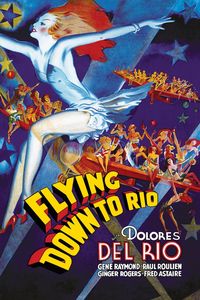
    (On Cable TV, February 2020) Everyone’s got to start somewhere, but for any viewer since 1934 it’s still a bit strange to see Fred Astaire in a supporting role in his first feature film Flying Down to Rio. It wasn’t his first feature film, but only by a technicality: A month earlier, Astaire showed up on screens for a single scene (playing himself) in Dancing Lady. Considering that there wasn’t anything to play in the earlier film, you can consider his supporting character role in Flying Down to Rio to be his first movie role as an actor—and more significantly, the first of his legendary pairings with Ginger Rogers. Any Astaire fan can clearly see that Hollywood didn’t know what to do with him yet—being relegated to a romantic subplot is something, but the way the camera captures his dancing (full frame but not full body, often obscured by others and relegated to the background, clearly not commanding the screen like he would in later films) is somewhat atypical for him. Still, Flying Down to Rio’s breezy fun still makes up for the less-than-reverent place given to Astaire: as a slightly naughty Pre-Code musical comedy that can escape to the exotic atmosphere of Rio de Janeiro, the film often feels significantly more risqué than the rest of Astaire’s career—the “Just a Gigolo” number is amusing, and his later films would most definitely not feature a dark-haired beauty lead actress in a two-piece bikini. One more thing distinguishes this early effort from Astaire’s later romantic-cad persona—his character shows up as a fiancé rather than going through the persistent-suitor routine… and I count this as an improvement of sorts. Aside from Astaire, Flying Down to Rio has a few other assets: the lead couple’s romantic adventures are entertaining, lead actress Dolores Del Rio is underused, Etta Moren is lovely as “the colored singer” (this is a direct quote from the credits) and the film ends on a very high note with an early special-effects showcase featuring a line of dancers on planes flying high above Rio. Still, the film’s most convincing asset here remains Astaire, who makes the most out of a secondary role and clearly shows his chemistry with Rogers. No wonder that by the following year, The Gay Divorcee would launch a long series of classic Astaire films, with or without Rogers at his side.