Elke Sommer

  • Gli orrori del castello di Norimberga [Baron Blood] (1972)

    (In French, On Cable TV, April 2022) There’s not a while lot to say about the unremarkable Baron Blood. It has its points of interest: If you’re looking for Joseph Cotten’s late-career 1970s horror film (as most classic Hollywood stars seem to have one), then this it. If you can’t get enough of Elke Sommer for whatever reason (I find her rather dull), then this is your chance to see her screaming for minutes on end. If you’re tracking Italian horror director Mario Bava’s career, then this is unarguably one of his movies. But as far as what these people do when they work together, well, Baron Blood feels about as median-quality as possible. The story has one American young man accidentally resurrecting his murderous vampiric ancestor, and a castle acting as a very gothic setting for the ensuing mayhem. It’s directed by Bava with professional aplomb, but the result is more efficient than effective. In the end, it’s more fun to see Cotten cackling and Sommer running through the castle’s corridors than anything else. A film with very specific appeal, then – even I, as a fan of haunted castle stories, can’t quite bring myself to recommend it.
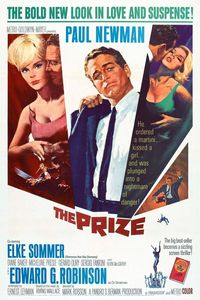
  • The Prize (1963)

    The Prize (1963)

    (On Cable TV, September 2020) Nothing, exactly nothing about The Prize makes any sense—least of all the plot, which is rather embarrassing for a narrative-driven thriller. The beginning sees an alcoholic, womanizing American author somehow winning the Nobel Prize for Literature (based on, what, a corpus of one novel?) The action begins after he flies into Stockholm to receive the prize, and meets the other winners. A lovely young Scandinavian (Elke Sommer, in an early role) is assigned to him as hostess, and his meetings with the other winners show an eclectic group of intellectuals. But as various strange events occur, we stumble onto a premise that only made sense at the height of the Cold War: a dastardly plan by the Soviets to replace the Nobel Prize winners with lookalikes so that the lookalikes can denounce the western world in their acceptance speeches and then “defect” to The Soviet Union. Trying to even pretend that this premise makes sense is tiresome, so let’s skip to the overall impression left by the film: it’s about as scattershot as its premise in blending comedy, young-punk protagonist, some danger from the spying team at work in Stockholm, Paul Newman in the lead role, Edward G. Robinson in one of his late-career performances, a scene set at a nudist convention, and many more idiosyncrasies than you’ll know what to make of. The film was a success upon release, but newer viewers are more likely to be perplexed by the ungainly blend of ill-fitting elements. At least Newman is quite likable, despite a character not necessarily written to be so. He’s almost enough to make us forget a plot that wouldn’t make sense even at the protagonist’s most drunken state.

  • Boy, Did I Get a Wrong Number! (1966)

    Boy, Did I Get a Wrong Number! (1966)

    (On TV, October 2019) There are movies that you must see merely because of their titles, and Boy, Did I Get a Wrong Number! certainly qualifies. Can anything measure up to the promises of the title? Well, maybe. In this case, we get Bob Hope as a middle-aged married man who accidentally gets his phone call connected (back in the time of operators who could mess up the cabling) to a runaway Hollywood bombshell desperate to stay away from the limelight. Many hijinks ensue, all the way to the police thinking he murdered the woman. It’s all complicated by the meddling of his maid, played as performance art by the irrepressible exploded-haired Phillis Diller. Boy, Did I Get a Wrong Number! is not what we’d call a refined or subtle comedy: The reactions are all exaggerated as if this was an extended sitcom episode, and the film barely makes an attempt to smooth in Hope’s usual one-liners or Diller’s over-the-top antics. Both of them easily outshine Elke Sommer, playing the bombshell and filmed as provocatively (in a bubble bath) as a 1960s film could get away with. The plotting is elementary, but the film strikes a chuckle every few minutes, and it’s amiable enough to be charming in its own way. (I’ve seen the film mentioned a few times as the “worst” of this-or-that category and that seems an exaggeration—perhaps the title was too imposing for those reviewers.)  All in all, Boy, Did I Get a Wrong Number! is a happy discovery—and it does live up to its magnificently silly title.