Gene Kelly

  • It’s Always Fair Weather (1955)

    It’s Always Fair Weather (1955)

    (On Cable TV, April 2020) A very strong selling point for It’s Always Fair Weather is that it reunites a good number of people who worked on Singin’ in the Rain: Director Stanley Donen, choreographer-star Gene Kelly, dancer-actress Cyd Charisse, and so on—this was, after all, one of the “Freed Unit” musicals handled with impeccable craftsmanship by people who knew what they were doing. The lineage from Singin’ in the Rain to The Band Wagon to It’s Always Fair Weather is not only obvious—it’s playful and very much self-aware. There is a lot to like here: Many distinctive musical numbers (trashcan tap-dancing, roller-skate tap sequence, boxing-ring serenade), innovative filmmaking (decade-passing montage, triple-split screen), some cultural commentary (poking at the advertising culture of TV, with a live-confession climax that must have felt far more innovative back then), clever musical touches (such as the brilliant use of Blue Danube as an internal musical number) and a far more wistful tone than you’d expect from a 1950s movie musical. Plus, well, there’s Cyd Charisse—her green dress is wonderful, her first long scene in a taxi is a delight, and those are only two of the reasons why she gets here one of her most substantial roles—singing, dancing, comedy and romance, almost as much as in Silk Stockings. It’s not exactly perfect—the missed opportunity to make this a sequel to On the Town still rankles—but sometimes, even its flaws are endearing. The wolf-whistling bit, for instance, is awful by today’s standards, but it’s so dated, so overdone (and kind of cute) that it becomes hilarious. The 1950s were a very strong decade for musicals, and the production history of It’s Always Fair Weather suggests that this was the beginning of the end of an era at MGM, with slashed budgets and less interest in the result. No matter—I’m ranking this film high on my list of top 1950s musicals, and if it signals the end of an incredible streak, then it’s a pretty high note on which to go out.
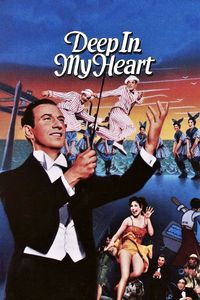
  • Deep in My Heart (1954)

    Deep in My Heart (1954)

    (On Cable TV, April 2020) Sigmund Romberg is largely forgotten these days, but once upon showbiz history, he was considered famous enough as a Broadway composer of successful operettas to warrant a full-length MGM musical about his life. Deep in My Heart, in assembling a jukebox of his most famous hits loosely arranged in-between fanciful sketches about the composer’s life, wasn’t even an outlier but the latest in a subgenre that tackled other composers’ work. (I have a specific fondness for Till the Clouds Roll By, but more for Lena Horne than Jerome Kern.) The advantage of a revue-style structure is that beyond the main biographical cast (featuring no less than José Ferrer, Merle Oberon, Walter Pidgeon and Paul Henreid), you can bring in very special guest stars in specific musical numbers. This is where Deep in My Heart may be most interesting, because the mid-1950s MGM roster was stacked with great bit performers. Here we get Gene Kelly in a fun vaudeville dancing duet with his brother Fred (Fred’s only screen credit despite an accomplished dancing career). We get Cyd Charisse (dubbed, but spectacular), Ann Miller looking terrific as the “It” girl, Ferrer dancing romantically with his then-new wife Rosemary Clooney, and a few other distinctive numbers as shows-within-the-show. Ferrer’s performance is occasionally terrific: at one point, he gets a breathless showcase with a one-man-show presentation of an upcoming show; at others, he speaks magnificent French dialogue. Alas, those individual performer highlights are really what Deep in my Heart is about—the film itself is fairly unremarkable and classical in matters of execution. Director Stanley Donen’s heart was obviously in the musical numbers more than the rest of the film, and who can fault him? Working with stars to deliver their standalone numbers ensures that the film is still worth a look today for fans of mid-century musicals.

  • Take Me Out to the Ball Game (1949)

    Take Me Out to the Ball Game (1949)

    (On Cable TV, March 2020) Part of the fun of watching Hollywood history is seeing talented performers getting paired up even when the match isn’t quite harmonious. Frank Sinatra—brilliant singer. Gene Kelly—terrific dancer. Both of them together? Well, you have to see Take Me Out to the Ball Game how they play together… and having Esther Williams as the female lead doesn’t hurt either. A prestige song-and-dance show from MGM (in Technicolour!), it blends its leads’ skills with America’s sport and the usual trappings of musical comedies. The highlight is the theme song, but there are a few good moments elsewhere too: Esther Williams inevitably dips into a pool at some point, and while director Busby Berkeley’s imprint on the film is faint (he only shot a small portion of it, and the rest was reportedly completed by Kelly and Stanley Donen), there are still traces of it in the finished product. On the other hand, there’s some weird stuff as well: the references to suicide and pedophilia in the middle of an upbeat wolf-whistling song are a bit off-putting to say the least. Also not quite as controlled for twenty-first century viewers: double standards in how a determined woman is portrayed compared to the equally persistent male characters. Ah well—this is from the late 1940s, after all. Still, a muddled average and no high peaks means that Take Me Out to the Ball Game suffers in comparison to other Sinatra/Kelly vehicles like On the Town and Anchors Aweigh. They can’t all be perfect. In this case, it still means we get Sinatra singing and Kelly dancing.

  • Seagulls Over Sorrento aka Crest of the Wave (1954)

    Seagulls Over Sorrento aka Crest of the Wave (1954)

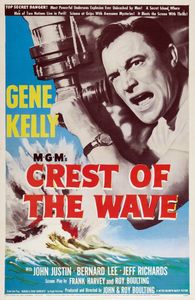
    (On Cable TV, March 2020) A plain description of Seagulls Over Sorrento sounds like a madlib gone weird: Here’s Gene Kelly playing a lieutenant in a techno-thriller set on a small Scottish Island about the development of better torpedoes in a black-and-white film adapted from a British play by an Australian writer. Um, okay? Part of this madness can be explained by the fact that MGM had to make movies in England during the 1950s as a way to spend funds that could not be repatriated home—and how the era’s filmmaking could compress an entire film’s production schedule in a few weeks in order to allow its stars to fly away to another project. This was even easier for a project like Seagulls Over Sorrento, which added only a few Hollywoodish enhancements to a stage-bound project. (Like many military movies, at least one character has to die in order for us to take this seriously.) Perhaps given the weirdness of the premise, the film had a weak box office upon release, and is a bit obscure today, especially when measured against Kelly’s other projects of the time. Still, Seagulls Over Sorrento is something all right—clearly not the kind of film that should be your first, second or third stop for either 1950s cinema or Gene Kelly’s filmography, but something like an intriguing find at the bottom of the barrel, fit to cause wonder and amusement as you explore how it came to be.

  • Xanadu (1980)

    Xanadu (1980)

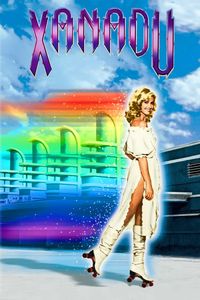
    (On TV, January 2020) There is an infamous place in movie history for Xanadu, often disregarded as one of the worst musicals of all time. That’s an exaggeration, but there’s no denying that Xanadu remains a strikingly weird experience to undergo. Updating a 1940s film plot to the disco era, this is an attempt to make a musical focused on roller-skates, disco and pinball machines. It stars no less an unlikely couple as Olivia Newton-John and legend Gene Kelly in his last feature-film role. (They do share a scene and a few dance moves.) The plot is near-incomprehensible for reasons best explained by a chaotic production process that left dangling a few narrative threads of earlier script drafts. The result is immediately recognizable at being from 1980 (plus or minus two years), far more dated than the earlier musicals that inspired it. The staging isn’t particularly inspired, but the music—wow, the music! Olivia Newton-John and her signature disco sound don’t do much for me, but the other half of the soundtrack is from Jeff Lynne’s Electric Light Orchestra, and those remain timeless songs. (Indeed, at least three of them made for the movie have gone on to become minor ELO hits.) There is something this close to delirium watching Gene Kelly in circa-1980 montages, trying out clothing and being subject to the blunt optical effects of the era. The film was cutting edge then and is now highly stylized in its use of disco visual references. Up to a certain level, Xanadu escapes mere considerations of being good or bad—it’s an experience, and I can now proudly say that I have seen it.

  • The Three Musketeers (1948)

    The Three Musketeers (1948)

    (On Cable TV, November 2019) There have been a lot of adaptations of Alexandre Dumas’ The Three Musketeers over the years, so the only way to talk about them is to highlight how they differ from one another. In the case of 1948’s version, the answer is simpler than we think: Gene Kelly. That’s it: Gene Kelly as d’Artagnan, meeting the three musketeers and fighting valiantly against Milady, Countess de Winter (Lana Turner!) for the honour of France. The casting highlights doesn’t stop there, what with Vincent Price as Richelieu and Angela Lansbury as Queen Anne. The swashbuckling is strong in this late-1940s MGM spectacle, and while director George Sidney said he drew inspiration from westerns in staging the sword-fighting cinematography, the presence of Kelly suggests that there’s quite a bit of dancing inspiration in there as well—and Kelly’s skills were uniquely well suited for a non-singing sword-fighting hero. The colour cinematography still pops out today, and the rest of the adventure is handled competently, although perhaps too sedately when not busy with action scenes. Remove the cast and the sword-fighting and the film becomes far more ordinary, but that’s the nature of all versions of The Three Musketeers: we’re there for the swords, the rest is just fancy wrapping. If you want the story, read the book.

  • Summer Stock (1950)

    Summer Stock (1950)

    (On Cable TV, September 2019) In the context of Judy Garland’s career, Summer Stock is often best known as her final MGM film and the one in which she inaugurated the tuxedo/fedora/nylons outfit that she would use as a trademark in her later years. But for those (such as myself) who don’t particularly like Garland, Summer Stock is best seen as solid MGM musical from the early 1950s, using the studio’s expertise to transform something fairly ordinary into a few remarkable set-pieces. Gene Kelly is the bigger draw here, as he plays a theatrical director who arrives with his troupe on a farm where he convinces the owner (Garland) that they will compensate for the imposition by doing chores while rehearsing their next show. Having found an excuse to blend the Broadway musical with a rural setting, Summer Stock quickly gets going in combining the two: One number has a red tractor as a centrepiece, while an anthology-worth piece has Gene Kelly dancing around with a newspaper and creaky boards. “Get Happy” would turn out to be Garland’s late-career standard number, but the film is bigger than her: The atmosphere is upbeat, the dance numbers are colourful and while the film is overshadowed by much-better musicals at around the same time (Singin’ in the Rain on one side, Easter Weekend on the other), it’s still a fun watch for any musical fan. This is Kelly and Garland doing what they do best, and their on-screen smiles are contagious.

  • Ziegfeld Follies (1945)

    Ziegfeld Follies (1945)

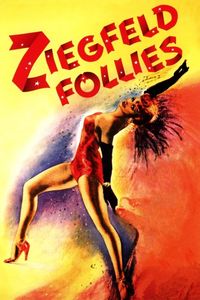
    (On Cable TV, August 2019) For fans of golden-age Hollywood musicals, it’s easy to get excited about Ziegfeld Follies from the get-go, as the names pile up the opening credits: Fred Astaire, Gene Kelly, Judy Garland, Cyd Charisse, Lena Horne, Lucille Ball in the same movie? Well, yes, but don’t expect a full narrative: As the opening number makes clear (featuring William Powell reprising his titular role in the Oscar-winning The Great Ziegfeld, looking down from paradise and wishing he could assemble another revue), this is a series of unconnected musical numbers and comic sketches featuring some of the era’s biggest stars. First number “Here’s to the Girls/Bring on the Wonderful Men” gets going with a bang, with Fred Astaire introducing Cyd Charisse leading to Lucille Ball in full grandiose Ziegfeld choreography, with a cute and very funny spoof from the deadpan Virginia O’Brien to wrap it up. The comedy numbers that follow have nearly all aged poorly—the comic style is broad, repetitive and laid on far too thick. The exception is the half-comedy, half-musical number “The Great Lady Has an Interview” in which a great-looking Judy Garland sings and charms her way through a satire of interviews—the number concludes with an extended comedy/dance/song tour de force from Garland. Still, there’s a lot more: Astaire features in three other numbers in the film, all of them quite different. “This Heart of Mine” starts on a conventional note with Astaire as a gentleman thief sneaking his way in a jewelry-heavy ball, where he dances with Lucille Bremer—but then the floor under them becomes a pair of treadmills and then a giant turntable and we see Astaire’s gift for innovative dance choreography take flight, leading to a cute conclusion. “Limehouse Blues” is something different, billed as a “dramatic pantomime” with a tragic storyline that takes Astaire (in yellowface, alas) through a vividly imagined Asian-inspired dance. But the kicker is “The Babbitt and The Bromide,” the sole golden-era joint performance by Astaire and Gene Kelly: the number plays up both the sincere admiration and the playful audience-imposed rivalry between the two screen legends. It’s everything such a joint performance between the two should be. For fans of more classical dancing/singing numbers, Esther Williams, Lena Horne and Kathryn Grayson all get standard numbers showing both their beauty and talent. A few other numbers and sketches round the film, perhaps the only other highlight being a half-funny comic sketch featuring Fanny Brice (one of Ziegfeld’s original 1910s girls) with Hume Cronyn (an actor still remembered in the 2010s for roles in 1980s films)—an astonishing duo. Disconnected, uneven but very impressive at times, Ziegfeld Follies is a real treat for golden Hollywood musical fans.

  • That’s Dancing (1985)

    That’s Dancing (1985)

    (On Cable TV, March 2019) Fans of the wonderful That’s Entertainment! anthology series of classical Hollywood musical numbers will get another, albeit smaller, charge out of That’s Dancing, a more modest but focused look at the evolution of big-screen dancing from the silent era to the 1980s. It’s a clip show, of course, but a fun one—the clips (coming mostly but not exclusively from MGM) are introduced by such notables as Gene Kelly, Ray Bolger and Liza Minelli. As an illustrated history of dance in movies, it’s full of small delights for fans of the form, and noted mentions of such legends as Bill “Bojangles” Robinson, the Nicholas Brothers, Fred Astaire and Ginger Allen and Eleanor Powell. Among various little treasures, the film even presents a number cut from The Wizard of Oz! Kelly’s narration is fun, especially as he seems enthusiastic about dance at a venerable age. Mikhail Baryshnikov gamely tries to make on-screen ballet history interesting—a slight challenge compared to everything else on display. It ends with a look at the musicals of the 1970s-80s, all the way to Michael Jackson’s Thriller music video. The result is perhaps not as all-entertaining as the That’s Entertainment series given its focus on dance rather than musical numbers (the distinction in thin but real), but That’s Dancing is still one good moment after another, less constrained by MGM’s archive and quite willing to go past the golden age of Hollywood musicals to the then-present.

  • Inherit the Wind (1960)

    Inherit the Wind (1960)

    (On Cable TV, March 2019) By 1960, director Stanley Kramer was hitting his prime era as a socially conscious filmmaker, tackling topics that studios were reluctant to feature. Inherit the Wind is about the Scopes Trial of 1925, in which attorney Clarence Darrow famously argued in favour of teaching evolution in schools. The text is enhanced by a subtext that mulls over McCarthyism, bringing additional interest to the result. The Hillsboro evolution trial subject matter is compelling enough, but I found myself unexpectedly captivated by the acting talent on display in the movie. The headliner is Spencer Tracy, of course, as he plays Darrow and brings his usual unassuming strength to the role. There’s also one great late-career role for Fredric March as the prosecuting lawyer. But my happy surprise was to see Gene Kelly playing a cynical newspaper reporter, very far from his musical roles but compelling from beginning to end thanks to some incredible dialogue. (A quote for the ages: “I do hateful things for which people love me, and I do loveable things for which they hate me. I’m admired for my detestability. (…) I may be rancid butter, but I’m on your side of the bread.”) The humour is quite biting. It helps that the script takes the time to lay the groundwork in describing life in a small town (“Old Time Religion” is used as a musical leitmotif), right before the media circus begins. Inherit the Wind remains of topical relevance today: on the basic issue of evolution in school, it often looks as if some areas of the United States have barely advanced in a century, and the everlasting debate between free-thinking and authoritarian rule remains at the root of quite a few political issues even right now. Inherit the Wind’s technical quality translates into something still immediately accessible. It’s sobering to think that the exact same film would be just as controversial today—I can already imagine a dozen disingenuous columns arguing that movies like this one are why the red states keep voting against their own self-interest.

  • That’s Entertainment, Part II (1976)

    That’s Entertainment, Part II (1976)

    (On Cable TV, March 2019) As amazing as the first That’s Entertainment movie musical compilation film can be, there’s a good argument to be made that That’s Entertainment, Part II is equally impressive, albeit in slightly different ways. Directed by dance legend Gene Kelly, it features Kelly and Fred Astaire in their second (and last) dance sequence together—which doubled as Astaire’s last dance number as well. Both of them get to present clips (Kelly even showing up in Paris), which are one bundle of joy after another. This follow-up is a more deliberate affair than the first, with a conscious intention to go beyond MGM musicals to encompass comedy skits (including the Marx Brothers’ famous stateroom sequence) and tributes to non-musical stars and a retrospective about Spencer Tracy and Katharine Hepburn. Still, the foundations of the film are the musical clips, and the MGM catalogue is so deep that the result is still well worth a look even when it’s missing the most classic numbers already featured in the first film. That’s Entertainment, Part II can work both for neophytes and jaded fans of the musical genre: By introducing the highlights for newcomers, and by reminding connoisseurs of what they’ve seen: There’s a mixture of discovery and appreciation throughout. Being somewhere between the two extremes at the moment, I had fun identifying films I had already seen and performers I already knew, all the while taking notes of movies that I had to see next. One warning: The title song “That’s Entertainment” attains earworm status at some point during the course of the film. It’s a very small price to pay (if it’s even one) for a great retrospective.

  • Anchors Aweigh (1945)

    Anchors Aweigh (1945)

    (On Cable TV, January 2019) I’m probably showing the shallowness of my pool of reference, but Anchors Aweigh certainly struck me as a dry run for the more successful On the Town four years later. After all, both movies star Gene Kelly and Frank Sinatra as sailors on shore leave, reaching for the same kind of audience-friendly mixture of comedy and music. It’s as if both sprang from the same starting point, with On the Town improving upon its predecessor by featuring more couples and swapping Los Angeles for New York. Still, Anchors Aweigh is far more than a prototype—it’s a perfectly enjoyable film in its own right. The plot is serviceable as a way to showcase what its leads do best. Sinatra is great while singing a quiet number at a piano, while Gene Kelly dances as well as ever—famously with an animated Jerry the Mouse, but also in a market sequence, and then again in a dream Spanish adventure sequence. The colourful look at 1945 movie studios pleasantly blurs the line between fiction and memorializing then-reality. George Sidney’s direction is slickly professional (especially during the Hollywood Bowl piano sequence), and female lead Kathryn Grayson is very, very cute. While comparisons with On the Town do Anchors Aweigh no favour, it’s a very enjoyable musical, and it’s doubly worth seeing by classical Hollywood fans by virtue of showing us what MGM studios looked like at the close of WW2.

  • That’s Entertainment! (1974)

    That’s Entertainment! (1974)

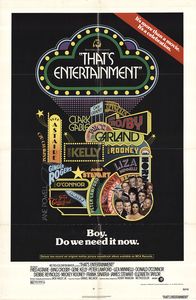
    (On Cable TV, December 2018) In the running for the title of the greatest clip show ever made, That’s Entertainment! does have the advantage of great source material to draw from: nothing less than the heydays of MGM musicals, featuring greats such as Fred Astaire, Gene Kelly and so many others that it would be exhausting to list them all. Various stars such as James Stewart, Bing Crosby and Elizabeth Taylor introduce some of the archival segments. Helmed by writer/director Jack Haley Jr. from MGM’s library extensive library, the film is a pure celebration of musicals as an art form, and of MGM as a powerhouse studio. Ironically, the film also acts as a tombstone for the classical MGM—filmed on the studio’s backlot, That’s Entertainment! presents the MGM studios right after they were sold off to finance the studio’s debts. As a result, the backdrop behind the presenters is decrepit, rusted, faded, overgrown with weeds, showing Hollywood’s past grandeur in a documentary fashion. The contrast between that and the clip shows is astounding, as we get a quick greatest hits of MGM’s most memorable numbers and fascinating segments about Astaire, Kelly, Esther Williams and Judy Garland. That’s Entertainment! is an absolutely fascinating film, and it deserves its enduring popularity—TCM even used it, along with its sequels, as a perfect lead in to the New Year’s Eve celebrations. Now, I want a good affordable copy of it on Blu-Ray.

  • Les demoiselles de Rochefort [The Young Girls of Rochefort] (1967)

    Les demoiselles de Rochefort [The Young Girls of Rochefort] (1967)

    (In French, On TV, December 2018) Just as I was tempted to dismiss writer/director Jacques Demy on the basis of the unbearable Les parapluies de Cherbourg, here comes the much better Les demoiselles de Rochefort to redeem it all. This far improved follow-up fixes my two biggest annoyances with the previous film: Much of the dialogue is spoken rather than sung, and it does feature a happy ending (even though it’s by mere seconds—the film does toy with its audience toward the end, perhaps keenly aware that those having seen Les parapluies de Cherbourg almost expected an unhappy ending.) That alone could have been enough to make it a good movie, but then it goes the extra mile. Not only does it feature a young gorgeous Catherine Deneuve and her sister Françoise Dorléac, but here is no less than Gene Kelly (visibly older, but still capable) walking in for a few scenes and a dance number. Very, very colourful, Les demoiselles de Rochefort makes the best of its coastal-town setting, starting with an elevated bridge dance sequence, then spending much of its time in a public square with a fantastically glassed-in café set. There’s a little bit of atonal weirdness when it turns out that there’s an axe murderer (!) hanging around, but otherwise the film is far more successful than its predecessor. “Chanson des Jumelles” is a great, memorable number, but it’s really the cheerful colourful atmosphere of the film that wins audiences over. I happened upon the movie by chance, playing as it was in the middle of the night on an unlikely TV channel, and almost gave it a pass. Only Gene Kelly’s name drew me in, and I’m glad it did—Les demoiselles de Rochefort is now one of my favourite French films of the 1960s, which is saying something considering the strengths of the decade for French cinema.

  • Let’s Make Love (1960)

    Let’s Make Love (1960)

    (In French, On TV, November 2018) I’m on a quest to watch pretty much everything that George Cukor has directed, and for Let’s Make Love to feature Marilyn Monroe is just extra incentive. Coming at this film with expectations raised too high may be a problem, though: despite a few cameos and occasional flashes of wit, the result is decidedly average and not quite what we’d expect from the cast or the opening moments. The first few minutes of the film do set up a far funnier film than what we get, through narration explaining the family history of the lead character (played by Yves Montand), a Franco-American billionaire who ends up playing himself in a satirical play in order to get close to Monroe’s character. The difficulties in having a businessman attempting to become a stage sensation soon lead him to the film’s most inspired sequences, namely hiring Milton Berle for comedy tips, Gene Kelly for dancing lessons and Bing Crosby to learn how to sing. The three men play themselves, leading to a few cool moments if you’re already a fan of these entertainment legends. Otherwise, though, the film is surprisingly underwhelming. The traditional romantic comedy hijinks aren’t executed particularly well when Montand looks lost (thanks to language difficulties), Monroe is fine but doesn’t have much of a character besides looking pretty (this was at a point in her career when she was gathering a reputation for being unreliable), and the casting definitely seems off. High expectations make this film a disappointment, so do try to keep them under check: it’s not as good as you think it will be from reading the cast list, and the behind-the-scenes drama of making the film (what with an affair between the two leads even as they were married to other high-profile celebrities) is arguably more interesting than what shows up on-screen. [December 2018: My opinion of Let’s Make Love went up a small notch after catching an English-language broadcast of the film: The French version not only has some very awkward transitions between English-language songs and interstitial French dialogue, but has the gall to cut off some of the Berle/Kelly/Crosby material that is the highlight of the film. French dubs are usually much better than this.]